6-K: Report of foreign issuer [Rules 13a-16 and 15d-16]
Published on
UNITED STATES
SECURITIES AND EXCHANGE COMMISSION
WASHINGTON, D.C. 20549
FORM 6-K
REPORT OF FOREIGN PRIVATE ISSUER
PURSUANT TO RULE 13a – 16 OR 15d – 16 UNDER THE
THE SECURITIES EXCHANGE ACT OF 1934
For the month of January, 2015
Commission File No. 0-53646
Eagleford Energy Corp.
|
(Translation of Registrant’s name into English)
1 King Street West, Suite 1505 Toronto, Ontario, Canada M5H 1A1 |
(Address of principal executive office)
Indicate by check mark whether the registrant files or will file annual reports under cover of Form 20-F or Form 40F.
| Form 20-F x | Form 40-F ¨ |
Indicate by check mark if the registrant is submitting the Form 6-K in paper as permitted by Regulation S-T Rule 101(b)(1):
| Yes ¨ | No x |
Indicate by check mark if the registrant is submitting the Form 6-K in paper as permitted by Regulation S-T Rule 101(b)(7):
| Yes ¨ | No x |
TABLE OF CONTENTS
1. Eagleford Energy Corp. Notice of Annual and Special Meeting of Shareholders and Record Date dated as of January 2, 2015 as filed on SEDAR on January 5, 2015.
2. Eagleford Energy Corp. Notice of Meeting and Management Information Circular dated as of January 18, 2015 as filed on SEDAR on January 28, 2015.
3. Eagleford Energy Corp. Form of Proxy and Supplemental Mailing Card for use at Annual and Special Meeting to be held on February 28, 2015 as filed on SEDAR on January 28, 2015.
Pursuant to the requirements of the Securities Exchange Act of 1934, the registrant has duly caused this report to be signed on its behalf by the undersigned, thereunto duly authorized.
| Dated: January 28, 2015 | EAGLEFORD ENERGY CORP. |
| By: | /s/ James Cassina | |
| Name: | James Cassina | |
| Title: | President |
Item 1
| TMX Equity Transfer Services | 200 University Ave., Suite 400 |
| Toronto, Ontario M5H 4H1 | |
| T 416.361.0152 F 416.361.0470 |
VIA ELECTRONIC TRANSMISSION
January 2, 2015
TO ALL APPLICABLE EXCHANGES AND COMMISSIONS:
| RE: | EAGLEFORD ENERGY CORP |
Confirmation of Notice of Record and Meeting Dates
We are pleased to confirm that Notice of Record and Meeting Dates was sent to The Canadian Depository for Securities.
We advise the following with respect to the upcoming Annual and Special Meeting of Security Holders for the subject issuer.
| 1. | ISIN: | CA27004H1010 | ||
| CUSIP: | 27004H101 | |||
| 2. | Date Fixed for the Meeting: | February 18, 2015 | ||
| 3. | Record Date for Notice: | January 19, 2015 | ||
| 4. | Record Date for Voting: | January 19, 2015 | ||
| 5. | Beneficial Ownership Determination Date: | January 19, 2015 | ||
| 6. | Classes or Series of Securities that entitle the holder to receive Notice of the Meeting: | COMMON | ||
| 7. | Classes or Series of Securities that entitle the holder to vote at the meeting: | COMMON | ||
| 8. | Business to be conducted at the meeting: | Annual and Special | ||
| 9. | Notice-and-Access: | |||
| Registered Shareholders: | NO | |||
| Beneficial Holders: | NO | |||
| Stratification Level: | NOT APPLICABLE | |||
|
|
10. | Reporting Issuer is sending proxy-related materials directly to Non-Objecting Beneficial Holders: | NO | |
| 11. | Issuer paying for delivery to Objecting Beneficial Owners: | NO |
Yours Truly,
TMX EQUITY TRANSFER SERVICES
“ Fraser Monkman “
Relationship Manager
Fraser.Monkman@tmx.com
tmxequitytransferservices.com
Item 2

(Formerly: Eagleford Energy Inc.)
NOTICE OF MEETING
AND
MANAGEMENT INFORMATION CIRCULAR
in respect of the
ANNUAL AND SPECIAL MEETING OF SHAREHOLDERS
to be held on Wednesday, February 18, 2015
Dated as of January 15, 2015
NOTICE OF ANNUAL AND SPECIAL MEETING OF SHAREHOLDERS
to be held on Wednesday, February 18, 2015
TO THE SHAREHOLDERS OF EAGLEFORD ENERGY CORP.:
NOTICE IS HEREBY GIVEN that an annual and special meeting (the "Meeting") of shareholders ("Shareholders") of common shares ("Common Shares") of Eagleford Energy Corp. (the "Company") will be held at the offices of WeirFoulds LLP, Mason Room A, Suite 4100, 66 Wellington Street West, Toronto, Ontario, Canada, M5K 1B7, at 2:00 p.m. (Toronto time) on Wednesday, February 18, 2015 for the following purposes:
| 1. | to receive the audited financial statements of the Company for the year ended August 31, 2014 and the report of the auditors thereon; |
| 2. | to elect the directors of the Company for the ensuing year; |
| 3. | to appoint the auditors of the Company for the ensuing year, and to authorize the directors to fix the auditors' remuneration; |
| 4. | to consider and, if thought advisable, to approve a special resolution, in the form of the proposed special resolution set forth in the Information Circular, the text of which is incorporated herein by reference, authorizing the forward split of the Company’s issued and outstanding Common Shares on an up to five (5) for one (1) basis, or the consolidation of the Company’s issued and outstanding Common Shares on an up to one (1) for ten (10) basis, all subject to required regulatory approval; |
| 5. | to consider and, if thought advisable in conjunction with a determination to proceed with a consolidation or share split as described in the Information Circular, to approve a special resolution in the form of the proposed special resolution set forth in the Information Circular, the text of which in incorporated herein by reference, an amendment to the articles of the Company to change the name of the Company to “Eagleford Resources Inc.” or such other name as may be approved by the board of directors of the Company and applicable regulatory and exchange authorities; and |
| 6. | to transact such other business as may properly be brought before the Meeting or any adjournment or adjournments thereof. |
Shareholders should refer to the accompanying management information circular for more detailed information with respect to the matters to be considered at the Meeting.
If you are a registered shareholder of the Company and are unable to attend the Meeting in person, please date and execute the accompanying form of proxy and return it in the envelope provided to TMX Equity Transfer Services, the registrar and transfer agent of the Company, at 200 University Avenue, Suite 300, Toronto, Ontario M5H 4H1 by no later than 4:00 p.m. (Toronto time) on February 16, 2015.
If you are not a registered shareholder of the Company and receive these materials through your broker or through another intermediary, please complete and return the form of proxy in accordance with the instructions provided to you by your broker or by the other intermediary.
DATED this 15th day of January, 2015.
BY ORDER OF THE BOARD OF DIRECTORS
| "James Cassina" |
| JAMES CASSINA |
| Chief Executive Officer, President and Director |
Registered shareholders unable to attend the Meeting are requested to date, sign and return their form of proxy in the enclosed envelope. If you are a non-registered shareholder of the Company and receive these materials through your broker or through another intermediary, please complete and return the materials in accordance with the instructions provided to you by your broker or by the other intermediary. Failure to do so may result in your shares not being eligible to be voted by proxy at the Meeting.
PROXY STATEMENT AND MANAGEMENT INFORMATION CIRCULAR FOR THE ANNUAL AND SPECIAL MEETING OF SHAREHOLDERS TO BE HELD ON FEBRUARY 18, 2015
PURPOSE OF SOLICITATION
THIS INFORMATION CIRCULAR IS FURNISHED IN CONNECTION WITH THE SOLICITATION OF PROXIES BY THE MANAGEMENT OF EAGLEFORD ENERGY CORP. ("EAGLEFORD" OR THE "COMPANY") FOR USE AT THE ANNUAL AND SPECIAL MEETING (THE "MEETING") OF THE HOLDERS OF COMMON SHARES ("COMMON SHARES") OF THE COMPANY.
The Meeting will be held at the offices of WeirFoulds LLP, Mason Room A, Suite 4100, 66 Wellington Street West, Toronto, Ontario, Canada, M5K 1B7 at 2:00 p.m. (Toronto time) on Wednesday, February 18, 2015, and at any adjournments thereof for the purposes set forth in the Notice of Annual and Special Meeting of Shareholders accompanying this management information circular ("Information Circular").
Although it is expected that the solicitation of proxies will be primarily by mail, proxies may also be solicited personally or by telephone, facsimile or personal interview by regular employees of the Company, or by other proxy solicitation services retained by the Company. The costs thereof will be borne by the Company. In accordance with National Instrument 54-101 – Communication with Beneficial Owners of Securities of a Reporting Issuer, arrangements have been made with brokerage houses and other intermediaries to forward solicitation materials to the beneficial owners of Common Shares of the Company held of record by such persons and the Company may reimburse such persons for reasonable fees and disbursements incurred by them in doing so.
Unless otherwise specified, information contained in this Information Circular is given as January 15, 2015 and, unless otherwise specified, all amounts shown represent Canadian dollars. The record date for the Meeting has been set as January 19, 2015 (the "Record Date").
APPOINTMENT AND REVOCATION OF PROXIES
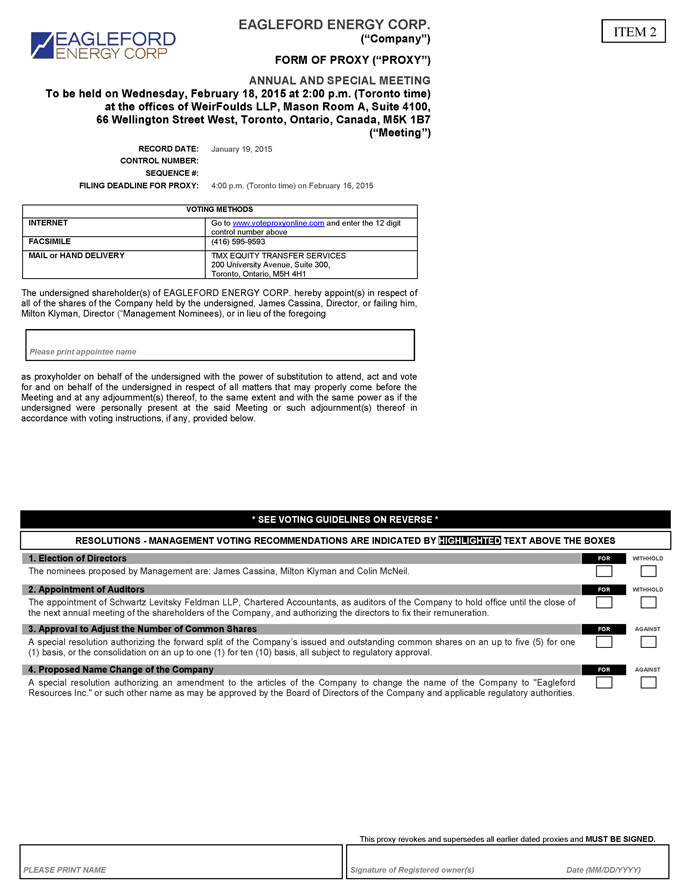
Enclosed herewith is a form of proxy for use at the Meeting. The persons named in the form of proxy are directors and officers of the Company.
A SHAREHOLDER HAS THE RIGHT TO DESIGNATE OR APPOINT A PERSON OR COMPANY (WHO NEED NOT BE A SHAREHOLDER) TO ATTEND AND ACT FOR HIM AND ON HIS BEHALF AT THE MEETING OTHER THAN THE PERSONS DESIGNATED IN THE ENCLOSED INSTRUMENT OF PROXY.
Such right may be exercised by striking out the names of the two persons designated in the instrument of proxy and by inserting in the blank space provided for that purpose the name of the desired person or company or by completing another proper instrument of proxy and, in either case, depositing the completed and executed proxy with the registrar and transfer agent of the Company, TMX Equity Transfer Services at 200 University Avenue, Suite 300, Toronto, Ontario M5H 4H1 at any time prior to 4:00 p.m. (Toronto time) on Monday, February 16, 2015.
A Shareholder forwarding the enclosed form of proxy may indicate the manner in which the appointee is to vote with respect to any specific item by checking the appropriate space. If the Shareholder giving the proxy wishes to confer a discretionary authority with respect to any item of business, then the space opposite the item is to be left blank. The shares represented by the proxy submitted by a Shareholder will be voted in accordance with the directions, if any, given in the proxy.
A Shareholder who has given a proxy may revoke it at any time in so far as it has not been exercised. A proxy may be revoked, as to any matter on which a vote shall not already have been cast pursuant to the authority conferred by such proxy, by instrument in writing executed by the Shareholder or by his attorney authorized in writing or, if the Shareholder is a body corporate, by a duly authorized officer, attorney or representative thereof and deposited at the registered office of the Company at any time prior to 4:00 p.m. (Toronto time) on the last business day preceding the day of the Meeting, or any adjournment thereof, or with the Chairman of the Meeting on the day of the Meeting or any adjournment thereof, and upon either of such deposits the proxy is revoked. A proxy may also be revoked in any other manner permitted by law. The Company's registered office is located at Suite 1505, 1 King Street West, Toronto, Ontario, M5H 1A1.
ADVICE TO BENEFICIAL HOLDERS OF COMMON SHARES
The information set forth in this section is of significant importance to many shareholders of the Company as a substantial number of shareholders do not hold shares in their own name. Shareholders who do not hold their shares in their own name (referred to in this Information Circular as "Beneficial Shareholders") should note that only proxies deposited by shareholders whose names appear on the records of the Company as the registered holders of Common Shares can be recognized and acted upon at the Meeting. If Common Shares are listed in an account statement provided to a shareholder by a broker, then in almost all cases those Common Shares will not be registered in the shareholder's name on the records of the Company. Such Common Shares will more likely be registered under the names of the shareholder's broker or an agent of that broker. In Canada, the vast majority of such shares are registered under the names of CDS & Co. (the registration name for CDS Depository and Clearing Services Inc., which acts as nominee for many Canadian brokerage firms). Common Shares held by brokers or their agents or nominees can only be voted (for or against resolutions) upon the instructions of the Beneficial Shareholder. Without specific instructions, brokers and their agents and nominees are prohibited from voting shares for the broker's clients.
THEREFORE, BENEFICIAL SHAREHOLDERS SHOULD ENSURE THAT INSTRUCTIONS RESPECTING THE VOTING OF THEIR COMMON SHARES ARE COMMUNICATED TO THE APPROPRIATE PERSON.
Applicable regulatory policy requires intermediaries/brokers to seek voting instructions from Beneficial Shareholders in advance of shareholders' meetings. Every intermediary/broker has its own mailing procedures and provides its own return instructions which should be carefully followed by Beneficial Shareholders in order to ensure that their Common Shares are voted at the Meeting. Often, the form of proxy supplied to a Beneficial Shareholder by its broker is identical to the form of proxy provided to registered shareholders; however, its purpose is limited to instructing the registered shareholder how to vote on behalf of the Beneficial Shareholder. The majority of brokers now delegate responsibility for obtaining instructions from clients to Broadridge Financial Services, Inc. ("Broadridge"). Broadridge typically mails a scanable voting instruction form in lieu of the form of proxy. The Beneficial Shareholder is requested to complete and return the voting instruction form to them by mail or facsimile. Alternatively, the Beneficial Shareholder can call a toll-free telephone number to vote the Common Shares held by the Beneficial Shareholder. Broadridge then tabulates the results of all instructions received and provides appropriate instructions respecting the voting of Common Shares to be represented at the Meeting. A Beneficial Shareholder receiving a voting instruction form cannot use that voting instruction form to vote Common Shares directly at the Meeting as the voting instruction form must be returned as directed by Broadridge well in advance of the Meeting in order to have the Common Shares voted.
Although a Beneficial Shareholder may not be recognized directly at the Meeting for the purposes of voting Common Shares registered in the name of his broker (or agent of the broker), a Beneficial Shareholder may attend at the Meeting as proxyholder for a registered shareholder and vote the Common Shares in that capacity. Beneficial Shareholders who wish to attend at the Meeting and indirectly vote their Common Shares as proxyholder for a registered shareholder should enter their own names in the blank space on the instrument of proxy provided to them and return the same to their broker (or the broker's agent) in accordance with the instructions provided by such broker (or agent), well in advance of the Meeting.
This Information Circular and enclosed Shareholder materials are being sent to both registered and non-registered owners of Shareholders. If you are a non-registered Shareholder, and the Company or its agent has sent these materials directly to you, your name and address and information about your holdings of Common Shares, have been obtained in accordance with applicable securities regulatory requirements from the intermediary holding on your behalf.
| - 2 - |
By choosing to send these materials to you directly, the Company (and not the intermediary holding on your behalf) has assumed responsibility for (i) delivering these materials to you, and (ii) executing your proper voting instructions. Please return your voting instructions as specified in the request for voting instructions.
MANNER OF VOTING AND EXERCISE OF DISCRETION BY PROXIES
The persons named in the enclosed instrument of proxy will vote or withhold from voting the Common Shares in respect of which they are appointed in accordance with the direction of the Shareholder appointing them and if the Shareholder specifies a choice with respect to any matter to be acted upon, the Common Shares shall be voted accordingly.
WHERE NO CHOICE IS SPECIFIED, THE PROXY WILL CONFER DISCRETIONARY AUTHORITY AND WILL BE VOTED FOR EACH OF THE MATTERS IDENTIFIED IN THE NOTICE AND DESCRIBED IN THIS INFORMATION CIRCULAR. THE ENCLOSED FORM OF PROXY ALSO CONFERS DISCRETIONARY AUTHORITY UPON THE PERSONS NAMED THEREIN TO VOTE WITH RESPECT TO ANY AMENDMENTS OR VARIATIONS TO THE MATTERS IDENTIFIED IN THE NOTICE OF MEETING AND WITH RESPECT TO OTHER MATTERS WHICH MAY PROPERLY COME BEFORE THE MEETING IN SUCH MANNER AS SUCH NOMINEE IN HIS JUDGMENT MAY DETERMINE. AS OF THE DATE OF THIS INFORMATION CIRCULAR, MANAGEMENT OF THE COMPANY KNOWS OF NO SUCH AMENDMENTS, VARIATIONS OR OTHER MATTERS TO COME BEFORE THE MEETING OTHER THAN THE MATTERS REFERRED TO IN THE NOTICE.
APPROVAL OF MATTERS
Unless otherwise noted, approval of matters to be placed before the Meeting is by "ordinary resolution", which is a resolution passed by a simple majority (50% plus 1) of the votes cast by Shareholders of the Company entitled to vote and present in person or represented by proxy.
interests of certain persons or companies in matters to be acted upon
No person who has been a director or officer of the Company at any time since the beginning of its last completed financial year, no proposed nominee for election as a director, and no associate or affiliate of any of the foregoing persons has any material interest, direct or indirect, by way of beneficial ownership of securities or otherwise, in any matter to be acted upon at the Meeting, other than the election of directors or the appointment of auditors.
VOTING SECURITiES AND PRINCIPAL HOLDERS THEREOF
The authorized capital of the Company consists of an unlimited number of Common Shares and an unlimited number of preference shares of which, as of the date of this Information Circular, an aggregate of 27,671,541 Common Shares of the Company are issued and outstanding and no preference shares are issued. Each common share entitles the holder thereof to one vote at all meetings of Shareholders.
All holders of Common Shares of the Company of record at the close of business on the Record Date will be entitled either to attend and vote at the Meeting in person the shares held by them or, provided a completed and executed proxy shall have been delivered to the Company as described above, to attend and vote thereat by proxy the shares held by them. However, if a holder of Common Shares of the Company has transferred any shares after the Record Date and the transferee of such shares establishes ownership thereof and makes a written demand, not later than ten (10) days before the Meeting, to be included in the list of Shareholders entitled to vote at the Meeting, the transferee will be entitled to vote such shares.
| - 3 - |
As of the date of this Information Circular, the only persons or companies who, to the knowledge of the directors and executive officers of the Company, beneficially own, or control or direct, directly or indirectly, voting securities carrying ten percent (10%) or more of the issued and outstanding voting shares of the Company are as follows:
| Name | Number of Shares | Percentage
of Outstanding Common Shares | ||||
| James Cassina(1) | 3,507,870 Common Shares | 12.68 | % |
Notes:
| (1) | Of the 3,570,870 Common Shares held by Mr. Cassina, 407,321 are held indirectly through Core Energy Enterprises Inc. and a further 3,100,549 are held directly by Mr. Cassina. |
SECURITIES AUTHORIZED FOR ISSUANCE UNDER EQUITY COMPENSATION PLANS
The following table sets forth the number of Common Shares to be issued upon exercise of outstanding incentive stock options ("Options") issued pursuant to compensation plans under which equity securities of the Company are authorized for issuance, the weighted average exercise price of such outstanding Options and the number of Common Shares remaining available for future issuance under such compensation plans as at August 31, 2014.
| Plan Category | Number of securities to be issued upon exercise of outstanding Options(1) | Weighted-average exercise price of outstanding Options | Number of securities remaining available for future issuance under equity compensation plans (excluding securities reflected in the first column)(1) | |||||||||
| Equity compensation plans approved by securityholders(1) | 105,000 | $ | 1.64 | 5,429,308 | ||||||||
| Equity compensation plans not approved by securityholders | N/A | N/A | N/A | |||||||||
| TOTAL | 105,000 | $ | 0.16 | 5,429,308 |
Note:
| (1) | Represents Options to purchase Common Shares granted pursuant to the Company’s option plan which at August 31, 2014 was a rolling 20% stock option plan. |
STATEMENT OF EXECUTIVE COMPENSATION
The Company's Statement of Executive Compensation, in accordance with the requirements of Form 51-102F6 – Statement of Executive Compensation, is set forth below, which contains information about the compensation paid to, or earned by, the Company's Chief Executive Officer and Chief Financial Officer and each of the other three most highly compensated executive officers of the Company earning more than CDN$150,000.00 in total compensation (the "Named Executive Officers" or "NEOs") during the Company's last three most recently completed financial years. Based on the foregoing, James Cassina the Company's President and Chief Executive Officer was the Company's only Named Executive Officer as at August 31, 2014.
Compensation Discussion and Analysis
Objective of the Compensation Program
The objectives of the Company's compensation program are to attract, hold and inspire performance of its NEO’s of a quality and nature that will enhance the sustainable profitability and growth of the Company. Due to the Company's present financial situation, the Company views it as an important objective of the Company's compensation program to ensure staff retention.
| - 4 - |
The Compensation Review Process
To determine compensation payable, the compensation committee of the Company (the "Compensation Committee") determines an appropriate compensation reflecting the need to provide incentive and compensation for the time and effort expended by the Named Executive Officers of the Company while taking into account the financial and other resources of the Company.
The Company’s Compensation Committee is comprised of Milton Klyman (Chair) and Colin McNeil. The Compensation Committee is comprised entirely of independent directors. Compensation is determined in the context of our strategic plan, our growth, shareholder returns and other achievements and considered in the context of position descriptions, goals and the performance of each NEO. With respect to directors’ compensation, the Compensation Committee reviews the level and form of compensation received by the directors, members of each committee, the chair of the board of directors (the "Board") of the Company and the chair of each Board committee, considering the duties and responsibilities of each director, his or her past service and continuing duties in service to us. The compensation of directors, the CEO and executive officers of competitors are considered, to the extent publicly available, in determining compensation and the Compensation Committee has the power to engage a compensation consultant or advisor to assist in determining appropriate compensation. Although the Compensation Committee may take into account executive compensation paid by companies comparable with the Company, no specific benchmarking policy is in place for determining compensation or any element of compensation.
In performing its duties, the Compensation Committee has the authority to engage such advisors, including executive compensation consultants, as it considers necessary. The Company does not currently have any contractual arrangement with any executive compensation consultant who has a role in determining or recommending the amount or form of senior officer or director compensation.
The Company does not have a policy that would prohibit a NEO or director from purchasing financial instruments, including prepaid variable forward contracts, equity swaps, collars or units of exchange funds, that are designed to hedge or offset a decrease in market value of equity securities granted as compensation or held, directly or indirectly, by the NEO or director. However, management is not aware of any NEO or director purchasing such an instrument.
Compensation Risk
The Company has not adopted a formal policy on compensation risk management nor has it engaged an independent compensation consultant. The Company recognizes that there may be risks in its current processes but given the size and number of executives dedicated on a full-time basis, the Company does not believe the risks to be significant.
The Company has a Compensation Committee, consisting of two independent members of the Board, to assist the Board in discharging its duties relating to compensation of the Company’s directors and senior officers. The Board believes that the executive compensation program of the Company should not raise its overall risk profile. Accordingly, the Company’s executive compensation programs include safeguards designed to mitigate compensation risks. The following measures impose appropriate limits to avoid excessive or inappropriate risk taking or payments:
| · | discretionary bonus payments, if any, are recommended to the Board by the Compensation Committee based on annual performance reviews; |
| · | the Compensation Committee consisting of a minimum of two members, all being independent; |
| · | stock option vesting and option terms of 5 years discourages excessive risk taking to achieve short-term goals; and |
| · | implementation of trading black-outs limit the ability of senior officers to trade in securities of the Company. |
| - 5 - |
Inappropriate and excessive risks by executives are also mitigated by regular meetings of the Board, at which, activity by the executives must be approved by the Board if such activity is outside previously Board-approved actions and/or as set out in a Board-approved budget. Given the current composition of the Company’s executive management team, the Board and the Compensation Committee are able to closely monitor and consider any risks which may be associated with the Company’s compensation practices. Risks, if any, may be identified and mitigated through regular Board meetings during which financial and other information of the Company are reviewed, including executive compensation.
Elements of Executive Compensation
The Company's NEO compensation program is based on the objectives of: (a) recruiting and retaining the executives critical to the success of the Company; (b) providing fair and competitive compensation; (c) balancing the interests of management and shareholders of the Company; and (d) rewarding performance, on the basis of both individual and corporate performance.
For the financial year ended August 31, 2014, the Company's NEO compensation program consisted of the following elements:
| (a) | a base salary/management fee (the "Short-Term Incentive"). |
| (b) | a long-term equity compensation consisting of stock options granted under the Company's stock incentive plan ("Long-Term Incentive"). |
The specific rationale and design of each of these elements are outlined in detail below.
Short-Term Incentive
Salaries form an essential element of the Company's compensation mix as they are the first base measure to compare and remain competitive relative to peer groups. Base salaries are fixed and therefore not subject to uncertainty and are used as the base to determine other elements of compensation and benefits. The base salary provides an immediate cash incentive for the Named Executive Officers. The Compensation Committee and the Board review salaries at least annually.
Base salary/management fees of the Named Executive Officer is set by the Compensation Committee on the basis of the applicable officer’s responsibilities, experience and past performance. In determining the base salary to be paid to a particular Named Executive Officer, the Compensation Committee considers the particular responsibilities related to the position, the experience level of the officer, and his or her past performance at the Company and the current financial position of the Company.
Long-Term Incentive
The granting of stock options is a variable component of compensation intended to reward the Company's Named Executive Officers for their success in achieving sustained, long-term profitability and increases in stock value. Stock options ensure that the Named Executive Officers are motivated to achieve long-term growth of the Company and continuing increases in shareholder value. In terms of relative emphasis, the Company places more importance on stock options.
The Company provides long-term incentive compensation through its stock option plan. The Compensation Committee recommends the granting of stock options from time to time based on its assessment of the appropriateness of doing so in light of the long-term strategic objectives of the Company, its current stage of development, the need to retain or attract particular key personnel, the number of stock options already outstanding and overall market conditions. The Compensation Committee views the granting of stock options as a means of promoting the success of the Company and higher returns to its shareholders. The Board grants stock options after reviewing recommendations made by the Compensation Committee.
| - 6 - |
As of our fiscal year end August 31, 2014 we had 60,000 option/stock appreciation rights or grants outstanding to our Named Executive Officers and directors.
Stock Option Plan
The Company’s Stock Option Plan (the "Option Plan") was adopted by the Board on December 21, 2010 and approved by a majority of our shareholders voting at the Annual and Special Meeting held on February 24, 2011. Amendments to the Option Plan were approved by the Board on January 25, 2012 and were approved and ratified by the shareholders of the Company on February 24, 2012.
The Company had 27,671,541 issued and outstanding Common Shares on January 15, 2015 and the aggregate maximum number of Common Shares that may be reserved for issuance under the Option Plan is 20% of the issued and outstanding Common Shares of the Company, which as at January 15, 2015 was equal to 5,534,308 Common Shares.
As of January 15, 2015, there were 1,100,000 Options outstanding under the Option Plan. Accordingly, as of January 15, 2015 there were 4,434,308 unallocated Options available for issuance under the Option Plan, representing approximately 16.02% of the Company's issued and outstanding Common Shares.
Description of the Option Plan
The Option Plan was adopted in order that we may be able to provide incentives for directors, officers, employees, consultants and other persons (an "Eligible Individual") to participate in our growth and development by providing us with the opportunity through share options to acquire an ownership interest in us. Directors and officers currently are not remunerated for their services except as stated in "Executive Compensation" above.
Under the Option Plan:
| 1. | options may be granted in such numbers and with such vesting provisions as the Board may determine; |
| 2. | the exercise price of Options shall be at the discretion of the Board; |
| 3. | the term and expiry date of the Options granted shall be determined in the discretion of the Board at the time of granting of the Options; |
| 4. | the maximum term for Options is five (5) years; |
| 5. | the Options are not assignable or transferable, with the exception of an assignment made to a personal representative of a deceased Participant; |
| 6. | the vesting period or periods within the five (5) year maximum term during which an Option or a portion thereof may be exercised by a Participant shall be determined by the Board. Further, the Board may, in its sole discretion at any time or in the Option agreement in respect of any Options granted, accelerate or provide for the acceleration of, vesting of Options previously granted; |
| 7. | in the event of the resignation or retirement of a Participant, or the termination of the employment of a Participant, whether with or without cause or reasonable notice, prior to the expiry time of an Option, such Option shall cease and terminate on the ninetieth day following the effective date of such resignation, retirement or termination, and in the event of the death of a holder of Options, such Options shall be exercisable until the earlier of one year following the death of the holder, or the expiry time of such Option, whichever occurs first, and thereafter shall be of no further force or effect whatsoever as to the Common Shares in respect of which such Option has not previously been exercised; |
| - 7 - |
8.
| in the event of a sale of the Company or all or substantially all of its property and assets or a change of control of the Company, holders of Options, whether such Options have vested or not in accordance with their terms, may exercise such options until the earlier of the expiry of the Options and the thirtieth day following the sale of the Company or all or substantially all of its property and assets or a change of control of the Company; |
| 9. | the aggregate number of Common Shares that may be reserved for issuance under the Option Plan, together with any Common Shares reserved for issuance under any other share compensation arrangement, must not exceed 20% of the number of Common Shares, on a non-diluted basis, outstanding at the time; and |
| 10. | the Board retains the right to suspend, terminate, or discontinue the terms and conditions of the Option Plan by resolution of the Board. |
The Company does not have any other long-term incentive plans, including any supplemental executive retirement plans.
Overview of How the Compensation Program Fits with Compensation Goals
The compensation package is designed to meet the goal of attracting, holding and motivating key talent in a highly competitive oil and gas exploration environment through salary and providing an opportunity to participate in the Company’s growth through stock options. Through the grant of stock options, if the price of the Company shares increases over time, both the Named Executive Officer and shareholders will benefit.
Summary Compensation Table (CDN$), Named Executive Officers
The following table provides information for the three most recently completed financial years ended August 31, 2014, 2013 and 2012 regarding compensation earned by James Cassina the President and Chief Executive Officer of the Company.
| Non-equity Incentive Plan Compensation | ||||||||||||||||||||||||||||||||||
| Name
and Principal Position | Year | Salary | Share
Based Awards | Option Based Awards(3) | Annual
Incentive Plans | Long
Term Incentive Plans | Pension
Value | All
Other Compen- sation(1) | Total
Compen- sation | |||||||||||||||||||||||||
| James | 2014 | $ | 75,000 | 0 | 0 | 0 | 0 | 0 | 1,000 | $ | 76,000 | |||||||||||||||||||||||
| Cassina, | 2013 | $ | 75,000 | 0 | 0 | 0 | 0 | 0 | 1,000 | $ | 76,000 | |||||||||||||||||||||||
| Chief | 2012 | $ | 75,000 | 0 | 31,970 | 0 | 0 | 0 | 1,100 | $ | 108,070 | |||||||||||||||||||||||
| Executive Officer, President and Director (2) | ||||||||||||||||||||||||||||||||||
Notes:
| (1) | Accrued on account of directors fees at a rate of $100 per meeting. |
| (2) | James Cassina has been the acting Chief Financial Officer for the years ended August 31, 2014, 2013 and 2012, and was appointed President of the Company on June 18, 2010. |
| (3) | These amounts represent the value of stock options granted. The fair value of the option grated is estimated on the date of grant using the Black Scholes option pricing model taking into account the following assumptions: (i) risk free interest rate (%); (ii) expected life (years); (iii) expected volatility (%). This is consistent with the accounting values used in the Company’s consolidated financial statements. The dollar amount in the column represents the total value ascribed to the stock options. |
Incentive Plan Awards
At August 31, 2014 the Company has outstanding 60,000 vested stock options exercisable at $1.60 until February 28, 2017 to Named Executive Officers and directors.
| - 8 - |
Outstanding Option-Based Awards, Named Executive Officers
The following table sets forth the outstanding option-based awards granted under the Plan to Named Executive Officers at August 31, 2014.
| Option-based Awards (CDN$) | Share-based Awards (CDN$) | |||||||||||||||||
| Name | Number of Securities underlying unexercised options (#) (1) | Option Exercise Price ($) | Option expiration date | Value of unexercised in-the- money options (2) (3) | Number of shares or units of shares that have not vested (#) | Market or payout value of share- based awards that have not vested ($) | Market or payout value of vested share-based awards not paid out or distributed | |||||||||||
| James Cassina, Chief Executive Officer, President and Director | 20,000 | $ | 1.60 | February 28, 2017 | NIL | NIL | NIL | NIL | ||||||||||
Notes:
| (1) | On March 1, 2012, the Company granted options to purchase 60,000 common shares to directors. These options are exercisable at $1.60 per share, vest immediately and expire on February 28, 2017. |
| (2) | Calculated using the closing price of the Company’s common shares of the OTCQB on August 31, 2014 of US$0.40 and subtracting the exercise price of in-the-money stock options. |
| (3) | Converted to Canadian dollars using the Bank of Canada noon exchange rate on August 31, 2014. |
Value Vested or Earned During the Financial Year Ended August 31, 2014
| Name and principal position | Option-based awards – Value vested during the year ($)(1) | Share-based awards – Value vested during the year ($) | Non-equity incentive plan compensation – Value earned during the year ($) | |||
| James Cassina Chief Executive Officer, President and Director | NIL | NIL | NIL |
Notes:
| (1) | Value, if any, of any options which vested during the financial year ended August 31, 2014 was calculated by multiplying the number of vested options by the difference between the market price at the time of vesting and the exercise price. |
Pension Plan Benefits
The Company does not currently provide pension plan benefits to its Named Executive Officers.
Termination and Change of Control Benefits
The Company does not currently have executive employment agreements in place with any of its Named Executive Officers.
The Company has no compensatory plan, contract or arrangement where a named executive officer or director is entitled to receive compensation in the event of resignation, retirement, termination, change of control or a change in responsibilities following a change in control.
Director Compensation
Each director of the Company is entitled to receive the sum of $100 for each meeting of the directors, meeting of a committee of the directors (of which the director is a member) or meeting of the shareholders attended. No such directors’ fees were paid for the year ended August 31, 2014.
| - 9 - |
The following table sets out the total compensation paid, accrued or awarded for each of the Company’s directors who are not Named Executive Officers during the year ended August 31, 2014:
| Name | Fees (1) | Share Based Awards | Option Based Awards(2) | Non-equity Incentive Plan Compensation | Pension Value | All Other Compensation | Total Compensation | |||||||||||||||||||||
| ($) | ($) | ($) | ($) | ($) | ($) | |||||||||||||||||||||||
| Milton Klyman | $ | 1,000 | 0 | 0 | 0 | 0 | 0 | $ | 1,000 | |||||||||||||||||||
| Colin McNeil | $ | 1,000 | 0 | 0 | 0 | 0 | 0 | $ | 1,000 | |||||||||||||||||||
| Alan Gaines(3) | $ | 100 | 0 | 0 | 0 | 0 | 0 | $ | 100 | |||||||||||||||||||
Notes:
| (1) | Accrued on account of directors fees at a rate of $100 per meeting. |
| (2) | These amounts represent the value of stock options granted. The fair value of the option grated is estimated on the date of grant using the Black Scholes option pricing model taking into account the following assumptions: (i) risk free interest rate (%); (ii) expected life (years); (iii) expected volatility (%). This is consistent with the accounting values used in the Company’s consolidated financial statements. The dollar amount in the column represents the total value ascribed to the stock options. |
| (3) | Mr. Gaines resigned from the board of directors on February 26, 2014. |
Outstanding Option-Based Awards, Directors
The following table sets forth the outstanding option-based awards granted under the Plan to each of the Company’s directors who are not Named Executive Officers during the year ended August 31, 2014:
| Option-based Awards (CDN$) | Share-based Awards (CDN$) | |||||||||||||
| Name | Number of Securities underlying unexercised options (#) | Option Exercise Price ($) | Option expiration date | Value of unexercised in-the- money options | Number of shares or units of shares that have not vested (#) | Market or payout value of share- based awards that have not vested ($) | Market or payout value of vested share-based awards not paid out or distributed | |||||||
| Milton Klyman, | NIL | N/A | N/A | N/A | NIL | NIL | NIL | |||||||
| Colin McNeil | NIL | N/A | N/A | N/A | NIL | NIL | NIL | |||||||
| Alan Gaines(1) | NIL | N/A | N/A | N/A | NIL | NIL | NIL | |||||||
Notes:
(1) Mr. Gaines resigned from the board of directors on February 26, 2014.
Value Vested or Earned During the Financial Year Ended August 31, 2014
| Name and principal position | Option-based awards – Value vested during the year ($)(1) | Share-based awards – Value vested during the year ($) | Non-equity incentive plan compensation – Value earned during the year ($) | |||
| Milton Klyman | NIL | NIL | NIL | |||
| Colin McNeil | NIL | NIL | NIL | |||
| Alan Gaines(2) | NIL | NIL | NIL |
Notes:
| (1) | Value, if any, of any options which vested during the financial year ended August 31, 2012 was calculated by multiplying the number of vested options by the difference between the market price at the time of vesting and the exercise price. |
| (2) | Mr. Gaines resigned from the board of directors on February 26, 2014. |
| - 10 - |
Retirement Policy for Directors
The Company does not have a retirement policy for its directors.
Directors’ and Officers’ Liability Insurance
The Company does not maintain directors’ and officers’ liability insurance.
CORPORATE GOVERNANCE
The Canadian Securities Administrators in National Instrument 58-101 ("NI 58-101") have adopted guidelines for effective corporate governance which address the constitution and independence of boards, the functions to be performed by boards and their committees and the recruitment, effectiveness and education of board members. A description of our corporate governance practices is set out below, including a discussion of the principal matters relating to corporate governance practices discussed in NI 58-101.
Corporate governance refers to the manner in which a board of directors oversees the management and direction of a corporation. Governance is not a static issue, and must be judged from time-to-time based on the evolution of a corporation with respect to its size and the nature or its business, and upon the changing standards of the community. Not all corporate governance systems are alike. The Company's approach has been developed with respect to the Company's growth and current status. The composition of the Board is reviewed on an annual basis by the full Board and management of the Company.
In reviewing the issue of corporate governance, the Board has determined to perform the function as an entire Board. Their mandate was to consider corporate governance matters and make recommendations consistent with the Company's position and size as a junior oil and gas Company. The resulting approach to corporate governance adopted by the Company's Board reflects these recommendations and recognizes the responsibility of the Board for the stewardship of the Company. Through regular review at quarterly meetings, the Company's Board will continue to examine these issues in light of the Company's development in the oil and gas exploration and exploitation business.
Most matters requiring approval of the Board of the Company were approved by written resolutions signed by all members of the Board, with detailed information being circulated to all members of the Board beforehand. Any member of the Board may request a formal meeting of the Board in the event that such director considers that the subject matter of a particular resolution requires full Board discussion. While it is standard practice for the Company's Board to pass written resolutions in lieu of holding formal meetings in person, the Board of Directors held four (4) formal meetings during fiscal 2014.
The information required to be disclosed by NI 58-101 is set out in Schedule "A" attached to this Information Circular.
AUDIT COMMITTEE
The mandate of the audit committee of the Board (the “Audit Committee”) is formalized in a written charter. The members of the Audit Committee of the Board are James Cassina, Milton Klyman (Chair) and Colin McNeil. Based on his professional certification and experience, the Board has determined that Milton Klyman is an Audit Committee Financial Expert and that James Cassina and Colin McNeil are financially literate. The Audit Committee's primary duties and responsibilities are to serve as an independent and objective party to monitor our financial reporting process and control systems, review and appraise the audit activities of our independent auditors, financial and senior management, and the lines of communication among the independent auditors, financial and senior management, and the Board for financial reporting and control matters including investigating fraud, illegal acts or conflicts of interest.
The Audit Committee held four (4) formal meetings in person or via conference call during fiscal 2014.
| - 11 - |
All information required to be disclosed by Multilateral Instrument 52-110 – Audit Committees is attached to this Information Circular as Schedule "B".
PARTICULARS OF MATTERS TO BE ACTED UPON
Election of Directors
The Board of the Company is currently comprised of three (3) directors.
UNLESS OTHERWISE SPECIFIED, THE PERSONS NAMED IN THE ACCOMPANYING PROXY INTEND TO VOTE FOR THE ELECTION OF ALL THREE (3) NOMINEES. MANAGEMENT OF THE COMPANY DOES NOT CONTEMPLATE THAT ANY OF THE NOMINEES WILL BE UNABLE TO SERVE AS A DIRECTOR, BUT IF THAT SHOULD OCCUR FOR ANY REASON PRIOR TO THE MEETING, IT IS INTENDED THAT DISCRETIONARY AUTHORITY SHALL BE EXERCISED BY THE PERSONS NAMED IN THE ENCLOSED FORM OF PROXY TO VOTE THE PROXY FOR THE ELECTION OF ANY OTHER PERSON OR PERSONS IN PLACE OF ANY NOMINEE(S) UNABLE TO SERVE. EACH DIRECTOR ELECTED WILL HOLD OFFICE UNTIL THE CLOSE OF THE FIRST ANNUAL AND SPECIAL MEETING OF SHAREHOLDERS OF THE COMPANY FOLLOWING HIS ELECTION UNLESS HIS OFFICE IS EARLIER VACATED IN ACCORDANCE WITH THE BY-LAWS OF THE COMPANY.
Management has been informed that each of the proposed nominees listed below is willing to serve as a director if elected. The following table and the notes thereto set out the name as well as the country and province and/or state of residence of each person proposed to be nominated for election as a director, his or her current position and office with the Company, his or her present principal occupation, business or employment, the date on which he or she was first elected or appointed a director of the Company and the approximate number of Common Shares beneficially owned, or controlled or directed, directly or indirectly, which is in each instance based on information furnished by the person concerned as of the date of this Information Circular.
| Name and Residence | Present Position(s) with the Company | Director Since | Principal Occupation | Common Shares Beneficially Owned Directly or Indirectly(1) | ||||||
| James Cassina(2) Nassau, Bahamas | Chief Executive Officer, President and Director | February, 2009 | Business Consultant | 3,507,870 | (4) | |||||
| Milton Klyman (2)(3) Toronto, Ontario | Director | August, 2000 | Self Employed Financial Consultant | 10,000 | (5) | |||||
| Colin McNeil (2)(3) Calgary, Alberta | Director | June, 2010 | Independent Consulting Geophysicist | Nil | ||||||
Notes:
| (1) | The information as to shares beneficially owned, directly or indirectly, not being within the knowledge of the Company, has been furnished by the respective proposed directors individually. |
| (2) | Member of the Audit Committee of the Company. |
| (3) | Member of the Compensation Committee of the Company. |
| (4) | Mr. Cassina holds directly 3,100,549 Common Shares and 814,350 Common Share purchase warrants. Each warrant is exercisable until August 30, 2017 to purchase one Common Share at a purchase price of $0.10 per share. Mr. Cassina holds indirectly through Core Energy Enterprises Inc., 407,321 Common Shares. Mr. Cassina has voting and investment power with respect to the shares owned by Core Energy Enterprises Inc. |
| (5) | Mr. Klyman holds 10,000 Common Shares. |
| - 12 - |
Corporate Cease Trade Orders, Bankruptcies, Penalties or Sanctions
Except as disclosed below, to the best knowledge of the Company, no proposed director of the Company is, as at the date hereof, or has been within the last ten years prior to the date hereof: (a) subject to a cease trade order, an order similar to a cease trade order or an order that denied a company access to any exemption under securities legislation that was in effect for a period of more than 30 consecutive days that was issued while the proposed director of the Company was acting in the capacity as director, chief executive officer or chief financial officer of that company; (b) subject to a cease trade order, an order similar to a cease trade order or an order that denied a company access to any exemption under securities legislation that was in effect for a period of more than 30 consecutive days that was issued after the proposed director of the Company ceased to be a director, chief executive officer or chief financial officer of that company and which resulted from an event that occurred while that person was acting in such capacity; or (c) a director or executive officer of any company that, while that person was acting in that capacity, or within a year of that person ceasing to act in that capacity, became bankrupt, made a proposal under any legislation relating to bankruptcy or insolvency or was subject to or instituted any proceedings, arrangement or compromise with creditors or had a receiver, receiver manager or trustee appointed to hold its assets.
James Cassina was Chairman of the Board of EnerNorth Industries Inc. (“EnerNorth”) from July 1, 2002 to March, 2007, and had been a Director of EnerNorth from 1996 to March 21, 2007, and President and Chief Executive Officer from July 22, 1998 to June 30, 2002. On March 20, 2007 EnerNorth filed an Assignment in Bankruptcy under the Bankruptcy and Insolvency Act (Canada).
Mr. Klyman had been a Director of EnerNorth from December 1997 to September 2000. Mr. Klyman was re-appointed a director of the EnerNorth in April 2001 until March 21, 2007. On March 20, 2007 EnerNorth filed an Assignment in Bankruptcy under the Bankruptcy and Insolvency Act (Canada).
To the knowledge of the Company, no proposed director of the Company: (a) has been subject to any penalties or sanctions imposed by a court relating to securities or by a securities regulatory authority or has entered into a settlement agreement with a securities regulatory; or (b) has been subject to any other penalties or sanctions imposed by a court or regulatory body that would likely be considered important to a reasonable Shareholder in deciding whether to vote for a proposed director of the Company.
To the knowledge of the Company, no proposed director of the Company is, or has within the ten years prior to the date hereof, become bankrupt, made a proposal under any legislation relating to bankruptcy or insolvency, or become subject to or instituted any proceedings, arrangement or compromise with creditors or had a receiver, receiver manager or trustee appointed to hold the assets of that individual.
Appointment of Auditors
Schwartz Levitsky Feldman LLP, Chartered Accountants, of Toronto, Ontario are the current auditors of the Company and were first appointed auditors of the Company in 2007. Shareholders of the Company will be asked at the Meeting to reappoint Schwartz Levitsky Feldman LLP, Chartered Accountants, of Toronto, Ontario, as the Company's auditors to hold office until the close of the next annual meeting of Shareholders of the Company, and to authorize the directors of the Company to fix the auditors' remuneration.
UNLESS OTHERWISE SPECIFIED, THE PERSONS NAMED IN THE ACCOMPANYING PROXY INTEND TO VOTE FOR THE APPOINTMENT OF SCHWARTZ LEVITSKY FELDMAN LLP, CHARTERED ACCOUNTANTS AS AUDITORS OF THE COMPANY UNTIL THE CLOSE OF THE NEXT ANNUAL AND SPECIAL MEETING OF SHAREHOLDERS AND FOR THE AUTHORIZATION OF THE DIRECTORS TO FIX THEIR REMUNERATION.
Financial Statements
Accompanying these materials is a copy of the audited consolidated financial statements of the Company for the financial period ended August 31, 2014, together with the auditors' report thereon. The directors will lay before the Meeting the said audited financial statements and auditors' report, receipt of which by the Meeting will not constitute approval or disapproval of any matters referred to therein.
| - 13 - |
Approval to Adjust the Number of Common Shares
As indicated above, management of the Company is continuing to evaluate potential acquisitions and exploration and development opportunities to complement the existing operations of the Company and to enhance future growth. In furtherance of these various initiatives that may be available to the Company, the Company may be required to adjust the existing capital structure, by changing the number of common shares issued and outstanding. A capital structure change of this nature could require an increase in the number of issued common shares by share split (a "Split") or a reduction in the number of issued common shares by share consolidation (a "Consolidation"). In either event, if acted upon by the Company, a Split or Consolidation would impact each shareholder identically in respect of the resulting number of common shares outstanding.
The Company will be seeking at the Meeting advance shareholder approval for any proposed Split or Consolidation that may be required, within the parameters contained in the special resolution set out below. The Company proposes that the advance approval being sought be restricted under the Split to a maximum of up to 5 times the number of common shares issued and outstanding at the date of implementing any Split and under any Consolidation to a maximum of up to 1/10 of the number of common shares issued and outstanding at the date of implementing any Consolidation.
To split or consolidate the common shares of the Company, the articles of the Company must be amended. Such an amendment must be authorized by a special resolution of shareholders. Shareholders of the Company will therefore be asked at the Meeting to consider and, if thought advisable, to authorize by means of a special resolution, an amendment to the articles of the Company: (i) in the case of a Split to split the issued and outstanding common shares of the Company resulting in each one (1) issued and outstanding common share being split for up to five (5) post split shares; and (ii) in the case of a Consolidation to consolidate the issued and outstanding common shares of the Company resulting in up to ten (10) issued and outstanding common shares being consolidated for one (1) post consolidated share. No fractional common shares of the Company will be issued in connection with the Consolidation or the Split and, in the event that a shareholder would otherwise be entitled to receive a fractional share upon such Split or Consolidation, the number of common shares of the Company to be received by such shareholder shall be rounded up to the nearest whole number of common shares.
The text of the special resolution shareholders will be asked to approve is as follows:
BE IT RESOLVED as a special resolution of the Company that:
| 1. | In the event the Company proceeds with a Split, the articles of the Company be amended to split the issued and outstanding common shares of the Company by changing each one of the issued and outstanding common shares of the Company to up to five (5) common shares of the Company. |
| 2. | In the event the Company proceeds with a Consolidation, the articles of the Company be amended to consolidate the issued and outstanding common shares of the Company by changing each one of the issued and outstanding common shares of the Company to up to one-tenth (1/10) of a common share of the Company. |
| 3. | No fractional common shares of the Company shall be issued in connection with the Split or the Consolidation and, in the event that a shareholder would otherwise be entitled to receive a fractional share upon such Split or Consolidation, the number of common shares of the Company to be received by such shareholder shall be rounded up to the nearest whole number of common shares. |
| 4. | Any one director or officer of the Company be and is hereby authorized, for and on behalf of the Company, to execute and deliver, or cause to be delivered, articles of amendment of the Company, as required pursuant to the Business Corporations Act (Ontario), and to do all such other acts or things necessary or desirable to implement, carry out and give effect to the aforesaid amendment to the articles of the Company. |
| - 14 - |
| 5. | The directors of the Company are hereby authorized, in their discretion, to amend this resolution so that if the if the Split is implemented the Split shall be less than one common share split into five (5) common shares, or if Consolidation is implemented the Consolidation shall be less than one common share consolidated into one-tenth of a common share, or otherwise to revoke this special resolution or any portion thereof before it is acted upon without further approval or authorization of the shareholders of the Company. |
To be approved, the special resolution must be passed by at least two-thirds of the votes cast by shareholders at the Meeting in respect of this special resolution, and approved by applicable regulatory and exchange authorities.
Unless otherwise specified, the persons named in the enclosed form of proxy will vote FOR the special resolution.
Proposed Name Change of the Company
In the event the Company determines it is in the best interests of the Company to implement either the Split or the Consolidation, the Company will need to change its name. In such a case the proposed name for the Company is “Eagleford Resources Inc.” or such other name as may be approved by the Board of the Company and applicable regulatory and exchange authorities.
To change the name, the articles of the Company must be amended. Such an amendment must be authorized by a special resolution of shareholders. Shareholders of the Company will therefore be asked at the Meeting to consider and, if thought advisable, to authorize by means of a special resolution, an amendment to the articles of the Company to change the name of the Company to “Eagleford Resources Inc.” or such other name as may be approved by the Board of the Company and applicable regulatory and exchange authorities.
Accordingly, management is seeking the approval of the shareholders to change the name of the Company in conjunction with a Consolidation or a Split. Such name change requires the approval of the shareholders, and applicable regulatory and exchange authorities of the Company by way of a special resolution, being a resolution passed by a majority of not less than 2/3 of the votes cast by shareholders at the Meeting. The following is the text of the proposed special resolution to be put forth by management at the Meeting:
BE IT RESOLVED as a special resolution of the Company that:
| 1. | The articles of the Company be amended to change the name of the Company from "Eagleford Energy Corp." to " Eagleford Resources Inc.” or such other name as approved by the Board of the Company and applicable regulatory and exchange authorities. |
| 2. | Any one director or officer of the Company be and is hereby authorized, for and on behalf of the Company, to execute and deliver, or cause to be delivered, articles of amendment of the Company, as required pursuant to the Business Corporations Act (Ontario), and to do all such other acts or things necessary or desirable to implement, carry out and give effect to the said change of name. |
| 3. | The directors of the Company are hereby authorized, in their discretion, to delay or revoke this special resolution or any portion thereof before it is acted upon without further approval or authorization of the shareholders of the Company. |
To be approved, the special resolution must be passed by at least two-thirds of the votes cast by shareholders at the Meeting in respect of this special resolution, and approved by applicable regulatory and exchange authorities.
Unless otherwise specified, the persons named in the enclosed form of proxy will vote FOR the special resolution.
| - 15 - |
INDEBTEDNESS OF DIRECTORS AND EXECUTIVE OFFICERS
During the fiscal year ended August 31, 2014, no loans were made by the Company to any senior officer, director or proposed nominee for election as a director or any key employee of the Company, or any of their respective associates, for any reason whatsoever.
MANAGEMENT CONTRACTS
Management functions of the Company and its subsidiaries are not to any substantial degree performed by those other than by the directors or executive officers of the Company or subsidiary.
INTEREST OF INFORMED PERSONS IN MATERIAL TRANSACTIONS
Except as disclosed herein, no informed person of the Company, proposed director of the Company nor any associate or affiliate of any informed person or proposed director has any material interest, direct or indirect, in any transaction since the commencement of the Company's financial year-ended August 31, 2014 or in any proposed transaction which has materially affected or would materially affect the Company or any of its subsidiaries.
Other matters which may come before the meeting
Management is not aware of any other business to come before the Meeting other than as set forth in the Notice of Meeting of Shareholders. If any other business properly comes before the Meeting, it is the intention of the persons named in the Instrument of Proxy to vote the Common Shares represented thereby in accordance with their best judgment on such matter.
ADDITIONAL INFORMATION
Additional information relating to the Company may be obtained or viewed from the System for Electronic Data Analysis and Retrieval (sedar) at www.sedar.com. Readers can also access and view the public insider trading reports via the System for Electronic Disclosure by Insiders at www.sedi.ca. The Company’s United States Securities and Exchange Commission filings can be viewed through the Electronic Data Gathering Analysis and Retrieval System (edgar) at www.sec.gov.
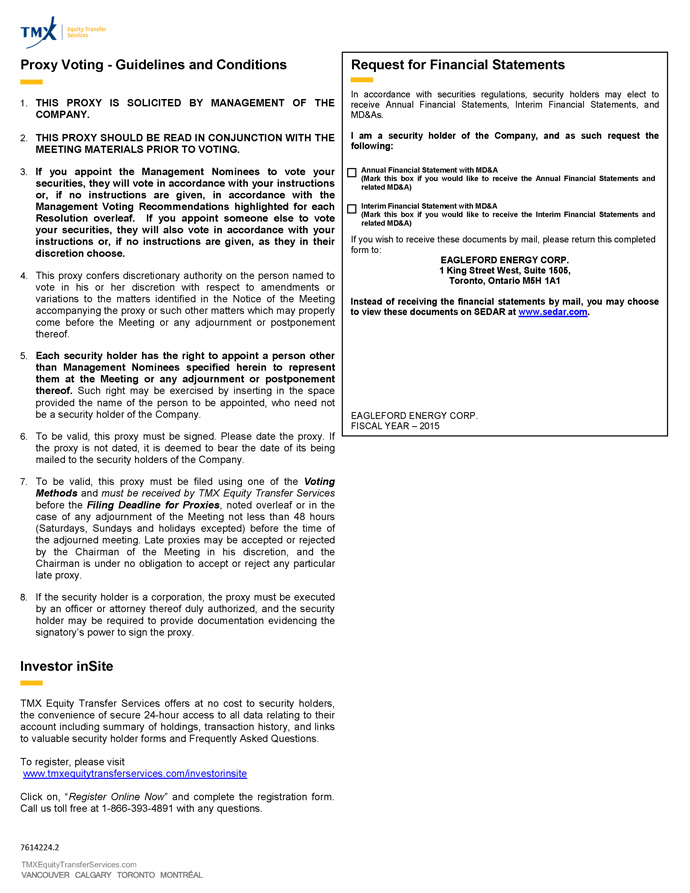
Shareholders may also contact the Company at Suite 1505, 1 King Street West, Toronto, Ontario M5H 1A1 or by telephone (416) 364-4039 to request copies of the Company’s financial statements and management’s discussion and analysis ("MD&A"). Financial information is provided in the Company’s comparative financial statements and MD&A for its most recently completed financial year.
| - 16 - |
APPROVAL OF INFORMATION CIRCULAR
The contents and the sending of this Information Circular to the shareholders of the Company have been approved by the Board of Directors of the Company. Unless otherwise specified, information contained in this Information Circular is given as of January 15, 2015.
DATED at Toronto, Ontario this 15th day of January, 2015.
|
BY ORDER OF THE BOARD OF DIRECTORS OF EAGLEFORD ENERGY CORP. | |
| "James Cassina" | |
| JAMES CASSINA | |
| Chief Executive Officer, President and Director |
| - 17 - |
SCHEDULE "A"
EAGLEFORD ENERGY CORP.
(the "Company")
FORM 58-101F1
CORPORATE GOVERNANCE DISCLOSURE
Pursuant to National Instrument 58-101 Disclosure of Corporate Governance Practices ("NI 58-101"), the Company is required and hereby discloses its corporate governance practices as of the date of this Information Circular.
Board of Directors
The mandate of our Board, prescribed by the Business Corporations Act (Ontario), is to manage or supervise the management of our business and affairs and to act with a view to our best interests. In doing so, the Board oversees the management of our affairs directly and through its committees.
Mr. Klyman was appointed to the Board on August 10, 2000, Mr. Cassina was appointed on February 9, 2010, Mr. McNeil was appointed on June 18, 2010 and Mr. Gaines was appointed on January 25, 2012. Our directors’ serve until our next Annual General Meeting or until a successor is duly elected, unless the office is vacated in accordance with our Articles or Bylaws. Our sole executive officer was appointed by our Board to serve until the earlier his resignation or removal, with or without cause by the directors. There was no compensation paid by us to our directors during the fiscal year ended August 31, 2014 for their services in their capacity as directors or any compensation paid to committee members.
As of January 15, 2015 our Board consists of three directors, two of which are "independent directors" in that they are "independent from management and free from any interest and any business or other relationship which could, or could reasonably be perceived to, materially interfere with the directors ability to act with a view to our best interests, other than interests and relationships arising from shareholding". The independent directors are Milton Klyman and Colin McNeil. It is our practice to attempt to maintain a diversity of professional and personal experience among our directors.
The independent directors of the Company do not hold regularly scheduled meetings at which non-independent directors and members of management are not in attendance. The Company holds meetings as required, at which the opinions of the independent directors are sought and duly acted upon for all material matters relating to the Company.
Directorships
The following directors of ours are directors of other Canadian or United States reporting issuers as follows:
| Milton Klyman | Western Troy Capital Resources Inc. |
Board and Committee Meetings
The Board has met at least once annually or otherwise as circumstances warrant to review our business operations, corporate governance and financial results. The table below reflects the attendance of each director of ours at each Board and committee meeting of the Board during the fiscal year ended August 31, 2014.
| Name | Board of Directors Meetings | Audit Committee Meetings | Compensation Committee Meetings | Petroleum and Natural Gas Committee Meetings | Disclosure Committee Meetings | |||||
| Milton Klyman | 4 | 4 | 1 | 1 | Nil | |||||
| James Cassina | 4 | 4 | Nil | 1 | Nil | |||||
| Colin McNeil | 4 | 4 | 1 | 1 | Nil | |||||
| Alan Gaines (1) | 1 | Nil | Nil | Nil | Nil |
| (1) | Mr. Gaines resigned from the board of directors on February 26, 2014. |
| A-1 |
Board Mandate
The Board assumes responsibility for stewardship of the Company, including overseeing all of the operation of the business, supervising management and setting milestones for the Company. The Board reviews the statements of responsibilities for the Company including, but not limited to, the code of ethics and expectations for business conduct.
The Board approves all significant decisions that affect the Company and its subsidiaries and sets specific milestones towards which management directs their efforts.
The Board ensures, at least annually, that there are long-term goals and a strategic planning process in place for the Company and participates with management directly or through its committees in developing and approving the mission of the business of the Company and the strategic plan by which it proposes to achieve its goals, which strategic plan takes into account, among other things, the opportunities and risks of the Company's business. The strategic planning process is carried out at each Board meeting where there are regularly reviewed specific milestones for the Company.
The strategic planning process incorporates identifying the main risks to the Company's objectives and ensuring that mitigation plans are in place to manage and minimize these risks. The Board also takes responsibility for identifying the principal risks of the Company's business and for ensuring these risks are effectively monitored and mitigated to the extent practicable. The Board appoints senior management.
The Company adheres to regulatory requirements with respect to the timeliness and content of its disclosure. The Board approves all of the Company's major communications, including annual and quarterly reports and press releases. The Chief Executive Officer authorizes the issuance of news releases. The Chief Executive Officer is generally the only individual authorized to communicate with analysts, the news media and investors about information concerning the Company.
The Board and the Audit Committee examine the effectiveness of the Company's internal control processes and information systems.
The Board as a whole, given its small size, is involved in developing the Company's approach to corporate governance. The number of scheduled Board meetings varies with circumstances. In addition, special meetings are called as necessary. The Chief Executive Officer establishes the agenda at each Board meeting and submits a draft to each director for their review and recommendation for items for inclusion on the agenda. Each director has the ability to raise subjects that are not on the agenda at any Board meeting. Meeting agendas and other materials to be reviewed and/or discussed for action by the Board are distributed to directors in time for review prior to each meeting. Board members have full and free access to senior management and employees of the Company.
Position Descriptions
The Board has not developed written position descriptions for the Chairman of the Board or the Chief Executive Officer. The Board is currently of the view that the respective corporate governance roles of the Board and management, as represented by the Chief Executive Officer, are clear and that the limits to management's responsibility and authority are well-defined.
Each of the Audit Committee, Compensation Committee, Disclosure Committee and a Petroleum and Natural Gas Committee has a chair and a mandate.
Orientation and Continuing Education
We have developed an orientation program for new directors including a director’s manual ("Director’s Manual") which contains information regarding the roles and responsibilities of the Board, each Board committee, the Board chair, the chair of each Board committee and our president. The Director’s Manual contains information regarding its organizational structure, governance policies including the Board Mandate and each Board committee charter, and our code of business conduct and ethics. The Director’s Manual is updated as our business, governance documents and policies change. We update and inform the Board regarding corporate developments and changes in legal, regulatory and industry requirements affecting us.
| A-2 |
Ethical Business Conduct
We have adopted a written code of business conduct and ethics (the "Code") for our directors, officers and employees. The Board encourages following the Code by making it widely available. It is distributed to directors in the Director’s Manual and to officers, employees and consultants at the commencement of their employment or consultancy. The Code reminds those engaged in service to us that they are required to report perceived or actual violations of the law, violations of our policies, dangers to health, safety and the environment, risks to our property, and accounting or auditing irregularities to the chair of the Audit Committee who is an independent director of ours. In addition, to requiring directors, officers and employees to abide by the Code, we encourage consultants, service providers and all parties who engage in business with us to contact the chair of the Audit Committee regarding any perceived and all actual breaches by our directors, officers and employees of the Code. The chair of our Audit Committee is responsible for investigating complaints, presenting complaints to the applicable Board committee or the Board as a whole, and developing a plan for promptly and fairly resolving complaints. Upon conclusion of the investigation and resolution of a complaint, the chair of our Audit Committee will advise the complainant of the corrective action measures that have been taken or advise the complainant that the complaint has not been substantiated. The Code prohibits retaliation by us, our directors and management, against complainants who raise concerns in good faith and requires us to maintain the confidentiality of complainants to the greatest extent practical. Complainants may also submit their concerns anonymously in writing. In addition to the Code, we have an Audit Committee Charter and a Policy of Procedures for Disclosure Concerning Financial/Accounting Irregularities.
Since the beginning of our most recently completed financial year, no material change reports have been filed that pertain to any conduct of a director or executive officer that constitutes a departure from the Code. The Board encourages and promotes a culture of ethical business conduct by appointing directors who demonstrate integrity and high ethical standards in their business dealings and personal affairs. Directors are required to abide by the Code and expected to make responsible and ethical decisions in discharging their duties, thereby setting an example of the standard to which management and employees should adhere. The Board is required by the Board Mandate to satisfy our CEO and other executive officers are acting with integrity and fostering a culture of integrity throughout the Company. The Board is responsible for reviewing departures from the Code, reviewing and either providing or denying waivers from the Code, and disclosing any waivers that are granted in accordance with applicable law. In addition, the Board is responsible for responding to potential conflict of interest situations, particularly with respect to considering existing or proposed transactions and agreements in respect of which directors or executive officers advise they have a material interest. The Board Mandate requires that directors and executive officers disclose any interest and the extent, no matter how small, of their interest in any transaction or agreement with us, and that directors excuse themselves from both Board deliberations and voting in respect of transactions in which they have an interest. By taking these steps the Board strives to ensure that directors exercise independent judgment, unclouded by the relationships of the directors and executive officers to each other and us, in considering transactions and agreements in respect of which directors and executive officers have an interest.
Nomination of Directors
The Board has not appointed a nominating committee and does not believe that such a committee is warranted at the present time. The entire Board determines new nominees to the Board, although a formal process has not been adopted. The nominees are generally the result of recruitment efforts by the Board members, including both formal and informal discussions among Board members and officers. The Board generally looks for the nominee to have direct experience in the oil and gas business and significant public company experience. The nominee must not have a significant conflicting public company association.
Compensation
The Board determines director and executive officer compensation by recommendation of the Compensation Committee. The Company's Compensation Committee reviews the amounts and effectiveness of compensation. Each of the members of the Compensation Committee are independent. The Board reviews the adequacy and form of compensation and compares it to other companies of similar size and stage of development. There is no minimum share ownership requirement of directors.
The Compensation Committee convenes to review director and officer compensation and status of stock options. The Compensation Committee also responds to requests from management and the Board to review recommendations of management for new senior employees and their compensation. The Compensation Committee has the power to approve and/or amend these recommendations.
| A-3 |
The Company has felt no need to retain any compensation consultants or advisors at any time since the beginning of the Company's most recently completed financial year.
Committees of the Board
Our Board discharges its responsibilities directly and through committees of the Board, currently consisting of the Audit Committee, a compensation committee (the "Compensation Committee"), a disclosure committee (the "Disclosure Committee") and a petroleum and natural gas committee (the "Petroleum and Natural Gas Committee").
Each of the Audit Committee, Disclosure Committee and the Petroleum and Natural Gas Committee consists of a majority of independent directors, while the Compensation Committee consists of independent directors. Each Committee has a specific mandate and responsibilities, as reflected in the charters for each committee.
Audit Committee
The mandate of the Audit Committee is formalized in a written charter. The members of the Audit Committee are James Cassina, Milton Klyman (Chair) and Colin McNeil. Based on his professional certification and experience, the Board has determined that Milton Klyman is an Audit Committee Financial Expert and that James Cassina and Colin McNeil are financially literate. The Audit Committee's primary duties and responsibilities are to serve as an independent and objective party to monitor our financial reporting process and control systems, review and appraise the audit activities of our independent auditors, financial and senior management, and the lines of communication among the independent auditors, financial and senior management, and the Board for financial reporting and control matters including investigating fraud, illegal acts or conflicts of interest.
Compensation Committee
The mandate of the Compensation Committee is formalized in a written charter. The members of the Compensation Committee are Colin McNeil and Milton Klyman (Chair). The Compensation Committee is comprised entirely of independent directors. Compensation is determined in the context of our strategic plan, our growth, shareholder returns and other achievements and considered in the context of position descriptions, goals and the performance of each individual director and officer. With respect to directors’ compensation, the Compensation Committee reviews the level and form of compensation received by the directors, members of each committee, the Board chair and the chair of each Board committee, considering the duties and responsibilities of each director, his or her past service and continuing duties in service to us. The compensation of directors, the CEO and executive officers of competitors are considered, to the extent publicly available, in determining compensation and the Compensation Committee has the power to engage a compensation consultant or advisor to assist in determining appropriate compensation.
Further information regarding the Compensation Committee's responsibilities, powers and operation of the Compensation Committee are set out above under the section entitled “Compensation Discussion and Analysis”.
Colin McNeil is an independent consulting geophysicist and has managed exploration programs and structured technical assessments for companies in the Middle East, Africa, Asia, Central and South America, the Arctic, and Canada. Colin McNeil has served as a director and held various positions with public and private companies.
Milton Klyman is a self-employed financial consultant and has been a Chartered Accountant since 1952. Milton Klyman is a Life Member of the Institute of Chartered Accountants of Ontario, a Life member of the Canadian Institute of Mining Metallurgy and Petroleum and a Fellow of the Institute of Chartered Secretaries and Administrators.
Disclosure Committee
The mandate of the Disclosure Committee is formalized in a written charter. The members of the Disclosure Committee are Milton Klyman, Colin McNeil and James Cassina (Chair). The Committee's duties and responsibilities include, but are not limited to, review and revise our controls and other procedures ("Disclosure and Controls Procedures") to ensure that (i) information required by us to be disclosed to the applicable regulatory authorities and other written information that we will disclose to the public is reported accurately and on a timely basis, and (ii) such information is accumulated and communicated to management, as appropriate to allow timely decisions regarding required disclosure; assist in documenting and monitoring the integrity and evaluating the effectiveness of the Disclosure and Control Procedures; the identification and disclosure of material information about us, the accuracy completeness and timeliness of our financial reports and all communications with the investing public are timely, factual and accurate and are conducted in accordance with applicable legal and regulatory requirements.
| A-4 |
Petroleum and Natural Gas Committee
The members of the Petroleum and Natural Gas Committee are Milton Klyman, James Cassina and Colin McNeil (Chair). The Petroleum and Natural Gas Committee has the responsibility of meeting with the independent engineering firms commissioned to conduct the reserves evaluation on our oil and natural gas assets and to discuss the results of such evaluation with each of the independent engineers and management. Specifically, the Petroleum and Natural Gas Committee’s responsibilities include, but are not limited to, a review of management’s recommendations for the appointment of independent engineers, review of the independent engineering reports and considering the principal assumptions upon which such reports are based, appraisal of the expertise of the independent engineering firms retained to evaluate our reserves, review of the scope and methodology of the independent engineers’ evaluations, reviewing any problems experienced by the independent engineers in preparing the reserve evaluation, including any restrictions imposed by management or significant issues on which there was a disagreement with management and a review of reserve additions and revisions which occur from one report to the next.
Assessments
The Board assesses, on an annual basis, the contributions of the Board as a whole, the Audit Committee and each of the individual directors, in order to determine whether each is functioning effectively. The Board monitors the adequacy of information given to directors, communication between the Board and management and the strategic direction and processes of the Board and committees. The Audit Committee will annually review the Audit Committee Charter and recommend, if any, revisions to the Board as necessary.
| A-5 |
Schedule "B"
EAGLEFORD ENERGY CORP.
(the "Company")
FORM 52-110F2
AUDIT COMMITTEE DISCLOSURE
Audit Committee Charter
The responsibilities and duties of the audit committee (the "Audit Committee") of the board of directors of the Company (the "Board") are set out in the Audit Committee’s charter (the "Charter"), the text of which is set forth in Exhibit 1 to this Schedule "B".
Composition of the Audit Committee
The members of the Audit Committee of the Board are James Cassina, Milton Klyman (Chairman) and Colin McNeil. Based on his professional certification and experience, the board has determined that Milton Klyman is an Audit Committee Financial Expert and that James Cassina and Colin McNeil are financially literate. The Audit Committee's primary duties and responsibilities are to serve as an independent and objective party to monitor our financial reporting process and control systems, review and appraise the audit activities of our independent auditors, financial and senior management, and the lines of communication among the independent auditors, financial and senior management, and the Board for financial reporting and control matters including investigating fraud, illegal acts or conflicts of interest.
Relevant Education and Experience of Audit Committee Members
Milton Klyman is the Chairman of the Audit Committee. He is a self-employed financial consultant and has been a Chartered Accountant since 1952. Milton Klyman is a Life Member of the Institute of Chartered Accountants of Ontario, a Life member of the Canadian Institute of Mining Metallurgy and Petroleum and a Fellow of the Institute of Chartered Secretaries and Administrators.
James Cassina is a consultant in business development, mergers and acquisitions and corporate finance. James Cassina has served as a director and held various executive positions with public companies.
Colin McNeil is an independent consulting geophysicist and has managed exploration programs and structured technical assessments for companies in the Middle East, Africa, Asia, Central and South America, the Arctic, and Canada. Colin McNeil has served as a director and held various positions with public and private companies.
Reliance on Certain Exemption
Since the commencement of the Company's most recently completed financial year, the Company has not relied upon any of the exemptions contained in the following provisions of NI 52-110: (i) Section 2.4 (De Minimis Non-audit Services); (ii) Section 3.2 (Initial Public Offerings); (iii) Section 3.4 (Events Outside Control of Member); (iv) Section 3.5 (Death, Disability or Resignation of Audit Committee Member); and (v) Part 8 (Exemptions).
Reliance on the Exemption in Subsection 3.3 or Section 3.6
Since the commencement of the Company's most recently completed financial year, the Company has not relied upon any of the exemptions contained in the following provisions of NI 52-110: (i) Subsection 3.3(2) (Controlled Companies); and (ii) Section 3.6 (Temporary Exemption for Limited and Exceptional Circumstances).
Reliance on Section 3.8
Since the commencement of the Company's most recently completed financial year, the Company has not relied upon the exemption in Section 3.8 (Acquisition of Financial Literacy) of NI 52-110.
Audit Committee Oversight
Since the commencement of the Company's most recently completed financial year, no recommendations were made by the Audit Committee to nominate or compensate an external auditor.
| B-1 |
Pre-approval Policies and Procedures
The policies and procedures adopted by the Audit Committee in respect of the engagement of the Company’s auditors in respect of non-audit services, being services other than audit services, is described under the heading "Responsibilities and Powers" in the Charter.
External Auditor Service Fees (By Category)
The aggregate fees billed or accrued for professional fees rendered by Schwartz Levitsky Feldman LLP, Chartered Accountants for the years ended August 31, 2014 and August 31, 2013 are as follows:
| Nature of Services | Fees Paid to Auditor in Year-ended August 31, 2014 | Fees Paid to Auditor in Year-ended August 31, 2013 | ||||||
| Audit Fees(1) | $ | 55,000 | $ | 55,000 | ||||
| Audit-Related Fees(2) | Nil | Nil | ||||||
| Tax Fees(3) | 5,000 | 5,000 | ||||||
| All Other Fees(4) | Nil | Nil | ||||||
| TOTALS | $ | 60,000 | $ | 60,000 | ||||
Notes:
| (1) | "Audit Fees" include fees necessary to perform the annual audit and any quarterly reviews of the Company's financial statements management discussion and analysis. This includes fees for the review of tax provisions and for accounting consultations on matters reflected in the financial statements. This also includes audit or other attest services required by legislation or regulation, such as comfort letters, consents, reviews of securities filings and statutory audits. |
| (2) | "Audit-Related Fees" include fees for assurance and related services that are reasonably related to the performance of the audit or review of the Company's financial statements and that are not included in "Audit Fees". |
| (3) | "Tax Fees" include fees for all professional services rendered by the Company's auditors for tax compliance, tax advice and tax planning. |
| (4) | "All Other Fees" include all fees for products and services provided by the Company's auditors not included in "Audit Fees", "Audit-Related Fees" and "Tax Fees". |
It is the policy of the Audit Committee that all audit and non-audit services are pre-approved prior to engagement. Before the initiation of each audit, the principal accountant submits a budget of the expected range of expenditures to complete their audit engagement (including Audit Fees and Tax Fees) to the Audit Committee for approval. In the event that the principal accountant exceeds these parameters, the individual auditor is expected to communicate to management the reasons for the variances, so that such variances can be ratified by the Audit Committee. As a result, 100% of expenditures within the scope of the noted budget are approved by the Audit Committee.
During fiscal 2013 and 2012 there were no hours performed by any person other than the primary accountant’s fulltime permanent employees.
Exemption
The Company is relying on the exemption provided by Section 6.1 of NI 52-110 which provides that the Company, as a “venture issuer”, is not required to comply with Part 3 and Part 5 (Reporting Obligations) of NI 52-110.
| B-2 |
exhibit 1
EAGLEFORD ENERGY CORP.
(the "Company")
AUDIT COMMITTEE CHARTER
This Charter was approved by the Board of Directors of the Company on May 28, 2009 and replaces all previous audit committee charters, terms of reference or other similar documents prescribing the procedures, powers and duties of the Audit Committee.
Audit Committee Charter
This Audit Committee Charter (the "Charter") has been adopted by the Board of Directors (the "Board") of Eugenic Corp. (the "Company"). The Audit Committee of the Board (the "Committee") will review and reassess this charter annually and recommend any proposed changes to the Board for approval. The Audit Committee’s primary duties and responsibilities are to:
| · | Oversee (i) the integrity of the Company’s financial statements; (ii) the Company’s compliance with legal and regulatory requirements; and (iii) the independent auditors’ qualifications and independence. |
| · | Serve as an independent and objective party to monitor the Company’s financial reporting processes and internal control systems. |
| · | Review and appraise the audit activities of the Company’s independent auditors and the internal auditing functions. |
| · | Provide open lines of communication among the independent auditors, financial and senior management, and the Board of Directors for financial reporting and control matters. |
Role and Independence: Organization
The Committee assists the Board on fulfilling its responsibility for oversight of the quality and integrity of the accounting, auditing, internal control and financial reporting practices of the Company. It may also have such other duties as may from time to time be assigned to it by the Board.
The Audit Committee is to be comprised of at least three directors. The majority of this Committee must be independent from management and free from any relationship that, in the opinion of the Board, would interfere with the exercise of his or her independent judgment as a member of the Committee.
All members shall, to the satisfaction of the Board, be financially literate (i.e. will have the ability to read and understand a balance sheet, an income statement, a cash flow statement and the notes attached thereto), and at least one member shall have accounting or related financial management expertise to qualify as "financially sophisticated". A person will qualify as "financially sophisticated" is an individual who possesses the following attributes:
| 1. | an understanding of financial statements and generally accepted accounting principles; |
| 1. | an ability to assess the general application of such principles in connection with the accounting for estimates, accruals and reserves; |
| 2. | experience preparing, auditing, analyzing or evaluating financial statements that present a breadth and level of complexity of accounting issues that are generally comparable to the breadth and complexity of issues that can reasonably be expected to be raised by the Company’s financial statements, or experience actively supervising one or more persons engaged in such activities; |
| 3. | an understanding of internal controls and procedures for financial reporting; and |
| 4. | an understanding of audit committee functions. |
The majority of the members of the Committee are "independent" as defined by the Securities and Exchange Commission, and the Board has determined that Mr. Klyman is an "audit committee financial expert" as defined in Item 401(h) of Regulation S-K promulgated by the Securities and Exchange Commission.
| B-3 |
The Committee members will be elected annually at the first meeting of the Board following the annual meeting of shareholders. Each member of the Committee serves during the pleasure of the Board and, in any event, only so long as he or she is a director.
One member of the Committee shall be appointed as chair. The chair shall be responsible for leadership of the Committee, including scheduling and presiding over meetings and making regular reports to the Board. The chair will also maintain regular liaison with the CEO, CFO, and the lead independent audit partner.
Responsibilities and Powers
Although the Committee may wish to consider other duties from time to time, the general recurring activities of the Committee in carrying out its oversight role are described below.
| · | Annual review and revision of this Charter as necessary with the approval of the Board. |
| · | Review and obtain from the independent auditors a formal written statement delineating all relationships between the auditor and the Company, consistent with Independence Standards Board Standard 1. |
| · | Recommending to the Board the independent auditors to be retained (or nominated for shareholder approval) to audit the financial statements of the Company. Such auditors are ultimately accountable to the Board and the Committee, as representatives of the shareholders. |
| · | Evaluating, together with the Board and management, the performance of the independent auditors and, where appropriate, replacing such auditors. |
| · | Obtaining annually from the independent auditors a formal written statement describing all relationships between the auditors and the Company. The Committee shall actively engage in a dialogue with the independent auditors with respect to any relationship that may impact the objectively and the independence of the auditors and shall take, or recommend that the Board take, appropriate actions to oversee and satisfy itself as to the auditors’ independence. |
| · | Ensuring that the independent auditors are prohibited from providing the following non-audit services and determining which other non-audit services the independent auditors are prohibited from providing: |
| o | Bookkeeping or other services related to the accounting records or financial statements of the Company; |
| o | Financial information systems design and implementation; |
| o | Appraisal or valuation services, fairness opinions, or contribution-in-kind reports; |
| o | Actuarial services; |
| o | Internal audit outsourcing services; |
| o | Management functions or human resources; |
| o | Broker or dealer, investment advisor or investment banking services; |
| o | Legal services and expert services unrelated to the audit; and |
| o | Any other services which the Public Company Accounting Oversight Board determines to be impermissible. |
| · | Approving any permissible non-audit engagements of the independent auditors. |
| · | Meeting with the auditors and management of the Company to review the scope of the proposed audit for the current year, and the audit procedures to be used, and to approve audit fees. |
| · | Reviewing the audited financial statements and discussing them with management and the independent auditors. Consideration of the quality of the Company’s accounting principles as applied in its financial reporting. Based on such review, the Committee shall make its recommendation to the Board as to the inclusion of the Company’s audited financial statement in the Company’s Annual Report to Shareholders. |
| · | Discussing with management and the independent auditors the quality and adequacy of and compliance with the Company’s internal controls. |
| · | Establishing procedures: (i) for receiving, handling and retaining of complaints received by the Company regarding accounting, internal controls, or auditing matters, and (ii) for employees to submit confidential anonymous concerns regarding questionable accounting or auditing matters. |
| · | Review and discuss all related party transactions involving the Company. |
| · | Engaging independent counsel and other advisors if the Committee determines that such advisors are necessary to assist the Committee in carrying out its duties. |
| B-4 |
| · | Publicly disclose the receipt of warning about any violations of corporate governance rules. |
Authority
The Committee will have the authority to retain special legal, accounting or other experts for advise, consultation or special investigation. The Committee may request any officer or employee of the Company, the Company’s outside legal counsel, or the independent auditor to attend a meeting of the Committee, or to meet with any member of, or consultants to, the Committee. The Committee will have full access to the books, records and facilities of the Company.
Meetings
The Committee shall meet at least yearly, or more frequently as the Committee considers necessary. Opportunities should be afforded periodically to the external auditor and to senior management to meet separately with the independent members of the Committee. Meetings may be with representatives of the independent auditors, and appropriate members of management, all either individually or collectively as may be required by the Chairman of the Committee.
The independent auditors will have direct access to the Committee at their own initiative.
The Chairman of the Committee will report periodically the Committee’s findings and recommendations to the Board of Directors
| B-5 |