20-F: Annual and transition report of foreign private issuers [Sections 13 or 15(d)]
Published on
SECURITIES
AND EXCHANGE COMMISSION
Washington,
D.C. 20549
FORM
20-F
¨REGISTRATION STATEMENT
PURSUANT TO SECTION 12(b) OR (g) OF THE SECURITIES EXCHANGE ACT OF
1934
OR
x ANNUAL
REPORT PURSUANT TO SECTION 13 OR 15(d) OF THE SECURITIES EXCHANGE ACT OF
1934
For the
fiscal year ended August 31, 2010
OR
¨ TRANSITION
REPORT PURSUANT TO SECTION 13 OR 15(d) OF THE SECURITIES EXCHANGE ACT OF
1934
For the
transition period from ______________________ to
______________________
OR
¨ SHELL COMPANY REPORT
PURSUANT TO SECTION 13 OR 15(d) OF THE SECURITIES EXCHANGE ACT OF
1934
Date of
event requiring this shell company
report ____________________________
Commission
File Number: 0-53646
EAGLEFORD
ENERGY INC.
(Exact
name of Registrant as specified in its charter)
Ontario,
Canada
(Jurisdiction
of incorporation or organization)
1
King Street West, Suite 1505
Toronto,
Ontario, Canada, M5H 1A1
(Address
of principal executive offices)
James
Cassina, Telephone (416) 364-4039, Fax (416) 364-8244
1
King Street West, Suite 1505, Toronto, Ontario, Canada, M5H 1A1
(Name,
telephone, e-mail and/or facsimile number and address of company contact
person)
Securities
registered or to be registered pursuant to section 12(b) of the Act:
None
Securities
registered or to be registered pursuant to Section 12(g) of the Act:
Common Stock, no
par value
(Title of Class)
Securities
for which there is a reporting obligation pursuant to Section 15(d) of the Act:
None
(Title of Class)
The
number of outstanding shares of the issuer’s common stock as of August 31, 2010
was 29,751,026 shares.
Indicate
by check mark if the registrant is a well-known seasoned issuer, as defined in
Rule 405 of the Securities Act. Yes ¨ No
x
If this
report is an annual or a transition report, indicate by check mark if the
registrant is not required to file reports pursuant to Section 13 or 15(d) of
the Securities Exchange Act of 1934. Yes ¨ No
x
Indicate
by check mark whether the registrant (1) has filed all reports required to be
filed by Section 13 or 15(d) of the Securities Exchange Act of 1934 during the
preceding 12 months (or for such shorter period that the registrant was required
to file such reports), and (2) has been subject to such filing requirements for
the past 90 days. Yes x No
¨
Indicate
by check mark whether the registrant has submitted electronically and posted on
its corporate Web site, if any, every Interactive Data File required to be
submitted and posted pursuant to Rule 405 of Regulation S-T (§232.405 of this
chapter) during the preceding 12 months (or for such shorter period that the
registrant was required to submit and post such files).
Yes ¨
No ¨
Indicate
by check mark whether the registrant is a large accelerated filer, an
accelerated filer, or a non-accelerated filer. See definition of “accelerated
filer and large accelerated filer” in Rule 12b-2 of the Exchange Act. (Check
one):
|
Large
accelerated filer ¨
|
Accelerated
filer ¨
|
Non-accelerated
filer x
|
Indicate
by check mark which basis of accounting the registrant has used to prepare the
financial statements included in this filing:
|
U.S.
GAAP ¨
|
International
Financial Reporting Standards
by
the International Accounting Standards Board ¨
|
Other x
|
If
“Other” has been checked in response to the previous question, indicate by check
mark which financial statement item the registrant has elected to follow.
‘
Item
17 x
Item 18 ¨
If this
is an annual report, indicate by check mark whether the registrant is a shell
company (as defined in Rule 12b-2 of the Exchange Act).
Yes ¨
No x
Table
of Contents
|
GENERAL
|
1
|
|
|
NOTE
REGARDING FORWARD-LOOKING STATEMENTS
|
1
|
|
|
PART
I
|
1
|
|
|
ITEM
1
|
IDENTITY
OF DIRECTORS, SENIOR MANAGEMENT AND ADVISORS
|
1
|
|
A.
|
DIRECTORS
AND SENIOR MANAGEMENT
|
1
|
|
B.
|
ADVISERS
|
1
|
|
C.
|
AUDITORS
|
1
|
|
ITEM
2
|
OFFER
STATISTICS AND EXPECTED TIMETABLE
|
2
|
|
A.
|
OFFER
STATISTICS
|
2
|
|
B.
|
METHOD
AND EXPECTED TIMETABLE
|
2
|
|
ITEM
3
|
KEY
INFORMATION
|
2
|
|
A.
|
SELECTED
FINANCIAL DATA
|
2
|
|
B.
|
CAPITALIZATION
AND INDEBTEDNESS
|
5
|
|
C.
|
REASONS
FOR THE OFFER AND USE OF PROCEEDS
|
5
|
|
D.
|
RISK
FACTORS
|
5
|
|
ITEM
4
|
INFORMATION
ON THE COMPANY
|
12
|
|
A.
|
HISTORY
AND DEVELOPMENT OF THE COMPANY
|
13
|
|
B.
|
BUSINESS
OVERVIEW
|
17
|
|
C.
|
ORGANIZATIONAL
STRUCTURE
|
21
|
|
D.
|
PROPERTY,
PLANTS AND EQUIPMENT
|
21
|
|
ITEM
4A
|
UNRESOLVED
STAFF COMMENTS
|
26
|
|
ITEM
5
|
OPERATING
AND FINANCIAL REVIEW AND PROSPECTS
|
26
|
|
A.
|
OPERATING
RESULTS
|
44
|
|
B.
|
LIQUIDITY
AND CAPITAL RESOURCES
|
48
|
|
C.
|
RESEARCH
AND DEVELOPMENT, PATENTS AND LICENSES
|
49
|
|
D.
|
TREND
INFORMATION
|
49
|
|
E.
|
OFF-BALANCE
SHEET ARRANGEMENTS
|
50
|
|
F.
|
TABULAR
DISCLOSURE OF CONTRACTUAL OBLIGATIONS
|
51
|
|
G.
|
SAFE
HARBOR
|
53
|
|
ITEM
6.
|
DIRECTORS,
SENIOR MANAGEMENT AND EMPLOYEES
|
53
|
|
A.
|
DIRECTORS
AND SENIOR MANAGEMENT
|
53
|
|
B.
|
COMPENSATION
|
54
|
|
C.
|
BOARD
PRACTICES
|
57
|
|
D.
|
EMPLOYEES
|
64
|
|
E.
|
SHARE
OWNERSHIP
|
64
|
|
ITEM
7
|
MAJOR
SHAREHOLDERS AND RELATED PARTY TRANSACTIONS
|
66
|
|
A.
|
MAJOR
SHAREHOLDERS
|
66
|
|
B.
|
RELATED
PARTY TRANSACTIONS
|
67
|
|
C.
|
INTERESTS
OF EXPERTS AND COUNSEL
|
68
|
|
ITEM
8
|
FINANCIAL
INFORMATION
|
68
|
|
A.
|
CONSOLIDATED
STATEMENTS AND OTHER FINANCIAL INFORMATION
|
68
|
|
B.
|
SIGNIFICANT
CHANGES
|
68
|
|
ITEM
9
|
THE
OFFER AND LISTING
|
68
|
|
A.
|
OFFER
AND LISTING DETAILS
|
68
|
|
B.
|
PLAN
OF DISTRIBUTION
|
69
|
i
|
C.
|
MARKETS
|
69
|
|
D.
|
SELLING
SHAREHOLDERS
|
69
|
|
E.
|
DILUTION
|
69
|
|
F.
|
EXPENSES
OF THE ISSUE
|
69
|
|
ITEM
10
|
ADDITIONAL
INFORMATION
|
69
|
|
A.
|
SHARE
CAPITAL
|
69
|
|
B.
|
MEMORANDUM
AND ARTICLES OF ASSOCIATION
|
69
|
|
C.
|
MATERIAL
CONTRACTS
|
71
|
|
D.
|
EXCHANGE
CONTROLS
|
72
|
|
E.
|
TAXATION
|
73
|
|
F.
|
DIVIDENDS
AND PAYING AGENTS
|
76
|
|
G.
|
STATEMENT
BY EXPERTS
|
76
|
|
H.
|
DOCUMENTS
ON DISPLAY
|
76
|
|
I.
|
SUBSIDIARY
INFORMATION
|
76
|
|
ITEM
11
|
QUANTITATIVE
AND QUALITATIVE DISCLOSURE ABOUT MARKET RISK
|
76
|
|
ITEM
12
|
DESCRIPTION
OF SECURITIES OTHER THAN EQUITY SECURITIES
|
78
|
|
A.
|
DEBT
SECURITIES
|
78
|
|
B.
|
WARRANTS
AND RIGHTS
|
78
|
|
C.
|
OTHER
SECURITIES
|
78
|
|
D.
|
AMERICAN
DEPOSITORY SHARES
|
78
|
|
PART
II
|
78
|
|
|
ITEM
13
|
DEFAULTS,
DIVIDENDS ARREARAGES AND DELINQUENCIES
|
78
|
|
ITEM
14
|
MATERIAL
MODIFICATIONS TO THE RIGHTS OF SECURITY HOLDERS AND USE OF
PROCEEDS
|
78
|
|
ITEM
15
|
CONTROLS
AND PROCEDURES
|
79
|
|
ITEM
16
|
[RESERVED]
|
80
|
|
A.
|
AUDIT
COMMITTEE FINANCIAL EXPERT
|
80
|
|
B.
|
CODE
OF ETHICS
|
80
|
|
C.
|
PRINCIPAL
ACCOUNTANT FEES AND SERVICES
|
81
|
|
D.
|
EXEMPTIONS
FROM THE LISTING STANDARDS FOR AUDIT COMMITTEES
|
81
|
|
E.
|
PURCHASES
OF EQUITY SECURITIES BY THE ISSUER AND AFFILIATED
PURCHASERS
|
82
|
|
F.
|
CHANGE
IN REGISTRANT’S CERTIFYING ACCOUNTANT
|
82
|
|
G.
|
CORPORATE
GOVERNANCE
|
82
|
|
PART
III
|
82
|
|
|
ITEM
17
|
FINANCIAL
STATEMENTS
|
82
|
|
ITEM
18
|
FINANCIAL
STATEMENTS
|
82
|
|
ITEM
19
|
EXHIBITS
|
82
|
ii
GENERAL
In this
Annual Report, references to “we”, “us”, “our”, the “Company”, and “Eagleford”
mean Eagleford Energy Inc., and its subsidiaries, unless the context requires
otherwise.
We use
the Canadian dollar as our reporting currency and our financial statements are
prepared in accordance with Canadian generally accepted accounting principles.
Note 16 to our annual consolidated financial statements provide a reconciliation
of our financial statements to United States generally accepted accounting
principles. All monetary references in this document are to Canadian dollars,
unless otherwise indicated. All references in this document to “dollars” or “$”
or “CDN$” mean Canadian dollars, unless otherwise indicated, and references to
“US$” mean United States dollars.
Except as
noted, the information set forth in this Annual Report is as of January 31, 2011
and all information included in this document should only be considered accurate
as of such date. Our business, financial condition or results of operations may
have changed since that date.
NOTE
REGARDING FORWARD-LOOKING STATEMENTS
Much of
the information included in this Annual Report is based upon estimates,
projections or other “forward-looking statements”. Such forward-looking
statements include any projections or estimates made by us and our management in
connection with our business operations. These statements relate to future
events or our future financial performance. In some cases you can identify
forward-looking statements by terminology such as “may”, “should”, “expects”,
“plans”, “anticipates”, “believes”, “estimates”, “predicts”, “potential” or
“continue” or the negative of those terms or other comparable terminology. While
these forward-looking statements, and any assumptions upon which they are based,
are made in good faith and reflect our current judgment regarding the direction
of our business, actual results will almost always vary, sometimes materially,
from any estimates, predictions, projections, assumptions or other future
performance suggested herein. Such estimates, projections or other
forward-looking statements involve various risks and uncertainties and other
factors, including the risks in the section titled “Risk Factors” below, which
may cause our actual results, levels of activities, performance or achievements
to be materially different from any future results, levels of activity,
performance or achievements expressed or implied by these forward-looking
statements. We caution the reader that important factors in some cases have
affected and, in the future, could materially affect actual results and cause
actual results to differ materially from the results expressed in any such
estimates, projections or other forward-looking statements. Although we believe
that the expectations reflected in the forward-looking statements are
reasonable, we cannot guarantee future results, levels of activity, performance
or achievements. Except as required by applicable law, including the securities
laws of the United States, we do not intend to update any of the forward-looking
statements to conform those statements to actual results.
The
statements contained in Item 4 – “Information on the Company”, Item 5 –
“Operating and Financial Review and Prospects” and Item 11 – “Quantitative and
Qualitative Disclosures About Market Risk” are inherently subject to a variety
of risks and uncertainties that could cause actual results, performance or
achievements to differ significantly.
PART
I
|
ITEM 1
|
IDENTITY OF DIRECTORS, SENIOR
MANAGEMENT AND ADVISORS
|
A. DIRECTORS
AND SENIOR MANAGEMENT
Not
applicable. This Form 20-F is being filed as an Annual Report under
the Exchange Act.
B. ADVISERS
Not
applicable. This Form 20-F is being filed as an Annual Report under
the Exchange Act.
C. AUDITORS
Not
applicable. This Form 20-F is being filed as an Annual Report under
the Exchange Act.
1
|
ITEM 2
|
OFFER STATISTICS AND EXPECTED
TIMETABLE
|
A. OFFER
STATISTICS
Not
applicable. This Form 20-F is being filed as an Annual Report under
the Exchange Act.
B. METHOD
AND EXPECTED TIMETABLE
Not
applicable. This Form 20-F is being filed as an Annual Report under
the Exchange Act.
|
KEY
INFORMATION
|
A. SELECTED
FINANCIAL DATA
The
following table presents selected financial data derived from our Audited
Consolidated Financial Statements for the fiscal years ended August 31, 2010,
2009, 2008, 2007 and 2006. You should read this information in conjunction with
our Audited Consolidated Financial Statements and related notes (Item 17),
as well as Item 4: “Information on the Company” and Item 5: “Operating and
Financial Review and Prospects” of this Annual Report.
Our
consolidated financial statements have been prepared in accordance with Canadian
generally accepted accounting principles (“Canadian GAAP”) in Canadian dollars.
Note 17 to the audited annual consolidated financial statements provides
descriptions of material measurement differences between Canadian GAAP and US
generally accepted accounting principles (“US GAAP”) as they relate to us and a
reconciliation of our consolidated financial statements to US GAAP.
The
selected consolidated statement of operations data set forth below for the years
ended August 31, 2010, 2009, 2008 and 2007 and the selected consolidated balance
sheet data set forth below as of August 31, 2010, 2009, 2008 and 2007 is derived
from our consolidated financial statements, which have been audited by Schwartz
Levitsky Feldman LLP, Chartered Accountants, Toronto, Canada all of which are
attached to and forming part of this Annual Report under Item 17 – Financial
Statements.
The
selected consolidated statement of operations data set forth below for the year
ended August 31, 2006 and the selected consolidated balance sheet data set forth
below as of August 31, 2006 is derived from our consolidated financial
statements, which have been audited by BDO Dunwoody LLP, Chartered Accountants,
Toronto, Canada.
2
EAGLEFORD
ENERGY INC.
Presented
Pursuant to Canadian Generally Accepted Accounting Principles
(STATED
IN CANADIAN DOLLARS)
|
YEARS
ENDED AUGUST 31,
|
||||||||||||||||||||
|
|
2010
|
2009
|
2008
|
2007
|
2006
|
|||||||||||||||
|
CONSOLIDATED STATEMENT
OF OPERATIONS DATA
|
||||||||||||||||||||
|
Revenue
|
$ | 105,375 | $ | 56,199 | $ | 292 | $ | 637 | $ | 760 | ||||||||||
|
Income
(loss) from oil and gas operations
|
(35,586 | ) | (53,626 | ) | 268 | 541 | 311 | |||||||||||||
|
Administrative
expenses
|
653,153 | 276,815 | 50,782 | 40,691 | 51,463 | |||||||||||||||
|
Operating
loss for the year
|
(688,739 | ) | (330,441 | ) | (50,514 | ) | (40,150 | ) | (51,152 | ) | ||||||||||
|
Interest
income
|
30 | 1,580 | - | 205 | - | |||||||||||||||
|
Net
loss and comprehensive loss for the year
|
(688,709 | ) | (328,861 | ) | (50,514 | ) | (39,945 | ) | (51,152 | ) | ||||||||||
|
Loss
per common share basic and diluted
|
(0.028 | ) | (0.019 | ) | (0.006 | ) | (0.006 | ) | (0.008 | ) | ||||||||||
|
Weighted
average common shares
|
||||||||||||||||||||
|
outstanding
|
24,687,130 | 17,646,295 | 7,955,482 | 6,396,739 | 6,396,739 | |||||||||||||||
|
BALANCE
SHEET INFORMATION
|
||||||||||||||||||||
|
Working
capital (deficiency)
|
(744,262 | ) | (137,372 | ) | (93,634 | ) | (483,860 | ) | (444,839 | ) | ||||||||||
|
Total
assets
|
6,107,452 | 600,327 | 208,486 | 9,746 | 8,298 | |||||||||||||||
|
Total
shareholders’ equity (deficiency)
|
4,239,777 | 265,994 | (93,186 | ) | (482,860 | ) | (442,915 | ) | ||||||||||||
3
The
following table sets forth our selected consolidated financial data as set forth
in the preceding table, as reconciled pursuant to United States Generally
Accepted Accounting Principles:
EAGLEFORD
ENERGY INC.
Presented
Pursuant to United States Generally Accepted Accounting Principles
(STATED
IN CANADIAN DOLLARS)
|
YEARS
ENDED AUGUST 31,
|
||||||||||||||||||||
|
2010
|
2009
|
2008
|
2007
|
2006
|
||||||||||||||||
|
CONSOLIDATED STATEMENT
OF OPERATIONS DATA
|
||||||||||||||||||||
|
Revenue
|
$ | 105,375 | $ | 56,199 | $ | 292 | $ | 637 | $ | 760 | ||||||||||
|
Income
(loss) from operations
|
(35,586 | ) | (53,626 | ) | 268 | 541 | 311 | |||||||||||||
|
Administrative
expenses
|
653,153 | 276,815 | 50,782 | 40,691 | 51,463 | |||||||||||||||
|
Operating
loss for the year
|
(688,739 | ) | (330,441 | ) | (50,514 | ) | (40,150 | ) | (51,152 | ) | ||||||||||
|
Interest
income
|
30 | 1,580 | - | 205 | - | |||||||||||||||
|
Net
loss and comprehensive loss according to Canadian GAAP
|
(688,709 | ) | (328,861 | ) | (50,514 | ) | (39,945 | ) | (51,152 | ) | ||||||||||
|
Unrealized
gain on marketable securities
|
- | - | - | - | (171 | ) | ||||||||||||||
|
Additional
impairment of oil and gas interests
|
(50,000 | ) | (73,638 | ) | - | - | - | |||||||||||||
|
Comprehensive
loss according to US GAAP
|
(738,709 | ) | (402,499 | ) | (50,514 | ) | (39,945 | ) | (51,323 | ) | ||||||||||
|
Net
loss per common share basic and diluted according to US
GAAP
|
(0.030 | ) | (0.023 | ) | (0.006 | ) | (0.006 | ) | (0.008 | ) | ||||||||||
|
Shares
used in the computation of basic and diluted earnings per
share
|
24,687,130 | 17,646,295 | 7,955,482 | 6,396,739 | 6,396,739 | |||||||||||||||
|
BALANCE
SHEET INFORMATION
|
||||||||||||||||||||
|
Working
capital deficiency
|
(744,262 | ) | (137,372 | ) | (93,634 | ) | (483,860 | ) | (444,840 | ) | ||||||||||
|
Total
assets per Canadian GAAP
|
6,107,452 | 600,327 | 208,486 | 9,746 | 8,298 | |||||||||||||||
|
Unrealized
gain on marketable securities
|
- | - | - | - | - | |||||||||||||||
|
Write-down
of marketable securities
|
- | - | - | - | (1 | ) | ||||||||||||||
|
Additional
impairment of oil and gas interests
|
(50,000 | ) | (73,638 | ) | - | - | - | |||||||||||||
|
Total
assets per US GAAP
|
6,057,452 | 526,689 | 208,486 | 9,746 | 8,297 | |||||||||||||||
|
Total
shareholders’ equity (deficiency) per Canadian
GAAP
|
4,239,777 | 265,994 | (93,186 | ) | (482,860 | ) | (442,915 | ) | ||||||||||||
|
Accumulated
other comprehensive income:
|
- | - | - | - | - | |||||||||||||||
|
Unrealized
gain on marketable securities
|
- | - | - | - | (1 | ) | ||||||||||||||
|
Additional
impairment of oil and gas interests
|
(50,000 | ) | (73,638 | ) | - | - | - | |||||||||||||
|
Total
shareholders’ equity (deficiency) per US
GAAP
|
4,189,777 | 192,356 | (93,186 | ) | (482,860 | ) | (442,916 | ) | ||||||||||||
|
OTHER
FINANC IAL DATA
|
||||||||||||||||||||
|
Cash
flow provided by (used in):
|
||||||||||||||||||||
|
Operating
activities
|
(219,320 | ) | (172,333 | ) | (50,414 | ) | (268 | ) | (17,523 | ) | ||||||||||
|
Investing
activities
|
(21,228 | ) | 80,499 | - | - | 11,512 | ||||||||||||||
|
Financing
activities
|
111,419 | 62,013 | 252,188 | - | - | |||||||||||||||
4
Differences
between Generally Accepted Accounting Principles (GAAP) in Canada and the United
States
For the
year ended August 31, 2010 the preparation of our Audited Consolidated
Financial Statements in accordance with Canadian GAAP with a reconciliation to
US GAAP recorded an additional impairment in oil and gas interests of $50,000 on
the consolidated balance sheet and on the consolidated statement of loss,
comprehensive loss and deficit. For the year ended August 31, 2009 the
preparation of our Audited Consolidated Financial Statements in accordance
with Canadian GAAP with a reconciliation to US GAAP recorded an additional
impairment in oil and gas interests of $73,638 on the consolidated balance sheet
and on the consolidated statement of loss, comprehensive loss and deficit. For
the years ended August 31, 2008 and 2007 the preparation of our Audited
Consolidated Financial Statements in accordance with US GAAP would not have
resulted in differences to the Consolidated Balance Sheet or Consolidated
Statement of Loss, Comprehensive Loss and Deficit from our Audited Consolidated
Financial Statements prepared using Canadian GAAP. For the years
ended August 31, 2006 the preparation of our Audited Consolidated Financial
Statements in accordance with US GAAP recorded an unrealized (loss) gain on
marketable securities in accumulated other comprehensive (loss) income on the
consolidated balance sheet and the consolidated statement of loss, comprehensive
loss and deficit of $(1).
Recently
Issued United States Accounting Standards are included in Note 17 to our August
31, 2010 Audited Consolidated Financial Statements.
Exchange
Rate Information
The
exchange rate between the Canadian dollar and the U.S. dollar was CDN$1.00 per
US$0.9989 (or US$0.9989 per CDN$1.00) as of January 31, 2011.
The
average exchange rates for the periods indicated below (based on the daily noon
buying rate for cable transfers in New York City certified for customs purposes
by the Federal Reserve Bank of New York) are as follows:
|
YEARS ENDED AUGUST 31,
|
||||||||||||||||||||
|
|
2010
|
2009
|
2008
|
2007
|
2006
|
|||||||||||||||
|
Average
exchange rate CDN$ per US$1.00
|
1.0640 | 1.0967 | 1.0631 | 1.0560 | 1.1066 | |||||||||||||||
|
Average
exchange rate US$ per CDN$1.00
|
0.9360 | 0.9033 | 0.9369 | 0.9440 | 0.8934 | |||||||||||||||
The high
and low exchange rates between the Canadian dollar and the U.S. dollar for each
of the six months ended January 31, 2011are as follows:
|
Month
|
Exchange rate CDN$ per
US$1.00
|
|||||||
|
Low
|
High
|
|||||||
|
January
2011
|
0.9864 | 1.0020 | ||||||
|
December
2010
|
1.0004
|
1.0176
|
||||||
|
November
2010
|
1.0012
|
1.0266
|
||||||
|
October
2010
|
1.0028
|
1.0298
|
||||||
|
September
2010
|
1.0219 |
|
1.0520 | |||||
|
August
2010
|
1.0154
|
1.0640
|
||||||
B. CAPITALIZATION
AND INDEBTEDNESS
Not
Applicable. This Form 20-F is being filed as an Annual Report under
the Exchange Act.
C. REASONS
FOR THE OFFER AND USE OF PROCEEDS
Not
Applicable. This Form 20-F is being filed as an Annual Report under
the Exchange Act.
D. RISK
FACTORS
Our
securities are highly speculative and subject to a number of risks. You should
not consider an investment in our securities unless you are capable of
sustaining an economic loss of the entire investment. In addition to the other
information presented in this Annual Report, the following risk factors should
be given special consideration when evaluating an investment in our
securities.
5
General
Risk Factors
We require
additional capital which may not be available to us on acceptable terms, or at
all. Both the exploration and development of oil and gas
reserves can be capital-intensive businesses. We intend to satisfy any
additional working capital requirements from cash flow and by raising capital
through public or private sales of debt or equity securities, debt financing or
short-term loans, or a combination of the foregoing. We have no
current arrangements for obtaining additional capital, and may not be able to
secure additional capital, or on terms which will not be objectionable to us or
our shareholders. Under such circumstances, our failure or inability
to obtain additional capital on acceptable terms or at all could have a material
adverse effect on us.
We have a history
of losses and a limited operating history as an oil and gas exploration and
development company which makes it more difficult to evaluate our future
prospects. To date, we have incurred significant losses. We
have a limited operating history upon which any evaluation of us and our
long-term prospects might be based. We are subject to the risks inherent in the
oil and gas industry, as well as the more general risks inherent to the
operation of an established business. We and our prospects must be
considered in light of the risks, expenses and difficulties encountered by all
companies engaged in the extremely volatile and competitive oil and gas markets.
Any future success we might achieve will depend upon many factors, including
factors, which may be beyond our control. These factors may include
changes in technologies, price and product competition, developments and changes
in the international oil and gas market, changes in our strategy, changes in
expenses, fluctuations in foreign currency exchange rates, general economic
conditions, and economic and regulatory conditions specific to the areas in
which we compete. To address these risks, we must, among other
things, comply with environmental regulations; expand our portfolio of proven
oil and gas properties and negotiate additional working interests and prospect
participations; and expand and replace depleting oil and gas
reserves.
We have
significant debt which may make it more difficult for us to obtain future
financing or engage in business combination transactions. We
have significant debt obligations. The degree to which this
indebtedness could have consequences on our future prospects includes the effect
of such debts on our ability to obtain financing for working capital, capital
expenditures or acquisitions. The portion of available cash flow that will need
to be dedicated to repayment of indebtedness will reduce funds available for
expansion. If we are unable to meet our debt obligations
through cash flow from operations, we may be required to refinance or adopt
alternative strategies to reduce or delay capital expenditures, or seek
additional equity capital.
Our future
operating results are subject to fluctuation based upon factors outside of our
control. Our operating results may in the future fluctuate
significantly depending upon a number of factors including industry conditions,
oil and gas prices, rate of drilling success, rates of production from completed
wells and the timing of capital expenditures. Such variability could
have a material adverse effect on our business, financial condition and results
of operations. In addition, any failure or delay in the realization
of expected cash flows from operating activities could limit our future ability
to participate in exploration or to participate in economically attractive oil
and gas projects.
Our operating
results will be affected by foreign exchange rates. Since
energy commodity prices are primarily priced in US dollars, a portion of our
revenue stream is affected by U.S./Canadian dollar exchange rates. We
do not hedge this exposure. While to date this exposure has not been
material, it may become so in the future.
Our inability to
manage our expected growth could have a material adverse effect on our business
operations and prospects. We may be subject to growth-related
risks including capacity constraints and pressure on our internal systems and
controls. The ability to manage growth effectively will require us to continue
to implement and improve our operational and financial systems and to expend,
train and manage our employee base. The inability to deal with this growth could
have a material adverse impact on our business, operations and
prospects.
To compete in our
industry, we must attract and retain qualified personnel. Our
ability to continue our business and to develop a competitive edge in the
marketplace depends, in large part, on our ability to attract and retain
qualified management and personnel. Competition for such personnel is
intense, and we may not be able to attract and retain such personnel which may
negatively impact our share price. We do not have key-man insurance on any of
our employees, directors or senior officers and we do not have written
employment agreements with any of our employees, directors or senior
officers.
6
We must continue
to institute procedures designed to avoid potential conflicts involving our
officers and directors. Some of our directors and officers are or may
serve on the board of directors of other companies from time to time. Pursuant
to the provisions of the Business Corporations Act ( Ontario ), our directors and
senior officers must disclose material interests in any contract or transaction
(or proposed contract or transaction) material to us. To avoid the
possibility of conflicts of interest which may arise out of their fiduciary
responsibilities to each of the boards, all such directors have agreed to
abstain from voting with respect to a conflict of interest between the
applicable companies. In appropriate cases, we will establish a
special committee of independent directors to review a matter in which several
directors, or members of management, may have a conflict.
We rely on the
expertise of certain persons and must insure that these relationships are
developed and maintained. We are dependent on the advice and
project management skills of various consultants and joint venture partners
contracted by us from time to time. Our failure to develop and
maintain relationships with qualified consultants and joint venture partners
will have a material adverse effect on our business and operating
results.
We must indemnify
our officers and directors against certain actions. Our
articles contain provisions that state, subject to applicable law, we must
indemnify every director or officer, subject to the limitations of the Business
Corporations Act (Ontario), against all losses
or liabilities that our directors or officers may sustain or incur in the
execution of their duties. Our articles further state that no
director or officer will be liable for any loss, damage or misfortune that may
happen to, or be incurred by us in the execution of his duties if he acted
honestly and in good faith with a view to our best interests. Such limitations
on liability may reduce the likelihood of litigation against our officers and
directors and may discourage or deter our shareholders from suing our officers
and directors based upon breaches of their duties to us, though such an action,
if successful, might otherwise benefit us and our shareholders.
We do not
currently maintain a permanent place of business within the United States. A
majority of our directors and officers are nationals or residents of countries
other than the United States, and all or a substantial portion of such persons'
assets are located outside the United States. As a result, it may be difficult
for investors to enforce within the United States any judgments obtained against
our company or our officers or directors, including judgments predicated upon
the civil liability provisions of the securities laws of the United States or
any state thereof.
The global
financial crisis is expected to cause petroleum and natural gas prices to remain
volatile for the near future. Recent market events and
conditions, including disruptions in the international credit markets and other
financial systems and the deterioration of global economic conditions, have
caused significant volatility to commodity prices. These conditions worsened in
2008 and are continuing into 2011, causing a loss of confidence in the broader
U.S. and global credit and financial markets and resulting in the collapse of,
and government intervention in, major banks, financial institutions and insurers
and creating a climate of greater volatility, less liquidity, widening of credit
spreads, a lack of price transparency, increased credit losses and tighter
credit conditions. Notwithstanding various actions by governments, concerns
about the general condition of the capital markets, financial instruments,
banks, investment banks, insurers and other financial institutions caused the
broader credit markets to further deteriorate and stock markets to decline
substantially. These factors have negatively impacted company valuations and
will impact the performance of the global economy going forward. Petroleum and
natural gas prices are expected to remain volatile for the near future as a
result of market uncertainties over the supply and demand of these commodities
due to the current state of the world economies, OPEC actions and the ongoing
global credit and liquidity concerns.
Since our sole
executive officer does not devote his full time to the performance of his
Company duties, he may engage in other work activities to our
detriment. James Cassina, our sole executive officer, devotes
approximately 75% of his work time to the performance of his Company duties.
Although he has an obligation to perform his duties in a manner consistent with
our best interests and through his stock ownership in the Company, is
incentivized to do so, may encounter conflicts regarding the availability and
use of his work time. Although there are no such present conflicts, the
development thereof could have a material adverse effect on us.
Risks
Factors Relating to Our Common Stock
Our stockholders
may have difficulty selling shares of our common stock as there is a limited
public trading market for such stock. There is only a limited
public market for our common stock, and no assurance can be given that a broad
or active public trading market will develop in the future or, if developed,
that it will be sustained. Our common stock trades on the Over-the-Counter
Bulletin Board. In addition, our common stock has not been qualified under
any applicable state blue-sky laws, and we are under no obligation to so qualify
or register our common stock, or otherwise take action to improve the public
market for such securities. Our common stock could have limited marketability
due to the following factors, each of which could impair the timing, value and
market for such securities: (i) lack of profits, (ii) need for
additional capital, (ii) limited public market for such securities; (iii) the
applicability of certain resale requirements under the Securities Act; and (iv)
applicable blue sky laws and the other factors discussed in this Risk Factors
section.
7
Possible
volatility of stock price. The market price for our common
stock may be volatile and is subject to significant fluctuations in response to
a variety of factors, including the liquidity of the market for the common
stock, variations in our quarterly operating results, regulatory or other
changes in the oil and gas industry generally, announcements of business
developments by us or our competitors, litigation, changes in operating costs
and variations in general market conditions. Because we have a
limited operating history, the market price for our common stock may be more
volatile than that of a seasoned issuer. Changes in the market price
of our securities may have no connection with our operating
results. No predictions or projections can be made as to what the
prevailing market price for our common stock will be at any time.
We do not
anticipate paying dividends on our common stock. We presently
plan to retain all available funds for use in our business, and therefore do not
plan to pay any cash dividends with respect to our securities in the foreseeable
future. Hence, investors in our common stock should not expect to
receive any distribution of cash dividends with respect to such securities for
the foreseeable future.
Our shareholders
may experience dilution of their ownership interests because of our future
issuance of additional shares of common stock. Our constating
documents authorize the issuance of an unlimited number of shares of common
stock, without par value. In the event that we are required to issue additional
shares of common stock or securities exercisable for or convertible into
additional shares of common stock, enter into private placements to raise
financing through the sale of equity securities or acquire additional oil and
gas property interests in the future from the issuance of shares of our common
stock to acquire such interests, the interests of our existing shareholders will
be diluted and existing shareholders may suffer dilution in their net book value
per share depending on the price at which such securities are sold. If we do
issue additional shares, it will cause a reduction in the proportionate
ownership and voting power of all existing shareholders.
At the
Annual and Special Meeting of Shareholders to be held on February 24, 2011,
shareholders will be asked to approve a resolution permitting us to issue up
30,851,026 additional shares of common stock by way of private placements,
acquisitions or equity credit lines to be completed on or before February 24,
2012.
At the
Annual and Special Meeting of Shareholders to be held on February 24, 2011,
shareholders will be asked to approve a resolution authorizing us to consolidate
our issued and outstanding common shares on an up to one (1) for four (4) basis,
or divide our issued and outstanding common shares on an up to four (4) for one
(1) basis.
At the
Annual and Special Meeting of Shareholders to be held on February 24, 2011,
shareholders will be asked to approve a resolution authorizing us to increase
the maximum aggregate number of common shares reserved for issuance under our
Stock Option Plan, as amended, (the “Plan”) to an amount equal to 20% of the
30,851,026 shares issued and outstanding as of January 14, 2011, the date of the
Notice of Meeting and Management Information Circular (or a total of 6,107,205
shares).
As of the
date of this Annual Report, no such options are issued.
Prospective
investors in our Company are urged to seek independent investment advice.
Independent legal, accounting or business advisors (i) have not been
appointed by, and have not represented or held themselves out as representing
the interests of prospective investors in connection with this Annual Report,
and (ii) have not “expertized” or held themselves out as “expertizing” any
portion of this Annual Report, nor is our legal counsel providing any opinion in
connection with us, our business or the completeness or accuracy of this Annual
Report. Neither we nor any of our respective officers, directors,
employees or agents, including legal counsel, make any representation or
expresses any opinion (i) with respect to the merits of an investment in our
common stock, including without limitation the proposed value of our common
stock; or (ii) that this Annual Report provides a complete or exhaustive
description of us, our business or relevant risk factors which an investor may
now or in the future deem pertinent in making his, her or its investment
decision. Any prospective investor in our common stock is therefore
urged to engage independent accountants, appraisers, attorneys and other
advisors to (a) conduct such due diligence review as such investor may deem
necessary and advisable, and (b) to provide such opinions with respect to the
merits of an investment in our Company and applicable risk factors upon which
such investor may deem necessary and advisable to rely. We will fully
cooperate with any investor who desires to conduct such an independent analysis
so long as we determine, in our sole discretion, that such cooperation is not
unduly burdensome.
8
Applicable SEC
rules governing the trading of “penny stocks” will limit the trading and
liquidity of our common stock and may affect the trade price for our common
stock. The Securities and Exchange Commission (“SEC”) has
adopted rules which generally define "penny stock" to be any equity security
that has a market price (as defined) of less than US$5.00 per share or an
exercise price of less than $5.00 per share, subject to certain exceptions. Our
securities will be covered by the penny stock rules, which impose additional
sales practice requirements on broker-dealers who sell to persons other than
established customers and "accredited investors". The term "accredited investor"
refers generally to institutions with assets in excess of US$5,000,000 or
individuals with a net worth in excess of US$1,000,000 or annual income
exceeding US$200,000 or US$300,000 jointly with their spouse.
The penny
stock rules require a broker-dealer, prior to a transaction in a penny stock not
otherwise exempt from the rules, to deliver a standardized risk disclosure
document in a form prepared by the SEC which provides information about penny
stocks and the nature and level of risks in the penny stock market. The
broker-dealer also must provide the customer with current bid and offer
quotations for the penny stock, the compensation of the broker-dealer and its
salesperson in the transaction and monthly account statements showing the market
value of each penny stock held in the customer's account. The bid and offer
quotations, and the broker-dealer and salesperson compensation information, must
be given to the customer orally or in writing prior to effecting the transaction
and must be given to the customer in writing before or with the customer's
confirmation.
In
addition, the penny stock rules require that prior to a transaction in a penny
stock not otherwise exempt from these rules, the broker-dealer must make a
special written determination that the penny stock is a suitable investment for
the purchaser and receive the purchaser's written agreement to the transaction.
These disclosure requirements may have the effect of reducing the level of
trading activity in the secondary market for the shares that are subject to
these penny stock rules. Consequently, these penny stock rules may affect the
ability of broker-dealers to trade our securities. We expect that the penny
stock rules will discourage investor interest in and limit the marketability of
our common shares.
In
addition to the "penny stock" rules described above, The Financial Industry
Regulatory Authority (“FINRA”) has adopted rules that require that in
recommending an investment to a customer, a broker-dealer must have reasonable
grounds for believing that the investment is suitable for that customer. Prior
to recommending speculative low priced securities to their non-institutional
customers, broker-dealers must make reasonable efforts to obtain information
about the customer's financial status, tax status, investment objectives and
other information. Under interpretations of these rules, the FINRA believes that
there is a high probability that speculative low priced securities will not be
suitable for at least some customers. The FINRA requirements will make it more
difficult for broker-dealers to recommend that their customers buy our common
shares, which may limit your ability to buy and sell our shares and have an
adverse effect on the market for our shares.
Risks
Factors Relating to Our Business
Our future
success is dependent upon our ability to locate, obtain and develop commercially
viable oil and gas deposits. Our future success is dependent
upon our ability to economically locate commercially viable oil and gas
deposits. We may not be able to consistently identify viable prospects, and such
prospects, if identified, may not be commercially exploitable. Our
inability to consistently identify and exploit commercially viable hydrocarbon
deposits would have a material and adverse effect on our business and financial
position.
Exploratory
drilling activities are subject to substantial risks. Our
expected revenues and cash flows will be principally dependent upon the success
of any drilling and production from prospects in which we
participate. The success of such prospects will be determined by the
economical location, development and production of commercial quantities of
hydrocarbons. Exploratory drilling is subject to numerous risks,
including the risk that no commercially productive oil and gas reservoirs will
be encountered. The cost of drilling, completing and operating wells is often
uncertain, and drilling operations may be curtailed, delayed or canceled as a
result of a variety of factors, including unexpected formation and drilling
conditions, pressure or other irregularities in formations, blowouts, equipment
failures or accidents, as well as weather conditions, compliance with
governmental requirements or shortages or delays in the delivery of
equipment. Our inability to successfully locate and drill wells that
will economically produce commercial quantities of oil and gas could have a
material adverse effect on our business and, financial position.
9
Our drilling and
exploration plans will be subject to factors beyond our control.
A prospect is a property that has been identified based on available
geological and geophysical information that indicates the potential for
hydrocarbons. Whether we ultimately drill a property may depend on a number of
factors including funding; the receipt of additional seismic data or
reprocessing of existing data; material changes in oil or gas prices; the costs
and availability of drilling equipment; the success or failure of wells drilled
in similar formations or which would use the same production facilities; changes
in estimates of costs to drill or complete wells; our ability to attract
industry partners to acquire a portion of our working interest to reduce
exposure to drilling and completion costs; decisions of our joint working
interest owners; and restrictions under provincial regulators.
Our operating
results are subject to oil and natural gas price volatility.
Our profitability, cash flow and future growth will be affected by
changes in prevailing oil and gas prices. Oil and gas prices have
been subject to wide fluctuations in recent years in response to changes in the
supply and demand for oil and natural gas, market uncertainty, competition,
regulatory developments and other factors which are beyond our
control. It is impossible to predict future oil and natural gas price
movements with any certainty. We do not engage in hedging
activities. As a result, we may be more adversely affected by
fluctuations in oil and gas prices than other industry participants that do
engage in such activities. An extended or substantial decline
in oil and gas prices would have a material adverse effect on our access to
capital, and our financial position and results of operations.
Unforeseen title
defects may result in a loss of entitlement to production and reserves.
Although we conduct title reviews in accordance with industry
practice prior to any purchase of resource assets, such reviews do not guarantee
that an unforeseen defect in the chain on title will not arise and defeat our
title to the purchased assets. If such a defect were to occur, our
entitlement to the production from such purchased assets could be
jeopardized.
Estimates of
reserves and predictions of future events are subject to uncertainties.
Certain statements included in this Annual Report contain estimates
of our oil and gas reserves and the discounted future net revenues from those
reserves, as prepared by independent petroleum engineers or us. There
are numerous uncertainties inherent in such estimates including many factors
beyond our control. The estimates are based on a number of assumptions including
constant oil and gas prices, and assumptions regarding future production,
revenues, taxes, operating expenses, development expenditures and quantities of
recoverable oil and gas reserves. Such estimates are inherently
imprecise indications of future net revenues, and actual results might vary
substantially from the estimates based on these assumptions. Any
significant variance in these assumptions could materially affect the estimated
quantity and value of reserves. In addition, our reserves might be
subject to revisions based upon future production, results of future exploration
and development, prevailing oil and gas prices and other factors. Moreover,
estimates of the economically recoverable oil and gas reserves, classifications
of such reserves and estimates of future net cash flows prepared by independent
engineers at different times may vary substantially. Information
about reserves constitutes forward-looking statements.
The success of
our business is dependent upon our ability to replace reserves.
Our future success depends upon our ability to find, develop and
acquire oil and gas reserves that are economically recoverable. As a
result we must locate, acquire and develop new oil and gas reserves to replace
those being depleted by production. Without successful funding for
acquisitions and exploration and development activities, our reserves will
decline. We may not be able to find and develop or acquire additional
reserves at an acceptable cost.
Most of our
competitors have substantially greater financial, technical, sales, marketing
and other resources than we do. We engage in the exploration
for and production of oil and gas, industries which are highly competitive. We
compete directly and indirectly with oil and gas companies in our exploration
for and development of desirable oil and gas properties. Many companies and
individuals are engaged in the business of acquiring interests in and developing
oil and gas properties in the United States and Canada, and the industry is not
dominated by any single competitor or a small number of competitors. Many of
such competitors have substantially greater financial, technical, sales,
marketing and other resources, as well as greater historical market acceptance
than we do. We will compete with numerous industry participants for the
acquisition of land and rights to prospects, and for the equipment and labor
required to operate and develop such prospects. Competition could materially and
adversely affect our business, operating results and financial condition. Such
competitive disadvantages could adversely affect our ability to participate in
projects with favorable rates of return.
10
Shortages of
supplies and equipment could delay our operations and result in higher operating
and capital costs. Our ability to conduct operations in a
timely and cost effective manner is subject to the availability of natural gas
and crude oil field supplies, rigs, equipment and service crews. Although none
are expected currently, any shortage of certain types of supplies and equipment
could result in delays in our operations as well as in higher operating and
capital costs.
Our business is
subject to interruption from severe weather. Presently, our operations
are conducted principally in the central region of Alberta, Canada and in
Southwest Texas. The weather in these areas and other areas in which we may
operate in the future can be extreme and can cause interruption or delays in our
drilling and construction operations.
We are dependent
on third-party pipelines and would experience a material adverse effect on our
operations were our access to such pipelines be curtailed or the rates charged
for use thereof materially increased. Substantially all our
sales of natural gas production are effected through deliveries to local
third-party gathering systems to processing plants. In addition, we
rely on access to inter-provincial pipelines for the sale and distribution of
substantially all of our gas. As a result, a curtailment of our sale of natural
gas by pipelines or by third-party gathering systems, an impairment of our
ability to transport natural gas on inter-provincial pipelines or a material
increase in the rates charged to us for the transportation of natural gas by
reason of a change in federal or provincial regulations or for any other reason,
could have a material adverse effect upon us. In such event, we would have to
obtain other transportation arrangements. We may not have economical
transportation alternatives and it may not be feasible for us to construct
pipelines. In the event such circumstances were to occur, our operating netbacks
from the affected wells would be suspended until, and if, such circumstances
could be resolved.
Our business is
subject to operating hazards and uninsured risks. The oil and
gas business involves a variety of operating risks, including fire, explosion,
pipe failure, casing collapse, abnormally pressured formations, adverse weather
conditions, governmental and political actions, premature reservoir declines,
and environmental hazards such as oil spills, gas leaks and discharges of toxic
gases. The occurrence of any of these events with respect to any property
operated or owned (in whole or in part) by us could have a material adverse
impact on us. Insurance coverage is not always economically feasible and is not
obtained to cover all types of operational risks. The occurrence of a
significant event that is not insured or insured fully could have a material
adverse effect on our financial condition.
Our business is
subject to restoration, safety and environmental risk. Our
present operations are primarily in western Canada and southwest Texas and
certain laws and regulations exist that require companies engaged in petroleum
activities to obtain necessary safety and environmental permits to operate. Such
legislation may restrict or delay us from conducting operations in certain
geographical areas. Further, such laws and regulations may impose liabilities on
us for remedial and clean-up costs, or for personal injuries related to safety
and environmental damages, such liabilities collectively referred to as “asset
retirement obligations”. While our safety and environmental activities have been
prudent in managing such risks, we may not always be successful in protecting us
from the impact of all such risks.
The termination
or expiration of any of our licenses and leases may have a material adverse
effect on our results of operations. Our properties are held
in the form of licenses and leases and working interests in licenses and leases.
If we, or the holder of the license or lease, fail to meet the specific
requirement of a license or lease, the license or lease may terminate or expire.
We may not meet the obligations required to maintain each license or lease. The
termination or expiration of our licenses or leases or the working interests
relating to a license or lease may have a material adverse effect on our results
of operations and business.
Compliance with
the Kyoto Protocol may subject us to increased operating costs.
Canada is a signatory to the United Nations Framework Convention on
Climate Change and has ratified the Kyoto Protocol established thereunder to set
legally binding targets to reduce nationwide emissions of carbon dioxide,
methane, nitrous oxide and other so-called "greenhouse gases". Recently,
representatives from approximately 170 countries met in Copenhagen, Denmark to
attempt to negotiate a successor to the Kyoto Protocol. Pursuant to the
resulting Copenhagen Accord, a non-binding political consensus rather than a
binding international treaty such as the Kyoto Protocol, the Government of
Canada revised its emissions reduction targets slightly. There has been much
public debate with respect to Canada's ability to meet these targets and the
Government's strategy or alternative strategies with respect to climate change
and the control of greenhouse gases. The Corporation's exploration and
production facilities and other operations and activities emit greenhouse gases
and require the Corporation to comply with Alberta's greenhouse gas emissions
legislation contained in the Climate Change and Emissions
Management Act and the Specified Gas Emitters
Regulation. The Corporation may also be required comply with the
regulatory scheme for greenhouse gas emissions ultimately adopted by the federal
government, which is now expected to be modified to ensure consistency with the
regulatory scheme for greenhouse gas emissions adopted by the United States. The
direct or indirect costs of these regulations may have a material adverse effect
on the Corporation's business, financial condition, results of operations and
prospects. The future implementation or modification of greenhouse gases
regulations, whether to meet the limits required by the Kyoto Protocol, the
Copenhagen Accord or as otherwise determined, could have a material impact on
the nature of oil and natural gas operations, including those of the
Corporation. Given the evolving nature of the debate related to climate change
and the control of greenhouse gases and resulting requirements, it is not
possible to predict the impact on the Corporation and its operations and
financial condition. See "Industry Conditions – Climate Change
Regulation".
11
Compliance with
new or modified environmental laws or regulations could have a materially
adverse impact on us. We are subject to various Canadian and
US laws and regulations relating to the environment. We believe that
we are currently in compliance with such laws and
regulations. However, such laws and regulations may change in the
future in a manner which will increase the burden and cost of compliance. In
addition, we could incur significant liability under such laws for damages,
clean-up costs and penalties in the event of certain discharges into the
environment. In addition, environmental laws and regulations may impose
liability on us for personal injuries, clean-up costs, environmental damage and
property damage as well as administrative, civil and criminal penalties. We
maintain limited insurance coverage for accidental environmental damages, but do
not maintain insurance for the full potential liability that could be caused by
such environmental damage. Accordingly, we may be subject to significant
liability, or may be required to cease production in the event of the noted
liabilities.
|
ITEM 4
|
INFORMATION ON THE
COMPANY
|
We are
incorporated under the laws of the Province of Ontario, and are registered as an
extra-provincial company in Alberta. Our primary activities are
investment in, exploration and development and production of oil and
gas.
We hold a
0.5% non-convertible gross overriding royalty in a natural gas well located in
the Haynes area in the Province of Alberta, Canada.
We hold a
5.1975% working interest held in trust through a joint venture partner in a
natural gas unit located in the Botha area in the Province of Alberta,
Canada.
Through
Dyami Energy LLC we hold a 75% working interest before payout which reduces to a
61.50% working interest after payout of $12,500,000 of production revenue in the
Matthews lease. Directly, we hold a 10% working interest before payout which
reduces to a 7.50% working interest after payout of $15,000,000 of production
revenue in the Matthews lease. The Matthews lease comprises approximately 2,629
gross acres of land in Zavala County, Texas.
Through
Dyami Energy LLC, we hold a 100% working interest in the Murphy Lease comprising
approximately 2,637 acres of land in Zavala County, Texas subject to a 10%
carried interest on the drilling costs from surface to base of the Austin Chalk
formation, and a 3% carried interest on the drilling costs from the top of the
Eagle Ford shale formation to basement on the first well drilled into a
serpentine plug and for the first well drilled into a second serpentine plug, if
discovered
Our
registered office and management office is located at 1 King Street West, Suite
1505, Toronto, Ontario, M5H 1A1, Telephone (416) 364-4039, Facsimile (416)
364-8244. Our books and financial records are located in the registered office
and management office. Our Canadian public filings can be accessed
and viewed via the System for Electronic Data Analysis and Retrieval (“SEDAR”)
at www.sedar.com. . Readers can also access and view our Canadian public insider
trading reports via the System for Electronic Disclosure by Insiders at
www.sedi.ca. Our Registrar and Transfer Agent is Equity Transfer & Trust
Company located at Suite 400, 200 University Avenue, Toronto, Ontario, M5H 4H1.
Our U.S. public filings are available at the public reference room of the U.S.
Securities and Exchange Commission (“SEC”) located at 100 F Street, N.E., Room
1580, Washington, DC 20549 and at the website maintained by the SEC at
www.sec.gov.
12
A. HISTORY
AND DEVELOPMENT OF THE COMPANY
We were
incorporated in Ontario, Canada on September 22, 1978, under the Business
Corporations Act (Ontario), under the name
Bonanza Red Lake Explorations Inc. (“Bonanza Red Lake”). By
prospectus dated November 20, 1978 and a further amendment to the Prospectus
dated January 10, 1979 we became a reporting issuer in the Province of Ontario
and raised $250,000 to acquire interests in and to explore and develop certain
mineral lands located near the Town of Red Lake, Ontario, Canada. In 1987, we
optioned our mineral lands in Red Lake, Ontario to Pure Gold Resources Inc., who
expended sufficient funds during 1988 and 1989 to earn an 85% interest in our
eight patented mineral claims, and then discontinued its exploration program on
the property. Bonanza Red Lake had subsequently written the carrying amount of
these mineral claims down to $1.
On March
29, 2000, Bonanza Red Lake entered into a Share Exchange Agreement with 1406768
Ontario Inc. (“1406768 Ontario”). 1406768 Ontario is a company
incorporated under the laws of the Province of Ontario by articles of
incorporation dated effective March 13, 2000. The purpose of the transaction was
to allow Bonanza Red Lake to acquire a company, 1406768 Ontario, which resulted
in our owning part of an operating business. At an Annual and Special
Meeting of shareholders held on May 10, 2000 we received shareholder approval
for the acquisition of 1406768 Ontario; the consolidation of Bonanza Red Lake’s
issued and outstanding common shares on a one new common share for every three
old common shares basis; a name change from Bonanza Red Lake to
Eugenic Corp; a new stock option plan (the “Plan”) authorizing 1,275,000 common
shares to be set aside for issuance under the Plan; and authorizing the
directors to determine or vary the number of directors of the Company from time
to time which pursuant to our Articles provide for a minimum of three and a
maximum of ten.
By
Articles of Amendment dated August 15, 2000, Bonanza Red Lake consolidated its
issued and outstanding common shares on a one new common share for every three
old common shares basis and changed the name of the company to Eugenic
Corp.
We
completed the acquisition of 1406768 Ontario on October 12, 2000 and acquired
all of the issued and outstanding shares of 1406768 Ontario for $290,000. The
purchase price was satisfied by our issuance of 5,800,000 company units at $0.05
per unit. Each unit consisted of one common share and one common
share purchase warrant entitling the holder to purchase one common share of ours
at an exercise price of $0.25 per common share until October 12, 2003. As a
result of this transaction, the original shareholders of 1406768 Ontario owned
90.7% of our issued shares. The acquisition resulted in a change in business and
an introduction of new management for us. The acquisition was accounted for as a
reverse take-over of us by 1406768 Ontario. Our net assets acquired at fair
value as at October 12, 2000 resulted in a deficiency of assets over liabilities
in the amount of $123,170 which was charged to share capital. All of the
5,800,000 outstanding warrants expired on October 12, 2003.
On
November 2, 2001, we were extra-provincially registered in the Province of
Alberta, Canada.
As part
of an initiative to create cash flow, we commenced oil and gas operations
effective August 31, 2001 and acquired a 25% working interest in one section of
land (640 gross acres) in the Windfall Area of Alberta, Canada for a purchase
price of $75,000. On June 25, 2003 we disposed of this property for
net proceeds of $85,000.
On
September 10, 2001, we entered into a Participation Agreement to acquire a 30%
interest in one section of land (640 gross acres) in the St Anne area of
Alberta, Canada by paying 40% of the costs to acquire approximately 7.1
kilometers of proprietary 2D seismic data. After review of the seismic data, it
was determined that the joint partners would not undertake to drill a test well.
Accordingly, the costs associated with acquiring this prospect were written off
during fiscal 2003 - $4,806 and in fiscal 2002 - $22,781.
We
entered into an Agreement dated February 28, 2002 to participate in drilling two
test wells by paying 10% of the costs to drill to earn a 6% working interest
before payout and a 3.6% working interest after payout. The first test well in
the Haynes area of Alberta, Canada was drilled and proved to contain uneconomic
hydrocarbons and was subsequently abandoned and costs of $38,855 were written
off in 2002. On August 28, 2003 the joint partners farmed out their interest in
the Haynes prospect for a 10% non-convertible overriding royalty (“NCOR”). The
farmee drilled a test well and placed the well on production commencing December
2003. Our share of this NCOR is 0.5%. The second test well in the
Mikwan area of Alberta, Canada was drilled and initially placed on production
from the Glauconite formation and later shut in during 2003. The
Glauconite formation was subsequently abandoned and the Belly River formation
was completed and placed on production in January 2004.
Effective
August 9, 2002, we entered into an agreement with Wolfden Resources Inc.
(“Wolfden”) and sold our 15% interest in 8 patented mining claims located in
Dome Township, Red Lake, Ontario (the “Mining Claims”) for consideration of
$5,000 plus we retained a 0.3% net smelter return royalty of the net proceeds
realized from the sale of recovered minerals. Wolfden also holds a right of
first refusal to purchase our 0.3% net smelter return royalty. Pursuant to an
arrangement dated effective August 18, 2006, Wolfden transferred certain assets
including its interests in and to the Mining Claims to Premier Gold Mines
Limited (“Premier”).
13
Effective
October 28, 2005, we surrendered our 6% working interest in a gas well slated
for abandonment and related expiring leases in the Mikwan area of
Alberta. In exchange for the surrender of interests, we were released
of our abandonment and site reclamation obligations.
On April
14, 2008, we completed a non-brokered private placement of a total of 2,575,000
units (each a "Unit") at a purchase price of $0.10 per Unit for gross proceeds
of $257,500 (the "Offering"). Each Unit was comprised of one common
share and one purchase warrant (each a "Warrant"). Each Warrant is
exercisable until April 14, 2011 to purchase one additional share of our common
stock at a purchase price of $0.20 per share.
On April
14, 2008, we also entered into an agreement (the "Debt Settlement Agreement")
with our then President, Secretary and Director, Sandra J. Hall, to convert debt
in the amount of $50,000 through the issuance of a total of 500,000 shares at an
attributed value of $0.10 per Share. In connection with the
conversion, Ms. Hall also agreed to forgive $38,000 of the debt owing to her by
us.
In
addition, on April 14, 2008, we also completed similar debt settlement
arrangements with two other arm's length parties, in an effort to reduce the
debt that we have reflected on our financial statements. In the
aggregate, we entered into agreements to convert $100,000 of debt, through the
issuance of a total of 1,000,000 shares at an attributed value of $0.10 per
share.
On
February 5, 2009, we completed a non-brokered private placement of 2,600,000
units (each a “Unit”) at a purchase price of $0.05 per Unit for gross proceeds
of $130,000. Each Unit was comprised of one common share (each a “Unit Share”)
and one purchase warrant (each a “Warrant”). Each Warrant is
exercisable until February 5, 2014 to purchase one additional share of our
common stock (each a “Warrant Share”) at a purchase price of $0.07 per share.
1407271 Ontario Inc. purchased 1,600,000 units. 1407271 Ontario Inc. is owned
100% by our former President, Ms. Sandra Hall. Ms. Hall is also the
sole director and officer of 1407271.
On
February 25, 2009, we completed a non-brokered private placement of 1,000,256
units (each a “Unit”) at a purchase price of $0.05 per Unit for gross proceeds
of approximately $50,013. Each Unit was comprised of one common share (each a
“Unit Share”) and one purchase warrant (each a “Warrant”). Each
Warrant is exercisable until February 25, 2014 to purchase one additional share
of our common stock (each a “Warrant Share”) at a purchase price of $0.07 per
share. Sandra Hall, our former president and former director, and Milton Klyman,
a director, purchased 600,000 Units and 50,000 Units, respectively.
On
February 27, 2009, we purchased all of the issued and outstanding shares issued
in the capital stock of 1354166 Alberta Ltd. (“1354166 Alberta”), a company
incorporated on October 3, 2007 in the Province of Alberta Canada (the
"Transaction") under the Business Corporations Act (Alberta). In
connection therewith, we issued to the shareholders of 1354166 an aggregate of
8,910,564 units (each a "Unit") at $0.05 per unit or an aggregate of $445,528
and following the closing repaid $118,000 of shareholder loans in 1354166 by
cash payment. . Each unit is comprised of one share of our common stock (each a
"Share") and one purchase warrant (each a "Warrant"). Each Warrant is
exercisable until February 27, 2014 to purchase one additional share of our
common stock at a purchase price of $0.07 per share. 1354166 is a private
company that has a 5.1975% working interest held in trust through a joint
venture partner in a natural gas unit located in the Botha area of Alberta,
Canada.
On
February 27, 2009, we entered into an agreement with a non-related party, to
convert debt in the amount of $62,500 through the issuance of a total of
1,250,000 units at an attributed value of $0.05 per unit (the "Debt
Settlement"). Each Unit was comprised of one common share (each a
“Unit Share”) and one purchase warrant (each a “Warrant”). Each
Warrant is exercisable until February 27, 2014 to purchase one additional share
of our common stock (each a “Warrant Share”) at a purchase price of $0.07 per
share.
By
Articles of Amendment dated November 12, 2009, 1406768 Ontario changed its name
to Eagleford Energy Inc.By Articles of Amalgamation dated November 30, 2009 we
amalgamated with Eagleford Energy Inc. and upon the amalgamation the amalgamated
entity's name became Eagleford Energy Inc.
Effective
June 10, 2010, we retained Gar Wood Securities, LLC (“Gar Wood”) to act as
Investment Banker/Financial Advisor to the Company for a period of two years.
Under the terms of the Gar Wood engagement, we agreed to pay a fee of 6% of the
gross proceeds raised and issue 1,500,000 common share purchase warrants (the
“Warrants”) as follows:
1,000,000
Warrants exercisable at US$1.00 to purchase 1,000,000 common shares expiring on
December 10, 2011 and issuable in three equal tranches on June 10, 2010,
December 10, 2010 and June 10, 2011; and 500,000
Warrants exercisable at US$1.50 to purchase 500,000 common shares expiring on
June 10, 2012 and issuable in three equal tranches on June 10, 2010, December
10, 2010 and June 10, 2011.
14
On
November 5, 2010 we terminated the agreement with Gar Wood dated June 10,
2010. As a result 36,430 warrants were cancelled out of the 333,333
warrants issued exercisable at $1.00 expiring December 10, 2011 and 18,215
warrants were cancelled out of the 166,667 warrants issued exercisable at $1.50
expiring June 10, 2012.During the fiscal year ended August 31, 2010, 1,100,000
of our common share purchase warrants were exercised at $0.07 expiring February
5, 2014 for proceeds of $77,000 and 1,000,000 of our common share purchase
warrants were exercised at $0.07 expiring February 27, 2014 for proceeds of
$70,000.
On August
31, 2010 we acquired a 10% working interest before payout and a 7.5% working
interest after payout of production revenue of $15 million in the Matthews lease
comprising approximately 2,629 gross acres of land in Zavala County, Texas (the
“Lease Interest”). As consideration for the Lease Interest we paid on closing
$212,780 (US$200,000), satisfied by US$25,000 in cash and $186,183 (US$175,000)
satisfied by the issuance of a 5% secured promissory note.US$100,000 of
principal together with accrued interest is due and payable on February 28, 2011
and US$75,000 of principal together with accrued interest is due and payable on
August 31, 2011. The Company may, in its sole discretion, prepay any portion of
the principal amount. The note is secured by the Lease Interest.
On August
31, 2010, we acquired 100% the issued and outstanding membership interests of
Dyami Energy LLC, a Texas limited liability corporation for consideration of
$4,218,812. (US$3,965,422) satisfied by (i) the issuance of 3,418,467 units of
the Company. Each unit is comprised of one common share and one-half a purchase
warrant. Each full warrant is exercisable into one additional common share at
US$1.00 per share on or before August 31, 2014 (the “Units’) and (ii) the
assumption of $1,021,344 (US$960,000) of Dyami Energy debt by way of a secured
promissory note.The note bears interest at 6% per annum, is secured by Dyami’s
interest in the Matthews and Murphy leases and is payable on December 31, 2011
or upon the Company closing a financing or series of financings in excess of
US$4,500,000.
Dyami
Energy holds a 75% working interest before payout and a 61.50% working interest
after payout of production revenue of $12.5 million in the Matthews Lease
comprising approximately 2,629 gross acres of land in Zavala County, Texas and a
100% working interest in a mineral lease comprising approximately 2,637 acres of
land in Zavala County, Texas (the “Murphy Lease”) subject to a 10% carried
interest on the drilling costs from surface to base of the Austin Chalk
formation, and a 3% carried interest on the drilling costs from the top of the
Eagle Ford shale formation to basement on the first well drilled into a
serpentine plug and for the first well drilled into a second serpentine plug, if
discovered (collectively the “Leases”).
The
Members of Dyami entered into lock up agreements on closing and placed 50% of
the Units in escrow (1,709,234 common shares and 854,617 purchase warrants)
until such time that we receive a National Instrument 51-101 compliant
report from an independent engineering firm indicating at least 100,000 boe of
proven reserves on either the Murphy Lease or any formation below the San Miguel
on the Matthews Lease (the “Report”). In the event the Report is not
received by Dyami Energy within two years of the closing date of the
acquisition, the escrow units are to be returned to us for cancellation. In
addition without our prior written consent, the Members may not offer, sell,
contract to sell, grant any option to purchase, hypothecate, pledge, transfer
title to or otherwise dispose of any of the Units during the period commencing
on August 31, 2010 and ending on August 31, 2011 (the “Lock-Up Period”). During
the Lock-Up Period, the Members may not effect or agree to effect any short sale
or certain related transactions with respect to the our common
shares.
In
connection with the Dyami Energy acquisition, we entered into a one year
employment agreement with Eric Johnson and reserved 850,000 common share
purchase warrants, exercisable on an earn-out basis, for the purchase of 850,000
common shares of our stock at a price of US$1.00 per share during a period of
five years from the date of issuance.
During
August 2010, Dyami Energy commenced operations to drill its Initial Test Well on
the Matthews Lease, Zavala County, Texas. On October 15, 2010 the well was spud
in and drilled to a measured depth of 8,563, feet including a 3,300 foot “in
section” lateral into the Eagle Ford shale formation. A shot point sleeve was
installed in the Eagle Ford shale formation to protect the well bore and
facilitate a multi stage frac completion.
15
The well
was logged extensively and 36 sidewall cores were taken from 4 key formations in
descending order, the San Miguel, the Austin Chalk, the Eagle Ford and the Buda.
The logs were interpreted by Weatherford International Ltd and the sidewall
cores were analyzed by Core Laboratories and Weatherford and based on those
results the Company is formulating a detailed frac design and
completion plan for the Dyami/Matthews #1 H well.
During
the fiscal year ended August 31, 2010 we spent $10,046 on exploration
expenditures related to the Matthews Lease.
The
following table summarizes the costs incurred in our oil and gas interests for
acquisition, exploration, and development activities for the years ended August
31, 2010, 2009 and 2008.
|
Oil and Gas Interests
|
2010
|
2009
|
2008
|
|||||||||
|
Developed-Alberta,
Canada
|
||||||||||||
|
Net
book value at September 1
|
$ | 407,000 | $ | 448 | $ | 448 | ||||||
|
Acquisition
of 1354166 Alberta
|
- | 538,995 | - | |||||||||
|
Depletion
|
(38,370 | ) | (26,638 | ) | (24 | ) | ||||||
|
Write
down of oil and gas interests
|
(54,630 | ) | (105,805 | ) | (528 | ) | ||||||
|
Total
developed, Alberta Canada
|
314,000 | 407,000 | 448 | |||||||||
|
Undeveloped-Texas
USA
|
||||||||||||
|
Acquisition
of oil and gas interests
|
212,780 | - | - | |||||||||
|
Exploration
expenditures
|
10,046 | - | - | |||||||||
|
Acquisition
of Dyami Energy
|
5,472,464 | - | - | |||||||||
|
Total
undeveloped, Texas, USA
|
5,695,290 | - | - | |||||||||
|
Total
developed and undeveloped
|
$ | 6,009,290 | $ | 407,000 | $ | 448 | ||||||
On
September 17, 2010, 500,000 of our common share purchase warrants were exercised
at $0.07 expiring February 5, 2014 for proceeds of $35,000.
On
September 24, 2010 600,000 of our common share purchase warrants were exercised
at $0.07 expiring February 27, 2014 for proceeds of $42,000.
On
January 26, 2011, 25,247 of our common share purchase warrants were exercised at
$0.07 expiring February 27, 2014 for proceeds of $1,767.
Subsequent
to the year-end August 31, 2010 and through to January 31, 2011, we received
US$1,760,000 and CDN$149,000 and issued promissory notes to five of our
shareholders. The notes are due on demand and bear interest at 10% per annum.
Interest is payable annually on the anniversary date of the notes.
Subsequent
to the year-end August 31, 2010 we received US $300,000 from our President and
issued a promissory note to him. The note is due on demand and bears interest at
10% per annum, Interest is payable annually on the anniversary date of the
note.
For the
three months ended November 30, 2010 we incurred $1,627,606 in expenditures
related to the Matthews/Dyami #1H well.
On
January 20, 2011 we spud our initial well, the Murphy/Dyami 1-H, on our 100%
working interest Murphy Lease comprising 2,637 acres of land in Zavala County,
Texas. The well was drilled vertically to a depth of 4,588 feet
through the Eagle Ford shale to the Buda formation and logged by Weatherford
International. Core samples were recovered from the Georgetown, Buda, Eagle Ford
Shale, Serpentine and the Escondido formations for interpretation and
analysis.
16
We intend
to apply additional capital to further enhance our property interests. As part
of our oil and gas development program, management of the Company anticipates
further expenditures to expand its existing portfolio of proved reserves.
Amounts expended on future exploration and development are dependent on the
nature of future opportunities evaluated by us. These expenditures could be
funded through cash held by the Company or through cash flow from operations.
Any expenditure which exceeds available cash will be required to be funded by
additional share capital or debt issued by us, or by other means. Our long-term
profitability will depend upon our ability to successfully implement our
business plan.
Our past
primary source of liquidity and capital resources has been loans and advances,
cash flow from oil and gas operations and proceeds from the sale of marketable
securities and from the issuance of common shares.
Our
registered office and principal place of business in Ontario is located at 1
King Street West, Suite 1505, Toronto, Ontario M5H 1A1. Our telephone
number at that address is (416) 364-4039.
B. BUSINESS
OVERVIEW
Directly
and through our wholly owned subsidiaries 1354166 Alberta and Dyami
Energy we are primarily engaged in the development, acquisition and production
of oil and gas interests located in Alberta, Canada and Texas, USA. Our
operations consist of a 0.5% NCOR in a natural gas well located in Haynes,
Alberta, Canada a 5.1975% working interest in a natural gas unit located in
Alberta, Canada, an 85% working interest before payout (69% working interest
after payout) in Matthews lease comprising 2,629 gross acres of land in Zavala
County, Texas. In addition, we hold a 100% working interest in the Murphy lease
comprising approximately 2,637 acres of land in Zavala County, Texas subject to
a 10% carried interest on the drilling costs from surface to base of the Austin
Chalk formation, and a 3% carried interest on the drilling costs from the top of
the Eagle Ford shale formation to basement on the first well drilled into a
serpentine plug and for the first well drilled into a second serpentine plug, if
discovered..
We have a
0.3% Net Smelter Return Royalty on 8 patented mining claims located in Red Lake,
Ontario, Canada.
For the
three fiscal years ending August 31, 2010, 2009 and 2008 the total gross revenue
derived from the sale of our natural gas interests was as follows:
|
Total
|
||||
|
August
31, 2010
|
$
|
105,375
|
||
|
August
31, 2009
|
$
|
56,199
|
||
|
August
31, 2008
|
$
|
292
|
||
We sell
our natural gas production to integrated oil and gas companies and marketing
agencies. Sales prices are generally set at market prices available in Canada or
the United States.
The level
of activity in the Canadian oil and gas industry is influenced by seasonal
weather patterns. Wet weather and spring thaw make the ground
unstable and municipalities and provincial transportation departments enforce
road bans that may restrict the level of activity. Seasonal factors
and unexpected weather patterns may lead to declines in production activity and
increased consumer demand or changes in supply during certain months of the year
may influence the commodity prices.
There is
an existing and available market for the oil and gas produced from the
properties. However, the prices obtained for production are subject to market
fluctuations, which are affected by many factors, including supply and demand.
Numerous factors beyond our control, which could affect pricing
include:
|
|
•
|
the
level of consumer product demand;
|
|
|
•
|
weather
conditions;
|
|
|
•
|
the
foreign supply of oil and gas;
|
|
|
•
|
the
price of foreign imports;
|
|
|
•
|
volatility
in market prices for oil and natural
gas;
|
|
|
•
|
ability
to raise financing;
|
17
|
|
•
|
reliance
on third party operators;
|
|
|
•
|
ability
to find or produce commercial quantities of oil and natural
gas;
|
|
|
•
|
liabilities
inherent in oil and natural gas
operations;
|
|
|
•
|
dilution
of interests in oil and natural gas
properties;
|
|
|
•
|
general
business and economic conditions;
|
|
|
•
|
the
ability to attract and retain skilled
staff;
|
|
|
•
|
uncertainties
associated with estimating oil and natural gas
reserves;
|
|
|
•
|
competition
for, among other things, financings, acquisitions of reserves, undeveloped
lands and skilled personnel; and
|
|
|
•
|
governmental
regulation and environmental
legislation.
|
We
caution that the foregoing list of important factors is not exhaustive.
Investors and others who base themselves on our forward-looking statements
should carefully consider the above factors as well as the uncertainties they
represent and the risk they entail. We also caution readers not to place undue
reliance on these forward-looking statements. Moreover, the forward-looking
statements may not be suitable for establishing strategic priorities and
objectives, future strategies or actions, financial objectives and projections
other than those mentioned above.
We do not
have a reliance on raw materials, as we operate in an extractive
industry.
We do not
have a reliance on any significant patents or licenses.
The oil
and gas business is highly competitive in every phase. Many of our
competitors have greater financial and technical resources, and have established
multi-national operations, secured land rights and licenses, which we may not
have. As a result, we may be prevented from participating in drilling
and acquisition programs (See, Item 3.D Key Information - Risk
Factors).
Governmental
Regulation/Environmental Issues
Our oil
and gas operations are subject to various United States and Canadian
governmental regulations including those imposed by the Texas Railroad
Commission and Alberta Energy Resources Conversation Board and Alberta Utilities
Commission. Matters subject to regulation include discharge permits for drilling
operations, drilling and abandonment bonds, reports concerning operations, the
spacing of wells, and pooling of properties and taxation. From time to time,
regulatory agencies have imposed price controls and limitations on production by
restricting the rate of flow of oil and gas wells below actual production
capacity in order to conserve supplies of oil and gas. The production, handling,
storage, transportation and disposal of oil and gas, by-products thereof, and
other substances and materials produced or used in connection with oil and gas
operations are also subject to regulation under federal, state, provincial and
local laws and regulations relating primarily to the protection of human health
and the environment. To date, expenditures related to complying with these laws,
and for remediation of existing environmental contamination, have not been
significant in relation to the results of operations of our company. The
requirements imposed by such laws and regulations are frequently changed and
subject to interpretation, and we are unable to predict the ultimate cost of
compliance with these requirements or their effect on our operations. These
regulations may adversely affect our operations and cost of doing business. It
is likely that these laws and regulations will become more stringent in the
future (See, Item 3.D Key Information - Risk Factors).
Climate
Change Regulation
Federal
In
December 2002, the Government of Canada ratified the Kyoto Protocol ("Kyoto Protocol"), which
requires a reduction in greenhouse gas emissions by signatory countries between
2008 and 2012. The Kyoto Protocol officially came into force on February 16,
2005 and commits Canada to reduce its greenhouse gas emissions levels to 6%
below 1990 "business-as-usual" levels by 2012.
18
In
anticipation of the expiry of the Kyoto Protocol in 2012, government leaders and
representatives from approximately 170 countries met in Copenhagen, Denmark from
December 6 to 18, 2009 (the "Copenhagen Conference") to
attempt to negotiate a successor to the Kyoto Protocol. The primary result of
the Copenhagen Conference was the Copenhagen Accord, which represents a broad
political consensus rather than a binding international treaty like the Kyoto
Protocol and has not been endorsed by all participating countries. The
Copenhagen Accord reinforces the commitment to reducing GHG emissions contained
in the Kyoto Protocol and promises funding to help developing countries mitigate
and adapt to climate change. Although certain countries, including Canada, have
committed to reducing their emissions individually or jointly by at least 80% by
2050, the Copenhagen Accord does not establish binding GHG emissions reduction
targets. The Copenhagen Accord calls for a review and implementation of its
stated goals by 2016.
In
response to the Copenhagen Accord, the Government of Canada indicated on January
29, 2010 that it will seek to achieve a 17% reduction in greenhouse gas
emissions from 2005 levels by 2020. This goal is similar to the goal expressed
in previous policy documents which are discussed below.
On
February 14, 2007, the House of Commons passed Bill C-288, An Act to ensure Canada meets its
global climate change obligations under the Kyoto Protocol. The resulting
Kyoto Protocol Implementation
Act came into force on June 22, 2007. Its stated purpose is to "ensure
that Canada takes effective and timely action to meet its obligations under the
Kyoto Protocol and help address the problem of global climate change." It
requires the federal Minister of the Environment to, among other things, produce
an annual climate change plan detailing the measures to be taken to ensure
Canada meets its obligations under the Kyoto Protocol. It also authorizes the
establishment of regulations respecting matters such as emissions limits,
monitoring, trading and enforcement.
On April
26, 2007, the Government of Canada released "Turning the Corner: An Action Plan
to Reduce Greenhouse Gases and Air Pollution" (the "Action Plan") which set forth
a plan for regulations to address both greenhouse gases and air pollution. An
update to the Action Plan, "Turning the Corner: Regulatory Framework for
Industrial Greenhouse Gas Emissions" was released on March 10, 2008 (the "Updated Action Plan").
Although draft regulations for the implementation of the Updated Action Plan
were intended to be published in the fall of 2008 and become binding on January
1, 2010, no such regulations have been proposed to date. Further,
representatives the Government of Canada have recently indicated that the
proposals contained in the Updated Action Plan will be modified to ensure
consistency with the direction ultimately taken by the United States with
respect to greenhouse gas emissions regulation, which may include an absolute
cap on emissions combined with allowances to be used for compliance that may be
partially auctioned off to regulated entities. It is also unclear whether the
approach adopted by the United States will provide for the payment into a
technology fund as a compliance mechanism, as is currently permitted in Alberta
and by the Updated Action Plan. As a result, many provisions of the Updated
Action Plan, described below, are expected to be significantly
modified.
The
stated goal of the Updated Action Plan, as currently drafted, is to reduce
greenhouse gas emissions to 20% below 2006 levels by 2020 and 60-70% by 2050. As
noted above, the goal has now been modified by the Government of Canada. The
Updated Action Plan outlines emissions intensity-based targets which will be
applied to regulated sectors on either a facility-specific, sector-wide or
company-by-company basis. Facility-specific targets applied to the upstream oil
and gas, oil sands, petroleum refining and natural gas pipelines sectors. Unless
a minimum regulatory threshold applies, all facilities within a regulated sector
will be subject to the emissions intensity targets.
The
Updated Action Plan makes a distinction between "Existing Facilities" and "New
Facilities". For Existing Facilities, the Updated Action Plan requires an
emissions intensity reduction of 18% below 2006 levels by 2010 followed by a
continuous annual emissions intensity improvement of 2%. "New Facilities" are
defined as facilities beginning operations in 2004 and include both greenfield
facilities and major facility expansions that (i) result in a 25% or greater
increase in a facility's physical capacity, or (ii) involve significant changes
to the processes of the facility. New Facilities will be given a 3-year grace
period during which no emissions intensity reductions will be required. Targets
requiring an annual 2% emissions intensity reduction will begin to apply in the
fourth year of commercial operation of a New Facility. Further, emissions
intensity targets for New Facilities will be based on a cleaner fuel standard to
encourage continuous emissions intensity reductions over time. The method of
applying this cleaner fuel standard has not yet been determined. In addition,
the Updated Action Plan indicates that targets for the adoption of carbon
capture and storage ("CCS") technologies will be
developed for oil sands in-situ facilities, upgraders and coal-fired power
generators that begin operations in 2012 or later. These targets will become
operational in 2018, although the exact nature of the targets has not yet been
determined.
19
Given the
large number of small facilities within the upstream oil and gas and natural gas
pipeline sectors, facilities within these sectors will only be subject to
emissions intensity targets if they meet certain minimum emissions thresholds.
That threshold will be (i) 50,000 tonnes of CO2 equivalents per facility per
year for natural gas pipelines; (ii) 3,000 tonnes of CO2 equivalents per
facility per year for the upstream oil and gas facility; and (iii)10,000
boe/d/company. These regulatory thresholds are significantly lower than the
regulatory threshold in force in Alberta, discussed below. In all other sectors
govern by the Updated Action Plan all facilities will be subject to
regulation.
Four
separate compliance mechanisms are provided for in the Updated Action Plan in
respect of the above targets: Technology Fund contributions, offset credits,
clean development credits and credits for early action. Regulated entities will
be able to use Technology Fund contributions to meet their emissions intensity
targets. The contribution rate for Technology Fund contributions will increase
over time, beginning at $15 tonnes per CO2 equivalent for the 2010-12 period,
rising to $20 in 2013, and thereafter increasing at the nominal rate of GDP
growth. Maximum contribution limits will also decline from 70% in 2010 to 0% in
2018. Monies raised through contributions to the Technology Fund will be used to
invest in technology to reduce greenhouse gas emissions. Alternatively,
regulated entities may be able to receive credits for investing in large-scale
and transformative projects at the same contribution rate and under similar
requirements as described above.
The
offset system is intended to encourage emissions reductions from activities
outside of the regulated sphere, allowing non-regulated entities to participate
in and benefit from emissions reduction activities. In order to generate offset
credits, project proponents must propose and receive approval for emissions
reduction activities that will be verified before offset credits will be issued
to the project proponent. Those credits can then be sold to regulated entities
for use in compliance or non-regulated purchasers that wish to either purchase
the offset credits for cancellation or banking for future use or
sale.
Under the
Updated Action Plan, regulated entities will also be able to purchase credits
created through the Clean Development Mechanism of the Kyoto Protocol which
facilitates investment by developed nations in emissions reduction projects in
developing countries. The purchase of such Emissions Reduction Credits will be
restricted to 10% of each firm's regulatory obligation, with the added
restriction that credits generated through forest sink projects will not be
available for use in complying with the Canadian regulations.
Finally,
a one-time credit of up to 15 million tonnes worth of emissions credits will be
awarded to regulated entities for emissions reduction activities undertaken
between 1992 and 2006. These credits will be both tradable and
bankable.
Alberta
Alberta
enacted the Climate Change and
Emissions Management Act (the "CCEMA") on July 1, 2007,
amending it through the Climate Change and Emissions
Management Amendment Act which received royal asset on November 4, 2008.
The CCEMA is based on an emissions intensity approach similar to the Updated
Action Plan and aims for a 50% reduction from 1990 emissions relative to GDP by
2020.
Alberta
facilities emitting more than 100,000 tonnes of greenhouse gases a year are
subject to comply with the CCEMA. Similarly to the Updated Action Plan, the
CCEMA and the associated Specified Gas Emitters Regulation
make a distinction between "Existing Facilities" and "New Facilities".
Existing Facilities are defined as facilities that completed their first year of
commercial operation prior to January 1, 2008 or that have completed 8 or more
years of commercial operation. Existing Facilities were required to reduce their
emissions intensity by March 31, 2008 by 12% from a baseline established by
their average emissions intensity between 2003 and 2005. New Facilities are
defined as facilities that completed their first year of commercial operation
subsequent to December 31, 2008, have completed less than 8 years of commercial
operation, or are designated as New Facilities in accordance with the Specified Gas Emitters Regulation. New Facilities
are also required to reduce their emissions intensity by 12% but this target is
based on the emissions intensity of the facility in its third year of commercial
operation and does not apply during the first 3 years of operation of the New
Facility. Unlike the Updated Action Plan, the CCEMA does not contain any
provision for continuous annual improvements beyond the 12% emissions intensity
required.
The CCEMA
contains similar compliance mechanisms as the Updated Action Plan. Regulated
emitters can meet their emissions intensity targets by contributing to the
Climate Change and Emissions Management Fund (the "Fund") at a rate of $15 per
tonne of CO2 equivalent. Unlike the Updated Action Plan, CCEMA contains no
provisions for an increase to this contribution rate. Emissions credits can be
purchased from regulated emitters that have reduced their emissions below the
100,000 tonne threshold or non-regulated emitters that have generated emissions
offsets through activities that result in emissions reductions in accordance
with established protocols published by the Government of Alberta. Unlike the
Updated Action Plan, the CCEMA does not contemplate a linkage to external
compliance mechanisms such as the Kyoto Protocol's Clean Development
Mechanism.
20
C. ORGANIZATIONAL
STRUCTURE
We have
two wholly owned subsidiaries. 1354166 Alberta Ltd., is a company
incorporated under the Business Corporations Act (Alberta) and Dyami Energy LLC
is a Texas Limited Liability company.
D. PROPERTY,
PLANTS AND EQUIPMENT
Our
executive offices consist of approximately 140 square feet of office space and
are rented at $500 per month on a month to month basis. ) The address of our
executive offices is 1 King Street West, Suite 1505, Toronto, Ontario
Canada.
Canada
We hold
directly a 0.5% NCOR in a natural gas well located in Haynes, Alberta,
Canada.
We hold
through our wholly owned subsidiary 1354166 Alberta a 5.1975% working interest
in a natural gas unit located in Botha, Alberta, Canada.
We have a
0.3% Net Smelter Return Royalty on eight patented mining claims located in Red
Lake, Ontario, Canada.
United
States
We hold
through our wholly owned subsidiary Dyami Energy a 75% working interest before
payout and a 61.5% working interest after payout of $12,500,000 of production in
Matthews lease comprising approximately 2,629 gross acres of land in Zavala
County, Texas.
We hold
directly a 10% working interest before payout and a 7.5% working interest after
payout of $15,000,000 of production in Matthews lease comprising approximately
2,629 gross acres of land in Zavala County, Texas.
We hold
through our wholly owned subsidiary Dyami Energy, a 100% working interest in the
Murphy lease comprising approximately 2,637 acres of land in Zavala County,
Texas subject to a 10% carried interest on the drilling costs from surface to
base of the Austin Chalk formation, and a 3% carried interest on the drilling
costs from the top of the Eagle Ford shale formation to basement on the first
well drilled into a serpentine plug and for the first well drilled into a second
serpentine plug, if discovered. The Matthews and Murphy Leases are subject to
royalties payable of 25%.
Our
Matthews Lease is situated adjacent to the Redhawk land block under development
by Petrohawk Energy Corporation in Zavala County, Texas and is part of the
Maverick Basin of Southwest Texas and downdip from the United States Geological
Studies north boundary of the Smackover-Austin-Eagle Ford total petroleum
system.
21
The map
below indicates the location of our Matthews Lease and Murphy Lease located in
Zavala County, Texas.
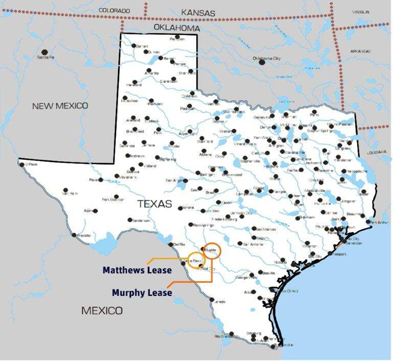
The table
below is a glossary of terms and abbreviations that may be used in this
Item.
GLOSSARY
OF TERMS
|
Natural
Gas
|
Mcf
|
1,000
cubic feet
|
||
|
MMcf
|
1,000,000
cubic feet
|
|||
|
Mcf/d
|
1,000
cubic feet per day
|
|||
|
Oil
and Natural Gas Liquids
|
Bbl
|
Barrel
|
||
|
Mbbls
|
1,000
barrels
|
|||
|
Blpd
|
Barrels
of liquid per day
|
|||
|
Boe
|
Barrel
of oil equivalent (1)
|
|||
|
Bpd
|
Barrels
per day
|
|||
|
Boepd
|
Barrels
of oil equivalent per day
|
|||
|
Bopd
|
Barrels
of oil per day
|
|||
|
NGLs
|
Natural
gas liquids
|
(1)
Disclosure provided herein in respect of BOEs may be misleading, particularly if
used in isolation. A BOE conversion ratio of 6 Mcf: 1 Bbl is based on
an energy equivalency conversion method primarily applicable at the burner tip
and does not represent a value equivalency at the wellhead.
The
following table sets forth certain standard conversions between Standard
Imperial Units and the International System of Units (or metric
units).
|
To
Convert From
|
To
|
Multiply By
|
||||
|
Mcf
|
Cubic
metres
|
28.317
|
||||
|
Cubic
metres
|
Cubic
feet
|
35.494
|
||||
|
Bbls
|
Cubic
metres
|
0.159
|
||||
|
Cubic
metres
|
Bbls
|
6.289
|
||||
|
Feet
|
Metres
|
0.305
|
||||
|
Metres
|
Feet
|
3.281
|
||||
|
Miles
|
Kilometers
|
1.609
|
||||
|
Kilometers
|
Miles
|
0.621
|
||||
|
Acres
(Alberta)
|
Hectares
|
0.405
|
||||
|
Hectares
(Alberta)
|
Acres
|
2.471
|
||||
22
The
process of evaluating reserves is inherently complex. It requires
significant judgments and decisions based on available geological, geophysical,
engineering and economics data. These estimates may change
substantially as additional data from ongoing development activities and
production performance becomes available and as economic conditions impacting
oil and gas prices and costs changes. The reserve estimates contained
herein are based on current production forecasts, prices and economic
conditions. These factors and assumptions include among others (i)
historical production in the area compared with production rates from analogous
producing areas; (ii) initial production rates, (iii) production decline rates,
(iv) ultimate recovery of reserves; (v) success of future development
activities; (vi) marketability of production, (vii) effects of government
regulation; and (viii) other government levies imposed over the life of the
reserves.
As
circumstances change and additional data becomes available, reserves estimates
also change. Estimates are reviewed and revised, either upward or
downward, as warranted by the new information. Revisions are often
required for changes in well performance, prices, economic conditions and
governmental restrictions. Revisions to reserve estimates can arise
from changes in year–end prices, reservoir performance and geological conditions
or production. These revisions can be either positive or negative
(See Item 3.D. Key Information – Risk Factors).
As a
Canadian issuer, we are required under Canadian law to comply with National
Instrument 51-101 “Standards of Disclosure for Oil and Gas Activities” (NI
51-101) issued by the Canadian Securities Administrators, in all of our reserves
related disclosures. NI 51-101 mandates significant changes in the way reporting
issuers are required to determine and publicly disclose information relating to
oil and gas reserves. Under NI 51-101, proved reserves is an estimate, the
premise of which means there must be at least a ninety percent probability that
actual quantities of crude oil and natural gas proved reserves recovered will
equal or exceed the estimated proved reserves.
The
purpose of NI 51-101 is to enhance the quality, consistency, timeliness and
comparability of crude oil and natural gas activities by reporting issuers and
elevate reserves reporting to a higher level of confidence and accountability.
In the United States, registrants, including foreign private issuers like us,
are required to disclose proved reserves using the standards contained in the
United States Securities and Exchange Commission (“SEC”) Regulation S-X.
However, under certain circumstances, applicable U.S. law permits us to comply
with our own country’s law if the requirements vary. We believe that the
standards for determining proved reserves under NI 51-101 meet those set forth
under U.S. law and thus we have presented our proved reserves under NI 51-101
only.
The crude
oil and natural gas industry commonly applies a conversion factor to production
and estimated proved reserve volumes of natural gas in order to determine an
“all commodity equivalency” referred to as barrels of oil equivalent (“boe”).
The conversion factor we have applied in this Report is the current convention
used by many oil and gas companies, where six thousand cubic feet (“mcf”) is
equal to one barrel (“bbl”). A boe is based on an energy equivalency conversion
method primarily applicable at the burner tip. It may not represent equivalency
at the wellhead and may be misleading if used in isolation.
Reserve Information. The
estimate of our proved reserves on a constant-pricing basis, and their
associated net present values, have been based on the August 31, 2010, 2009 and
2008 actual posted commodity prices as determined by our qualified reserves evaluator,
Sproule Associates Limited (“Sproule”), a member of the Association of
Professional Engineers Geologists and Geophysicists of Alberta, Canada.
Appropriate adjustments have been made to account for quality and
transportation, to the constant natural gas prices, and to the constant natural
gas by-products prices to reflect historical prices received for each
area. It should not be assumed that the discounted net present value
estimated by Sproule represents the fair market value of the reserves. Where the
present value is based on constant price and cost assumptions, there is no
assurance that such price and cost assumptions will be attained and variances
could be material. At August 31, 2010, our developed properties include a 0.5%
NCOR in a natural gas well located in Haynes, Alberta, Canada which is carried
on the books at NIL and through our wholly owned subsidiary 1354166 Alberta a
5.1975% working interest in a natural gas unit located in the Botha area
Northwest, Alberta near the town of Manning, Canada. The unit is governed by a
Pooling Agreement dated December 01, 1991 (covering Natural Gas in the Debolt
formation) which contains a Right of First Refusal provision. Under a
participation agreement dated October 15, 2003, 1354166 Alberta’s working
interest is held in trust by a joint venture partner.
The table
below sets out in CDN dollars the constant prices and the exchange rate used. As
of August 31, 2010 all of our reserves were located in Alberta,
Canada.
23
|
August
31, 2010
|
Natural
Gas Alberta AECO-C
|
4.07
$/Mcf
|
||
|
Exchange
Rate:
|
0.956
$ US/$ Cdn.
|
|||
|
August
31, 2009
|
Natural
Gas Alberta AECO-C
|
2.14
$/Mcf
|
||
|
Exchange
Rate:
|
0.9132
$ US/$ Cdn
|
|||
|
August
31, 2008
|
Natural
Gas Alberta AECO-C
|
6.92
$/Mcf
|
||
|
Exchange
Rate:
|
0.9483
$US/$Cdn.
|
Proved Reserves:
The following table reflects estimates of our proved developed
reserves as at August 31, 2010, 2009, and 2008 as reported by Sproule stated in
CDN dollars. All of our gas reserves are located in Canada. The
following table represents our net interest in its reserves (after crown
royalties, freehold royalties and overriding royalties and interests owned by
others). Estimated cash flow figures before income tax are net of all
royalties, operating and capital costs and discounted at 10% to the Net Present
Value (“NPV”). NPV figures are based on constant prices.
|
Period
|
Proved Reserves
|
Natural Gas
Mmcf
|
|
Net Present Value
discounted at 10%
|
|
|||
|
August
31, 2010
|
Proved
Developed
|
152
|
$
|
110
|
||||
|
August
31, 2009
|
Proved
Developed
|
29
|
$
|
Nil
|
||||
|
August
31, 2008
|
Proved
Developed
|
Nil
|
$
|
256
|
||||
Production Volume:
The following table sets forth the net quantities of natural gas
produced during the fiscal years ended August 31, 2010, 2009 and
2008.
|
August 31,
|
2010
|
|
|
2009
|
|
2008
|
|
|
Natural
Gas (Mcf)
|
24,941
|
16,412
|
37
|
Historical Production:
The following table sets out our net share of production, average
sales prices, average royalties, production costs and average net back per unit
of production for the fiscal years ended August 31, 2010, 2009 and
2008.
|
|
For the Years Ended
|
|||||||||||
|
Historical Production
|
August 31, 2010
|
August 31, 2009
|
August 31, 2008
|
|||||||||
|
Natural
Gas – Mcf/d
|
68 | 45 | l |
Nil
|
||||||||
|
Natural
Gas Prices- $/Mcf
|
$ | 4.42 | $ | 3.42 | $ | 9.23 | ||||||
|
Royalty
Costs - $/Mcf
|
0.98 | 0.63 |
Nil
|
|||||||||
|
Production
Costs - $/Mcf
|
2.62 | 3.28 | l |
Nil
|
||||||||
|
Net
Back - $/Mcf
|
$ | 0.62 | $ | (0.49 | ) | $ | 9.23 | |||||
Producing Wells:
The following table sets forth the number of our gross and net oil
and natural gas wells and the number of gross and net non-producing oil and
natural gas wells that we have an interest in by location as of August 31, 2010,
2009 and 2008. A gross well is a well in which we own an
interest. A net well represents the fractional interest we own in
gross wells. For the fiscal years ended August 31, 2010, 2009 and 2008 we held a
0.5% NCOR in a natural gas well located in Haynes, Alberta, Canada and through
our wholly owned subsidiary, 1354166 Alberta a 5.1975% working interest in a
natural gas unit located in the Botha area Northwest, Alberta near the town of
Manning, Canada.
The
following table sets out the number of gross and net producing oil and natural
gas wells and the number of gross and net non-producing oil and natural gas
wells that we have an interest in by location.
|
Location-
Alberta,
Canada
|
Gross Producing
Gas Wells
|
Net Producing
Gas Wells
|
Gross Non-Producing
Gas Wells
|
Net Non-Producing
Gas Wells
|
||||||||||||
|
2010
|
3 | 5.1975 | 6 | 5.1975 | ||||||||||||
|
2009
|
3 | 5.1975 | 6 | 5.1975 | ||||||||||||
|
2008
|
Nil
|
Nil
|
Nil
|
Nil
|
||||||||||||
24
Acreage. The following table
sets forth the developed and undeveloped acreage of the projects in which the
Company holds an interest, on a gross and a net basis as of August 31, 2010,
2009 and 2008. The developed acreage is stated on the basis of spacing units
designated by provincial authorities and typically on the basis of 160 acre
spacing unit for oil production and 640 acre spacing unit for gas production in
Alberta. Our developed acreage is located in Alberta, Canada. Our
undeveloped acreage is located in Zavala County, Texas.
|
August 31,
|
2010
|
|
2009
|
|
2008
|
|
||||||||||
|
|
Gross
|
|
|
Net
|
|
Gross
|
|
|
Net
|
|
Gross
|
|
|
Net
|
|
|
|
Developed
Acreage, Canada
|
8,320
|
432
|
8,320
|
432
|
Nil
|
Nil
|
||||||||||
|
Undeveloped
Acreage, USA
|
5,266
|
4,872
|
Nil
|
Nil
|
Nil
|
Nil
|
||||||||||
Reserve Reconciliation:
The following table sets forth a reconciliation of the changes in
our associated and non-associated gas (MMcf) reserves as at August 31, 2010
against such reserves as at August 31, 2009.
|
|
ASSOCIATED AND NON-ASSOCIATED
GAS
|
|||||||||||
|
|
Net Proved
(MMcf)
|
Net
Probable
(MMcf)
|
Net Proved
Plus
Probable
(MMcf)
|
|||||||||
|
At
August 31, 2009
|
248 | 91 | 339 | |||||||||
|
Technical
Revisions
|
(10 | ) | (22 | ) | (32 | ) | ||||||
|
Production
|
(25 | ) | - | (25 | ) | |||||||
|
At
August 31, 2010
|
213 | 69 | 282 | |||||||||
Production Estimates:
The following table indicates the volume of production estimated for
the year ending August 31, 2011 reflected in the estimates of future net revenue
based on constant prices and costs.
|
Property
|
|
Associated and Non-Associated Gas
(MMcf)
|
|
Botha,
Alberta
|
16
|
Additional Information Concerning
Abandonment and Reclamation Costs:
We base our estimates for
costs of abandonment and reclamation of surface leases and wells on previous
experience with similar well site locations and area terrain. We believe that
our range of estimates at $30,000 gross per well for abandonment and reclamation
costs are reasonable and applicable to its wells. Our independent
qualified reserves evaluator has also estimated similar costs in deriving our
estimate of future net revenue. Ultimately all wells in the natural gas unit
will require abandonment and reclamation. The total of such costs
estimated for 5.1975 net wells for the fiscal year ended August 31, 2010 was
$8,568 and $2,568 calculated using a discount rate of 10% percent. We do
not expect to pay abandonment and reclamation costs over the next 3 fiscal
years.
Present Activities, Results of
Exploration and Drilling:
During
August 2010, through Dyami Energy, we commenced operations to drill an initial
Eagle Ford shale test well on the Matthews Lease in Zavala County, Texas. The
well was spud on October 15, 2010 and was drilled to a measured depth of 8,563,
feet which includes a 3,300 foot “in section” lateral into the Eagle Ford shale
formation. A shot point sleeve was installed in the Eagle Ford shale formation
to protect the well bore and facilitate a multi stage frac
completion.
The well
was logged extensively and 36 sidewall cores were taken from 4 key formations in
descending order, the San Miguel, the Austin Chalk, the Eagle Ford and the Buda.
The logs were interpreted by Weatherford International Ltd and the sidewall
cores were analyzed by Core Laboratories and Weatherford and based on the
results we are is formulating a detailed frac design and completion
plan for the Dyami/Matthews #1 H well.
For the
three months ended November 30, 2010 we incurred $1,627,606 in expenditures
related to the Matthews/Dyami #1H well.
25
On
January 20, 2011 we spud the initial well, the Murphy/Dyami 1-H, on our 100%
working interest Murphy Lease comprising 2,637 acres of land in Zavala County,
Texas. The well was drilled vertically to a depth of 4,588 feet
through the Eagle Ford shale to the Buda formation and logged by Weatherford
International. Core samples were recovered from the Georgetown, Buda, Eagle Ford
Shale, Serpentine and the Escondido formations for interpretation and
analysis.
Governmental Regulation/Environmental
Issues: Our oil and gas operations are subject to various
Canadian and US governmental regulations. Matters subject to regulation include
discharge permits for drilling operations, drilling and abandonment bonds,
reports concerning operations, the spacing of wells, and pooling of properties
and taxation. From time to time, regulatory agencies have imposed price controls
and limitations on production by restricting the rate of flow of oil and gas
wells below actual production capacity in order to conserve supplies of oil and
gas. The production, handling, storage, transportation and disposal of oil and
gas, by-products thereof, and other substances and materials produced or used in
connection with oil and gas operations are also subject to regulation under
federal, state, provincial and local laws and regulations relating primarily to
the protection of human health and the environment. To date, expenditures
related to complying with these laws, and for remediation of existing
environmental contamination, have not been significant in relation to the
results of operations of our company. The requirements imposed by such laws and
regulations are frequently changed and subject to interpretation, and we are
unable to predict the ultimate cost of compliance with these requirements or
their effect on our operations (See, Item 3.D Key Information - Risk
Factors).
ITEM 4A UNRESOLVED STAFF
COMMENTS
Not
Applicable
ITEM 5 OPERATING AND FINANCIAL REVIEW AND
PROSPECTS
The
following discussion should be read in conjunction with our “Selected Financial
Data” under Item 3 above, our Audited Consolidated Financial Statements for the
fiscal years ended August 31, 2010, 2009 and 2008 and notes thereto included
under “Item 17”. Unless otherwise indicated, discussion under this Item is based
on Canadian dollars and is presented in accordance with Canadian Generally
Accepted Accounting Principles (“GAAP”). For reference to differences
between Canadian GAAP and United States Generally Accepted Accounting Principles
(“US GAAP”) see Note 17 to our Audited Consolidated Financial Statements for the
fiscal years ended August 31, 2010 and 2009.
Certain
measures in this discussion and analysis do not have any standardized meaning as
prescribed by Canadian generally accepted accounting principles such as netback
and other production figures and therefore are considered non-GAAP measures.
Therefore these measures may not be comparable to similar measures presented by
other issuers. These measures have been described and presented in order to
provide shareholders and potential investors with additional information
regarding the Company’s liquidity and its ability to generate funds to finance
its operations.
Certain
statements made in this Item are forward-looking statements under the Reform
Act. Forward- looking statements are based on current expectations
that involve a numbers of risks and uncertainties, which could cause actual
events or results to differ materially from those reflected herein. See, Item
3.D Key Information - Risk Factors for discussion of important factors, which
could cause results to differ materially from the forward- looking statements
below.
Overview
Eagleford
Energy Inc. is incorporated under the laws of the Province of Ontario, and is
registered as an extra-provincial company in Alberta. We are a
reporting issuer with the United States Securities and Exchange Commission and
our common shares trade on the Over-the-Counter Bulletin Board (OTCBB) under the
symbol EFRDF.
Our
operations consist of a 0.5% Non Convertible Overriding Royalty in a natural gas
well located in Haynes, Alberta, Canada a 5.1975% working interest in a natural
gas unit located in Alberta, Canada, an 85% working interest before payout (69%
working interest after payout) in Matthews lease comprising 2,629 gross acres of
land in Zavala County, Texas. In addition, we hold a 100% working interest in
the Murphy lease comprising approximately 2,637 acres of land in Zavala County,
Texas subject to a 10% carried interest on the drilling costs from surface to
base of the Austin Chalk formation, and a 3% carried interest on the drilling
costs from the top of the Eagle Ford shale formation to basement on the first
well drilled into a serpentine plug and for the first well drilled into a second
serpentine plug, if discovered..
26
We also
holds a 0.3% net smelter return royalty on eight mining claims located in Red
Lake Ontario which is carried on the Consolidated Balance Sheets at
$Nil.
Our
Audited Consolidated Financial Statements for the year ended August 31, 2010 and
2009 include the accounts of the Company, and our wholly owned subsidiaries
1354166 Alberta Ltd. from the date of acquisition, February 27, 2009 and Dyami
Energy from the date of acquisition August 31, 2010.
On
November 12, 2009, our wholly owned subsidiary 1406768 Ontario Inc. changed its
name to Eagleford Energy Inc. On November 30, 2009 we amalgamated with Eagleford
Energy Inc. and upon the amalgamation our new name became Eagleford Energy
Inc.
Financial
Instruments and Risk Factors
We are
exposed to financial risk, in a range of financial instruments including cash,
accounts receivable and accounts payable and income taxes payable and loans
payable. We manage our exposure to financial risks by operating in a manner that
minimizes our exposure to the extent practical.
The main
financial risks affecting us are discussed below.
The fair
value of financial instruments at August 31, 2010 and 2009 is summarized as
follows:
|
2010
|
2009
|
|||||||||||||||
|
Amount
|
Fair Value
|
Amount
|
Fair Value
|
|||||||||||||
|
Financial
assets
|
||||||||||||||||
|
Held
for trading
|
||||||||||||||||
|
Cash
and cash equivalents
|
$ | 43,776 | $ | 43,776 | $ | 172,905 | $ | 172,905 | ||||||||
|
Loans
and receivables
|
||||||||||||||||
|
Accounts
receivable
|
$ | 53,060 | $ | 53,060 | $ | 20,421 | $ | 20,421 | ||||||||
|
Related
party receivable
|
$ | 1,325 | $ | 1,325 | - | - | ||||||||||
|
Financial
liabilities
|
||||||||||||||||
|
Accounts
payable
|
$ | 488,741 | $ | 488,741 | $ | 152,984 | $ | 152,984 | ||||||||
|
Income
taxes payable
|
$ | - | $ | - | $ | 10,215 | $ | 10,215 | ||||||||
|
Loans
payable
|
$ | 110,000 | $ | 110,000 | $ | 167,500 | $ | 167,500 | ||||||||
|
Due
to shareholder
|
$ | 57,500 | $ | 57,500 | $ | - | $ | - | ||||||||
|
Secured
notes payable
|
$ | 1,207,527 | $ | 1,145,289 | $ | - | $ | - | ||||||||
Credit
Risk
Credit
risk is the risk of a financial loss to the Company if a customer or
counterparty to a financial instrument fails to meet its contractual obligation
and arises principally from joint venture partners and natural gas and oil
marketers. We are exposed to credit risk in respect to its cash and cash
equivalents and accounts receivable.
Cash and
cash equivalents are held in operating accounts with highly rated Canadian banks
and therefore the Company considers these assets to have negligible credit
risk.
Receivables
from petroleum and natural gas marketers are normally collected on the 25th day of
the month following production. The Company historically has not experienced any
collection issues with its petroleum and natural gas marketers. Joint venture
receivables are typically collected in one to three months of the joint venture
bill being issued to the partner. The Company attempts to mitigate the risk from
joint venture receivables by obtaining partner approval of significant capital
expenditures prior to the expenditure. However, the receivables are from
participants in the petroleum and natural gas sector, and collection of the
outstanding balances is dependent on industry factors such as commodity price
fluctuations, escalating costs and the risk of unsuccessful drilling. In
addition, a further risk exists with joint venture partners, such as
disagreements, that increase the potential for non-collection. The Company does
not typically obtain collateral from petroleum and natural gas marketers or
joint venture partners; however, the Company does have the ability to withhold
information and production from joint venture partners in the event of
non-payment.
27
As at
August 31, 2010 our accounts receivable was $53,060 (2009 $20,421) of which
$23,935 is due from government agencies (2009 $14,303), $5,797 is due from a gas
marketer (2009 $6,118) $15,391 is due from a joint venture partner (2009 $Nil)
and the balance of $7,937 is due from other trade receivables.
The
carrying amount of cash and cash equivalents and accounts receivable represents
our maximum credit exposure.
As at
August 31, 2010 our accounts receivable is aged as follows:
|
Current
(less than 90 days)
|
$ | 36,789 | ||
|
Past
due (more than 90 days)
|
16,271 | |||
|
Total
|
$ | 53,060 |
Liquidity
Risk
Liquidity
risk includes the risk that, as a result of our operational liquidity
requirements:
|
|
-
|
We
will not have sufficient funds to settle their obligations or other
transactions on the date they come
due;
|
|
|
-
|
We
will be forced to sell financial assets at a value which is less than what
they are worth; or
|
|
|
-
|
We
may be unable to settle or recover a financial asset at
all.
|
Our
operating cash requirements including amounts projected to complete our existing
capital expenditure program are continuously monitored and adjusted as input
variables change. These variables include but are not limited to, shareholder
loans, oil and natural gas production from existing wells, results from new
wells drilled, commodity prices, cost overruns on capital projects and
regulations relating to prices, taxes, royalties, land tenure, allowable
production and availability of markets. These variables create liquidity risk
which has necessitated the need to raise financing to meet capital and operating
cash-flow needs. Our has liquidity risk necessitates the our need to obtain debt
financing, enter into joint venture arrangements, or raise equity. There is no
assurance we will be able to obtain the necessary financing in a timely
manner.
The
following table illustrates our contractual maturities of financial liabilities
as at August 31, 2010.
|
Payments Due by Period
|
||||||||||||||||||||
|
Total
|
Less than
1 year
|
1-3 years
|
4-5 years
|
After
5 years
|
||||||||||||||||
|
Accounts
payable
|
$ | 488,741 | $ | 488,741 | - | - | - | |||||||||||||
|
Loan
payable
|
110,000 | 110,000 | - | - | - | |||||||||||||||
|
Secured
notes payable (1)
|
1,207,527 | 186,183 | $ | 1,021,344 | - | - | ||||||||||||||
|
Due
to shareholder
|
57,500 | 57,500 | - | - | - | |||||||||||||||
|
Asset
retirement obligation
|
3,907 | - | - | - | $ | 3,907 | ||||||||||||||
|
Total
contractual obligations
|
$ | 1,867,675 | $ | 842,424 | $ | 1,021,344 | - | $ | 3,907 | |||||||||||
|
|
(1)
|
Translated
at current exchange rate.
|
Capital
Management
Our
objective when managing capital is to safeguard our ability to continue as a
going concern. We set the amount of capital in proportion to risk. We manage the
capital structure and makes adjustments to it in light of changes in economic
conditions and the risk characteristics of any underlying assets. In order to
maintain or adjust capital structure we may from time to time issue equity,
issue debt, adjust its capital spending and sell assets to manage current and
projected debt levels Our board of directors does not establish quantitative
return on capital criteria for management, but rather relies on the expertise of
our management to sustain future development of the business.
As at
August 31, 2010, our capital structure included the following:
28
|
2010
|
2009
|
|||||||
|
Shareholders’
equity
|
$ | 4,239,777 | $ | 265,994 | ||||
|
Long
term debt
|
(1,025,251 | ) | (3,634 | ) | ||||
|
Working
capital deficiency
|
(744,262 | ) | (137,372 | ) | ||||
| $ | 2,470,264 | $ | 124,988 | |||||
Management
reviews its capital management approach on an ongoing basis and believes that
this approach, given our relative size, is reasonable.
There
were no changes in our capital management during the year ended August 31,
2010.
We are
not subjected to any externally imposed capital requirements.
Critical
Accounting Policies and Estimates and Change in Accounting Policies and Initial
Adoption
Our
significant accounting policies, estimates and changes to accounting policies
are also described in the Notes to the Audited Consolidated Financial
Statements for the fiscal years ended August 31, 2010, 2009, and 2008 (See Item
17 – Financial Statements). It is increasingly important to understand that the
application of generally accepted accounting principles involves certain
assumptions, judgments and estimates that affect reported amounts of assets,
liabilities, revenues and expenses. The application of principles can cause
varying results from company to company.
The most
significant accounting policies that impact us relate to oil and gas accounting
and reserve estimates.
Our
consolidated financial statements have been prepared in accordance with
accounting principles generally accepted in Canada. The preparation
of our consolidated financial statements in accordance with US GAAP have
resulted in differences to the consolidated balance sheet and the consolidated
statement of loss, comprehensive loss and deficit from the consolidated
financial statements prepared using Canadian GAAP (see Reconciliation to
Accounting Principles Generally Accepted in the United States
below).
Critical
Accounting Policies and Estimates
Going
Concern
Our
consolidated financial statements have been prepared on a going concern basis
which contemplates the realization of assets and the payment of liabilities in
the ordinary course of business. The Company plans to obtain additional
financing by way of debt or the issuance of common shares or some other means to
service its current working capital requirements, any additional or unforeseen
obligations or to implement any future opportunities. Should the Company be
unable to continue as a going concern, it may be unable to realize the carrying
value of its assets and to meet its liabilities as they become due. These
consolidated financial statements do not include any adjustments for this
uncertainty.
The
Company has accumulated significant losses and negative cash flows from
operations in recent years which raises doubt as to the validity of the going
concern assumption. As at August 31, 2010, the Company had a working capital
deficiency of $744,262 and an accumulated deficit of $1,717,235. Management of
the Company does not have sufficient funds to meet its liabilities for the
ensuing twelve months as they fall due. In assessing whether the going concern
assumption is appropriate, management takes into account all available
information about the future, which is at least, but not limited to, twelve
months from the end of the reporting period. The Company's ability to continue
operations and fund its liabilities is dependent on management's ability to
secure additional financing and cash flow. Management is pursuing such
additional sources of financing and cash flow to fund its operations and while
it has been successful in doing so in the past, there can be no assurance it
will be able to do so in the future. Management is aware, in making its
assessment, of material uncertainties related to events or conditions that may
cast significant doubt upon the Company's ability to continue as a going
concern. Accordingly, they do not give effect to adjustments that would be
necessary should the Company be unable to continue as a going concern and
therefore realize its assets and liquidate its liabilities and commitments in
other than the normal course of business and at amounts different from those in
the accompanying consolidated financial statements.
29
Principles
of Consolidation
On
November 12, 2009, the Company’s wholly owned subsidiary 1406768 Ontario Inc.
changed its name to Eagleford Energy Inc. On November 30, 2009 the Company
amalgamated with Eagleford Energy Inc. and upon the amalgamation the entity's
new name is Eagleford Energy Inc. The consolidated financial statements include
the accounts of Eagleford, the legal parent, together with its wholly-owned
subsidiaries, 1354166 Alberta Ltd. an Alberta operating company and Dyami Energy
LLC a Texas limited liability exploration stage company. All inter-company
accounts transactions have been eliminated on consolidation.
Oil
and Gas Interests
The
Company follows the successful efforts method of accounting for its oil and gas
interest. Under this method, costs related to the acquisition,
exploration, and development of oil and gas interests are capitalized. The
Company carries as an asset, exploratory well costs if a) the well found a
sufficient quantity of reserves to justify its completion as a producing well
and b) the Company is making sufficient progress assessing the reserves and the
economic and operating viability of the project. If a property is not productive
or commercially viable, its costs are written off to
operations. Impairment of non-producing properties is assessed based
on management's expectations of the properties.
Depletion
and Depreciation
Depletion
of petroleum and natural gas properties and depreciation of production equipment
are calculated on the unit of production basis based on:
|
|
(a)
|
total
estimated proved reserves calculated in accordance with National
Instrument 51-101, Standards of Disclosure for Oil and Gas
Activities;
|
|
|
(b)
|
total
capitalized costs, excluding undeveloped lands and unproved costs, plus
estimated future development costs of proved undeveloped reserves;
and
|
|
|
(c)
|
relative
volumes of petroleum and natural gas reserves and production, before
royalties, converted at the energy equivalent conversion ratio of six
thousand cubic feet of natural gas to one barrel of
oil.
|
Impairment
Test
The
Company performs a impairment test calculation in accordance with the Canadian
Institute of Chartered Accountants’ successful efforts method guidelines,
including an impairment test on undeveloped properties. The recovery of costs is
tested by comparing the carrying amount of the oil and natural gas assets to the
reserves report. If the carrying amount exceeds the recoverable amount, then
impairment would be recognized on the amount by which the carrying amount of the
assets exceeds the present value of expected cash flows using proved plus
probable reserves and expected future prices and costs. At August 31, 2010 the
Company recorded an impairment of $54,630 (2009 - $105,805).
Revenue
Recognition
Revenues
associated with the sale of crude oil and natural gas are recorded when the
title passes to the customer. The customer has assumed the risks and rewards of
ownership, prices are fixed or determinable and collectability is reasonably
assured. The
Company does not enter into ongoing arrangements whereby it is required to
repurchase its products, nor does the Company provide the customer with a right
of return.
Royalties
As is
normal to the industry, the Company's future production is subject to crown
royalties. These amounts are reported net of related tax
credits.
Transportation
Costs
paid by the Company for the transportation of natural gas, crude oil and natural
gas liquids from the wellhead to the point of title transfer are recognized when
the transportation is provided.
30
Environmental and Site
Restoration Costs
The
Company recognizes an estimate of the liability associated with an asset
retirement obligation (“ARO”) in the financial statements at the time the
liability is incurred. The estimated fair value of the ARO is recorded as a
long-term liability with a corresponding increase in the carrying amount of the
related asset. The capitalized amount is depleted on a straight-line basis over
the estimated life of the asset. The liability amount is increased each
reporting period due to the passage of time and the amount of accretion to
operations in the period. The ARO can also increase or decrease due to changes
in the estimates of timing of cash flows or changes in the original estimated
undiscounted cost. Actual costs incurred upon settlement of the ARO are charged
against the ARO to the extent of the liability recorded.
Foreign
Currencies
Assets
and liabilities denominated in currencies other than Canadian dollars are
translated at exchange rates in effect at the balance sheet date. Revenue and
expense items are translated at the average rates of exchange for the year.
Exchange gains and losses are included in the determination of net income for
the year
Marketable
Securities
At each
financial reporting period, the Company estimates the fair value of investments
which are held-for-trading, based on quoted closing bid prices at the
consolidated balance sheet dates or the closing bid price on the last day the
security traded if there were no trades at the consolidated balance sheet dates
and such valuations are reflected in the consolidated financial statements. The
resulting values for unlisted securities whether of public or private issuers,
may not be reflective of the proceeds that could be realized by the Company upon
their disposition. The fair value of the securities at August 31, 2010 was $1
(2009 - $1)
Financial
Instruments
All
financial instruments are recorded initially at estimated fair value on the
balance sheet and classified into one of five categories: held for trading, held
to maturity, available for sale, loans and receivables and other liabilities.
Cash and cash equivalents, and investments are classified as held for trading
and measured at estimated fair value. Accounts receivable and due from related
party are classified as loans and receivables and measured at amortized cost.
Accounts payable, loan payable, Due to shareholder and Secured notes payable are
classified as other liabilities and measured at amortized cost.
The
Company does not enter into derivative contracts (commodity price, interest rate
or foreign currency) in order to manage risk. The Company does not utilize
derivative contracts for speculative purposes, has not designated any derivative
contracts as hedges, and has not recorded any assets or liabilities as a result
of embedded derivatives.
The
estimated fair value of cash and cash equivalents, accounts receivable and
accounts payable approximate their carrying amounts due to their short terms to
maturity.
Cash
and cash equivalents
Cash and
cash equivalents include bank accounts, trust accounts, and term deposits with
maturities of less than three months.
Accounting
Estimates
The
preparation of the consolidated financial statements in conformity with Canadian
generally accepted accounting principles requires management to make estimates
and assumptions that affect the reported amounts of assets, liabilities, and the
disclosures of revenues and expenses for the reported year. Actual
results may differ from those estimates.
The
amounts recorded for depletion and amortization of oil and gas properties and
the valuation of these properties, are based on estimates of proved and probable
reserves, production rates, oil and gas prices, future costs and other relevant
assumptions. The effect on the consolidated financial statements of
changes in estimates in future periods could be significant.
31
Income
Taxes
The
Company accounts for income taxes under the asset and liability
method. Under this method, future income tax assets and liabilities
are recognized for the future tax consequences attributable to differences
between financial reporting and tax bases of assets and liabilities and
available loss carry forwards and are measured using the substantively enacted
tax rates and laws that will be in effect when the differences are expected to
be reversed. A valuation allowance is established to reduce tax
assets if it is more likely than not that all or some portions of such tax
assets will not be realized.
Non-Monetary
Transactions
Transactions
in which shares or other non-cash consideration are exchanged for assets or
services are measured at the fair value of the assets or services involved in
accordance with Section 3831 (“Non-monetary Transactions”) of the Canadian
Institute of Chartered Accountants Handbook (“CICA Handbook”).
Stock-Based
Compensation
The
Company has a stock-based compensation plan. Any consideration
received on the exercise of stock options or sale of stock is credited to share
capital. The Company records compensation expense and credits contributed
surplus for all stock options granted. Stock options granted during the year are
accounted for in accordance with the fair value method of accounting for
stock-based compensation. The fair value for these options is estimated at the
date of grant using the Black-Scholes option pricing model.
Loss
Per Share
Basic
loss per share is calculated by dividing the loss for the year by the weighted
average number of common shares outstanding during the year. Diluted loss per
share is computed using the treasury stock method. Under this method, the
diluted weighted average number of shares is calculated assuming the proceeds
that arise from the exercise of stock options and other dilutive instruments are
used to repurchase the Company’s shares at their weighted average market price
for the period.
Warrants
When the
Company issues units under a private placement comprising common shares and
warrants, the Company follows the relative fair value method of accounting for
warrants attached to and issued with common shares of the Company. Under this
method, the fair value of warrants issued is estimated using a Black-Scholes
option price model. The fair value is then related to the total of the net
proceeds received on issuance of the common shares and the fair value of the
warrants issued therewith. The resultant relative fair value is allocated to
warrants from the net proceeds and the balance of the net proceeds is allocated
to the common shares issued.
Change
in Accounting Policy and Future Accounting Changes
(a) EIC
Credit Risk
In
January 2009, the CICA’s EIC concluded that an entity’s own credit risk and the
credit risk of the counterparty should be taken into account in determining the
fair value of financial assets and financial liabilities, including derivative
instruments. The application of incorporating credit risk into the fair value
should result in entities re-measuring the financial assets and financial
liabilities as at the beginning of the period of adoption. This abstract should
be applied retrospectively without restatement of prior periods to all financial
assets and liabilities measured at fair value in interim and annual financial
statements for periods ending on or after January 20, 2009. Retrospective
application with restatement of prior periods is also permitted. The adoption of
this standard did not impact the financial position or results of operations of
the Company.
(b)
Financial Instruments – Disclosures
In June
2009, the Canadian Accounting Standards Board (“AcSB”) issued the amendments to
CICA Handbook Section 3862, Financial Instruments - Disclosures, which reflect
the corresponding amendments made by the International Accounting Standards
Board to IFRS 7, Financial Instruments: Disclosures, in March 2009. The
amendments require that all financial instruments measured at fair value be
presented into one of the three hierarchy levels set forth below for disclosure
purposes (see note 5). Each level is based on the transparency of the inputs
used to measure the fair value of assets and liabilities.
32
|
|
(i)
|
Level
1: Inputs are unadjusted quoted prices of identical instruments in active
markets.
|
|
|
(ii)
|
Level
2: Valuation models which utilize predominately observable market
inputs.
|
|
|
(iii)
|
Level
3: Valuation models which utilize predominately non-observable market
inputs.
|
The
classification of a financial instrument in the hierarchy is based upon the
lowest level of input that is significant to the measurement of fair value. The
amendments to Section 3862 also require additional disclosure relating to the
liquidity risk associated with financial instruments (see note 14). The
amendments improve disclosure of financial instruments specifically as it
relates to fair value measurements and liquidity risk. The adoption of the
amendments did not impact the Company’s financial position or results of
operations.
(c)
Goodwill and Intangible Assets
During
fiscal 2010 the Company adopted Section 3064, “Goodwill and Intangible Assets”.
This section replaces Section 3062, “Goodwill and Other Intangible Assets” and
Section 3450, “Research and Development Costs”. Various changes have made to
other sections of the CICA Handbook for consistency purposes. Section 3064
establishes standards for the recognition, measurement, presentation and
disclosure of goodwill subsequent to its initial recognition and of intangible
assets by profit-oriented enterprises. Standards concerning goodwill are
unchanged from the standards included in the previous Section 3062. The adoption
of this standard did not have an impact on the Company’s financial
statements.
(d)
General Standard of Financial Statement Presentation
During
fiscal 2010, the Company adopted amended Section 1400, “General Standard of
Financial Statement Presentation” which includes requirements to assess and
disclose the Company’s ability to continue as a going concern. The adoption of
this new section did not have an impact on the Company’s financial
statements.
(e)
Future Accounting Changes
Business
Combinations, Consolidated Financial Statements and Non-controlling Interests –
The CICA issued three new accounting standards in January 2009: section 1582,
Business Combinations,
section 1601, Consolidated
Financial Statements, and section 1602, Non-controlling interests.
These new standards will be effective for fiscal years beginning on or after
January 1, 2011. The Company is in the process of evaluating the requirements of
the new standards.
Section
1582 replaces section 1581, and establishes standards for the accounting for a
business combination. It provides the Canadian equivalent to International
Financial Reporting Standard IFRS 3 – Business Combinations. The section
applies prospectively to business combinations for which the acquisition date is
on or after the beginning of the first annual reporting period beginning on or
after January 1, 2011.
Sections
1601 and 1602 together replace 1600 – Consolidated Financial Statements.
Section 1601, establishes standards for the preparation of consolidated
financial statements. Section 1601 applies to interim and annual consolidated
financial statements relating to fiscal years beginning on or after January 1,
2011.
Section
1602 establishes standards for accounting for a non-controlling interest in a
subsidiary in consolidated financial statements subsequent to a business
combination. It is equivalent to the corresponding provisions of International
Financial Reporting Standard IAS 27 - Consolidated and Separate Financial
Statements and applies to interim and annual consolidated financial
statements relating to fiscal years beginning on or after January 1,
2011.
In
December 2009, the CICA issued EIC 175 – “Multiple Deliverable Revenue
Arrangements” replacing EIC 142 – “Revenue Arrangements with Multiple
Deliverables”. This abstract was amended to: (1) provide updated guidance on
whether multiple deliverables exist, how the deliverables in an arrangement
should be separated, and the consideration allocated; (2) require, in situations
where a vendor does not have vendor-specific objective evidence (“VSOE”) or
third-party evidence of selling price, that the entity allocate revenue in an
arrangement using estimated selling prices of deliverables; (3) eliminate the
use of the residual method and require an entity to allocate revenue using the
relative selling price method; and (4) require expanded qualitative and
quantitative disclosures regarding significant judgments made in applying this
guidance. The accounting changes summarized in EIC 175 are effective for fiscal
periods beginning on or after January 1, 2011, with early adoption permitted.
Adoption may either be on a prospective basis or by retrospective application.
If the Abstract is adopted early, in a reporting period that is not the first
reporting period in the entity’s fiscal period, it must be applied
retrospectively from the beginning of the Company’s fiscal period of adoption.
The Company expects to adopt EIC 175 effective January 1, 2011. The Company does
not believe the standard will have a material impact on its consolidated
financial statements.
33
In
February 2008, the Accounting Standards Board “(AcSB)” confirmed that the use of
IFRS will be required in 2011 for publicly accountable enterprises in Canada. In
April 2008, the AcSB issued an IFRS Omnibus Exposure Draft proposing that
publicly accountable enterprises be required to apply IFRS, in full and without
modification, for fiscal years beginning on or after January 1, 2011. The
Company will issue its initial audited consolidated financial statements under
IFRS including comparative information for the year ending August 31,
2011.
The
eventual changeover to IFRS represents changes due to new accounting standards.
The transition from current Canadian GAAP to IFRS is a significant undertaking
that may materially affect the Company's reported financial position and results
of operations.
The
Company is assessing the potential impacts of this changeover and is developing
its IFRS changeover plan, which will include project structure and governance,
resourcing and training, analysis of key GAAP differences and a phased plan to
assess accounting policies under IFRS as well as potential exemptions to the
initial adoption of IFRS as permitted by IFRS Statement 1.
RECONCILIATION
TO ACCOUNTING PRINCIPLES GENERALLY ACCEPTED IN THE UNITED STATES
Our
accounting policies do not differ materially from accounting principles
generally accepted in the United States ("US GAAP") except for the
following:
Oil and
Gas Interests
In
applying the successful efforts method under US GAAP (Regulation S-X Article
4-10), the Company performs a ceiling test based on the same calculations used
for Canadian GAAP except the Company is required to discount future net revenues
from proved reserves at 10% as opposed to utilizing the fair market value and
probable reserves are excluded. During the year an impairment loss of
$104,630 (2009 - $179,443) for US GAAP and an impairment loss
of $54,630 (2009- $105,805) was recorded for Canadian GAAP.
If US
GAAP was followed, the effect on the consolidated balance sheet would be as
follows:
|
2010
|
2009
|
|||||||
|
Total
assets according to Canadian GAAP
|
$ | 6,107,452 | $ | 600,327 | ||||
|
Additional
impairment of oil and gas interests
|
(50,000 | ) | (73,638 | ) | ||||
|
Total
assets according to US GAAP
|
$ | 6,057,452 | $ | 526,689 | ||||
|
2010
|
2009
|
|||||||
|
Total
shareholders’ equity according to Canadian GAAP
|
4,239,777 | $ | 265,994 | |||||
|
Deficit
adjustment per US GAAP
|
||||||||
|
Additional
impairment of oil and gas interests
|
(50,000 | ) | (73,638 | ) | ||||
|
Total
shareholders’ equity according to US GAAP
|
$ | 4,189,777 | $ | 192,356 | ||||
|
If
US GAAP was followed, the effect on the consolidated statements of loss
and comprehensive loss would be as
follows:
|
|
2010
|
2009
|
2008
|
||||||||||
|
Net
loss, comprehensive loss according to Canadian GAAP
|
688,709 | $ | 328,861 | $ | 50,514 | |||||||
|
Add: Additional
impairment of oil and gas interests
|
50,000 | 73,638 | - | |||||||||
|
Net
loss, comprehensive loss according to US GAAP
|
$ | 738,709 | $ | 402,499 | $ | 50,514 | ||||||
|
Loss
per share, basic and diluted
|
$ | (0.030 | ) | $ | (0.023 | ) | $ | (0.006 | ) | |||
|
Shares
used in the computation of loss per share
|
24,687,130 | 17,646,295 | 7,955,482 | |||||||||
34
DIFFERENCES
BETWEEN CANADIAN AND UNITED STATES GENERALLY ACCEPTED ACCOUNTING
PRINCIPLES
Adoption
of New Accounting Policies
Financial
Accounting Standards Board’s Codification of US GAAP
On July
1, 2009, the FASB’s Codification of US GAAP (the “Codification”) was issued to
create a consolidated reference source for all authoritative non-governmental US
GAAP. The Codification was not intended to change US GAAP, but rather reorganize
existing guidance by accounting topic to allow easier identification of
applicable standards. References in the Company’s consolidated financial
statements to US GAAP have been updated to reflect the
Codification.
Business
combinations
In
December 2007, the FASB issued ASC 805 — Business Combinations (“ASC 805”)
(formerly referred to as FAS 141R) which is effective for fiscal years beginning
after December 15, 2008. ASC 805, which will replace FAS 141, is applicable to
business combinations consummated after the effective date of December 15, 2008.
This Standard modifies the accounting of certain aspects of business
combinations. The adoption of ASC 805 did not have a material impact on the
Company’s consolidated financial statements.
Non-controlling
interests
In
December 2007, the FASB also issued ASC 810 - Non-controlling Interests in
Consolidated Financial Statements (“ASC 810”). ASC 810 will change the
accounting and reporting for minority interests, which will be re-characterized
as non-controlling interests and classified as a component of equity. ASC 810
requires retroactive adoption of the presentation and disclosure requirements
for existing minority interests. SFAS No. 160 is effective for fiscal years
beginning on or after December 15, 2008 and interim periods within those fiscal
years. The adoption of ASC 810 did not have a material impact on the Company’s
consolidated financial statements.
Derivative
Instruments and Hedging Activities
In March
2008, the FASB issued ASC 815 “Disclosures about Derivative Instruments and
Hedging Activities” (“ASC 815”). This Statement requires enhanced disclosures
about an entity’s derivative and hedging activities and thereby improves the
transparency of financial reporting. This Statement is effective for fiscal
years and interim periods beginning after November 15, 2008, with early
application encouraged. This Statement encourages, but does not require,
comparative disclosures for earlier periods at initial adoption. The adoption of
ASC 815 did not have a material impact on the Company’s consolidated financial
statements.
Subsequent
events
In May
2009, the FASB issued ASC 855, “Subsequent Events” (“ASC 855”). This Statement
established general standards of accounting for and disclosures of events that
occur after the balance sheet date but before financial statements are issued or
are available to be issued. In particular, this Statement details the period
after the balance sheet date during which management of a reporting entity
should evaluate events or transactions that may occur for potential recognition
or disclosure in the financial statements; the circumstances under which an
entity should recognize events or transactions occurring after the balance sheet
date in its financial statements; and the disclosures that an entity should make
about events or transactions that occur after the balance sheet date. The
adoption of ASC 855 did not have a material impact on the Company’s consolidated
financial statements.
The
Fair Value Measurement of Liabilities
In August
2009, the FASB issued ASU 2009-05 “Measuring Liabilities at Fair Value” (“ASU
2009- 05”), which provides amendments to Subtopic 820-10 “Fair Value
Measurements and Disclosures — Overall” and is effective prospectively for
interim periods beginning after October 1, 2009 for the Company. ASU 2009-05
provides clarification that in circumstances in which a quoted price in an
active market for the identical liability is not available, a reporting entity
is required to measure fair value using one of the valuation techniques that
uses (a) the quoted price of the identical liability when traded as asset; (b)
quoted prices for similar liabilities when traded as assets; or another
valuation technique that is consistent with the principles of Topic 820 “Fair
Value Measurements and Disclosures”. Therefore, the fair value of the liability
shall reflect nonperformance risk, including but not limited to a reporting
entity’s own credit risk. ASU 2009-05 also clarifies that when estimating the
fair value of a liability, a reporting entity is not required to include a
separate input or adjustment to other inputs relating to the existence of a
restriction that prevents the transfer of liability. The adoption of ASU 2009-05
will not have a material impact on the Company’s consolidated financial
statements.
35
Equity
method investees
The
Company adopted the FASB’s guidance on equity method investment accounting
considerations which is included in ASC 323 — Investments — Equity Method and
Joint Ventures and applicable for fiscal years beginning on or after December
15, 2008. The guidance indicates when investments accounted for using the equity
method are impaired and the appropriate initial measurement and accounting for
subsequent changes in ownership percentages. The adoption of this guidance did
not result in a material impact to the Company’s consolidated financial
statements.
Future
U.S. Accounting Policy Changes
Accounting
of Transfers of Financial Assets an amendment of FASB No. 140
In June
2009, FASB issued Statement No. 166, Accounting of Transfers of Financial Assets
an amendment of FASB No. 140, Accounting for Transfers and Servicing of
Financial Assets and Extinguishments of Liabilities. This statement is now known
as ASC 860. This Statement improves the relevance, representational
faithfulness, and comparability of the information that a reporting entity
provides in its financial statements about a transfer of financial assets; the
effects of a transfer on its financial position, financial performance, and cash
flows; and a transferor’s continuing involvement, if any, in transferred
financial assets. The Board undertook this project to address (1) practices that
have developed since the issuance of FASB Statement No. 140, Accounting for
Transfers and Servicing of Financial Assets and Extinguishments of Liabilities
that are not consistent with the original intent and key requirements of that
Statement and (2) concerns of financial statement users that many of the
financial assets (and related obligations) that have been derecognized should
continue to be reported in the financial statements of transferors. This
Statement must be applied as of the beginning of each reporting entity’s first
annual reporting period that begins after November 15, 2009, for interim periods
within that first annual reporting period and for interim and annual reporting
periods thereafter. Earlier application is prohibited. The Company does not
believe that the new standard will have any material impact to the Company’s
consolidated financial statements.
Variable
interest entities an Amendment to FASB Interpretation No.46(R)
In June
2009, FASB issued Statement No. 167, Amendment to FASB Interpretation No.46(R).
This Statement improves financial reporting by enterprises involved with
variable interest entities. The Board undertook this project to address (1) the
effects on certain provisions of FASB Interpretation No. 46 (revised December
2003), Consolidation of Variable Interest Entities, as a result of the
elimination of the qualifying special-purpose entity concept in FASB Statement
No. 166, Accounting for Transfers of Financial Assets, and (2) constituent
concerns about the application of certain key provisions of Interpretation
46(R), including those in which the accounting and disclosures under the
Interpretation do not always provide timely and useful information about an
enterprise’s involvement in a variable interest entity. This Statement shall be
effective as of the beginning of each reporting entity’s first annual reporting
period that begins after November 15, 2009, for interim periods within that
first annual reporting period, and for interim and annual reporting periods
thereafter. Earlier application is prohibited. The Company does not believe that
the new standard will have any material impact to the Company’s consolidated
financial statements.
In
December 2008, the SEC published its final rule, (SAB 113) Modernization of Oil
and Gas reporting requirements, to modernize and update oil and gas disclosure
requirements and align them with current practice and change in
technology. The Final Rule is effective for registration statements
filed on or after January 1, 2010 and for annual reports on Forms 10-K and 20-F
for fiscal years ending on or December 31, 2009. Adoption of this
Rule had no effect on the Company’s financial statements.
In
December 2008, the SEC published its final rule, (SAB 113) Modernization of Oil
and Gas reporting requirements, to modernize and update oil and gas disclosure
requirements and align them with current practice and change in
technology. The Final Rule is effective for registration statements
filed on or after January 1, 2010 and for annual reports on Forms 10-K and 20-F
for fiscal years ending on or December 31, 2009. Adoption of this
Rule had no effect on the Company’s financial statements.
36
INTERNATIONAL
FINANCIAL REPORTING STANDARDS
In
February 2008, the Accounting Standards Board “(AcSB)” confirmed that the use of
IFRS will be required in 2011 for publicly accountable enterprises in Canada. In
April 2008, the AcSB issued an IFRS Omnibus Exposure Draft proposing that
publicly accountable enterprises be required to apply IFRS, in full and without
modification, for fiscal years beginning on or after January 1, 2011. The
Company will issue its initial audited consolidated financial statements under
IFRS including comparative information for the year ending August 31,
2011.
The
eventual changeover to IFRS represents changes due to new accounting standards.
The transition from current Canadian GAAP to IFRS is a significant undertaking
that may materially affect the Company's reported financial position and results
of operations.
The
Company is assessing the potential impacts of this changeover and is developing
its IFRS changeover plan, which will include project structure and governance,
resourcing and training, analysis of key GAAP differences and a phased plan to
assess accounting policies under IFRS as well as potential exemptions to the
initial adoption of IFRS as permitted by IFRS Statement 1.
Transition
to International Financial Reporting Standards
In
February 2008, the Accounting Standards Board confirmed that the transition date
to International Financial Reporting Standards (“IFRS”) from Canadian GAAP will
be January 1, 2011 for publicly accountable enterprises. The Company will issue
its initial unaudited consolidated financial statements under IFRS including
comparative information for the quarter ending February 28, 2011.
The
transition from current Canadian GAAP to IFRS is a significant undertaking that
may materially affect the Company's reported financial position and results of
operations. The Company is assessing the potential impacts of this changeover
and has commenced the development of an IFRS implementation plan to prepare for
this transition, which will include project structure and governance, resourcing
and training, analysis of key GAAP differences and a phased plan to assess
accounting policies under IFRS as well as potential exemptions to the initial
adoption of IFRS as permitted by IFRS Statement 1.
The table
below summarizes the key elements of the transition plan and the expected timing
of activities related to the Company’s transition:
|
Initial
analysis of key areas for which changes to accounting policies may be
required
|
Completed
|
||
|
Detailed
analysis of all relevant IFRS requirements and identification of area
requiring accounting policy changes or those with accounting policy
alternatives
|
Throughout
fiscal 2010 and 2011
|
||
|
Assessment
of first-time adoption (IFRS 1) requirements and
alternatives
|
Throughout
fiscal 2010 and 2011
|
||
|
Final
determination of changes to accounting policies and choices to be made
with respect to first-time adoption alternatives
|
Q2,
Q3 (August 31, 2011)
|
||
|
Resolution
of the accounting policy change implications on information technology,
internal controls and contractual arrangements
|
Q2,
Q3 (August 31, 2011)
|
||
|
Management
and employee training
|
Throughout
the transition period
|
||
|
Quantification
of the Financial Statement impact of changes in accounting
policies
|
Throughout
fiscal
2011
|
The
Company is in the process of analyzing key areas where changes to current
accounting policies may be required. While an analysis will be
required for all accounting policies, the initial key areas of assessment
include:
•
Property, Plant and Equipment
Pre-exploration
costs
Exploration
and evaluation costs
Depletion,
depreciation and amortization
• Impairment
testing
• Decommissioning
liabilities (known as “asset retirement obligations” under Canadian
GAAP)
37
• Stock-based
compensation
• Income
taxes
Each of
these significant impact areas is discussed in more detail below.
Property,
Plant and Equipment
IFRS and
Canadian GAAP contain the same basic principles for property, plant, and
equipment; however, there are some differences. Specifically, IFRS requires
property, plant and equipment to be measured at cost in accordance with IFRS,
breaking down material items into components and amortizing each one separately.
In addition, unlike Canadian GAAP, IFRS permits property, plant and equipment to
be measured at fair value or amortized cost. The Company’s initial analysis is
that no further componentization was necessary in property, plant, and
equipment.
In moving
to IFRS, the Company will be required to adopt different accounting policies for
pre-exploration activities, exploration and evaluation costs and depletion,
depreciation and accretion.
Pre-exploration
costs are costs incurred before the Company obtains the legal right to explore
an area. Under Canadian GAAP, these costs are capitalized, while under IFRS,
these costs must be expensed. At this time, the Company does not anticipate that
this accounting policy difference will have a significant impact on the
financial statements.
During
the Exploration and Evaluation phase, the Company capitalizes costs incurred for
these projects under Canadian GAAP. Under IFRS, the Corporation has the
alternative to either continue capitalizing these costs until technical
feasibility and commercial viability of the project is determined, or to expense
these costs as incurred. The Company does not currently have any
Exploration and Evaluation assets.
Under
Canadian GAAP, the Company calculates its depletion, depreciation and
amortization rate at the country cost centre level. Under IFRS, this rate will
be calculated at a lower unit of account level. At this time, the Company has
not finalized its policy in this regard, and therefore the impact of this
difference in accounting policy is not reasonably determinable.
Impairment
Testing
For the
first step of the impairment test under Canadian GAAP, future cash flows are not
discounted. Under IFRS, the future cash flows are discounted. In addition, for
Property, Plant and Equipment, impairment testing is currently performed at the
country cost centre level, while under IFRS, it will be performed at a lower
level, referred to as a cash-generating unit. The impairment calculations will
be performed using either total proved or proved plus probable reserves.
Canadian GAAP prohibits reversal of impairment losses. Under IFRS if the
conditions giving rise to impairment have reversed, impairment losses previously
recorded would be partially or fully reversed to eliminate write-downs recorded.
The Company expects to adopt these changes in accounting policy prospectively.
At this time, the impact of accounting policy differences related to impairment
testing is not reasonably determinable.
Asset
Retirement Obligation
Under
Canadian GAAP, the Company recognizes a liability for the estimated fair value
of the future retirement obligations associated with Property, Plant and
Equipment. The fair value is capitalized and amortized over the same period as
the underlying asset. The Company estimates the liability based on the estimated
costs to abandon and reclaim its net ownership interest in wells and facilities,
including an estimate for the timing of the costs to be incurred in future
periods. These cash outflows are discounted using a credit-adjusted rate.
Changes in the net present value of the future retirement obligation are
expensed through accretion as part of depletion, depreciation and accretion.
Under IFRS, these liabilities are known as “decommissioning liabilities” and are
included in the scope of IAS 37 Provisions, Contingent Liabilities and
Contingent Assets. Decommissioning liabilities are calculated at each
reporting period by estimating the risk-adjusted future cash outflows which are
discounted using a risk-free rate. Changes in the net present value of the
future retirement obligation are expensed through accretion as part of
depletion, depreciation and accretion. Due to the change in the discount rate
from a credit-adjusted rate to a risk-free rate, the Company expects there will
be an increase in the value of the decommissioning liability under IFRS as
compared to Canadian GAAP.
38
Stock-based
Compensation
IFRS 2
Share-Based Payments
requires the expense related to share-based payments to be recognized as
the options vest; that is, for options that vest over a period of time, each
tranche must be treated as a separate option grant which accelerates the expense
recognition in comparison to Canadian GAAP which allows the expense to be
recognized on a straight-line basis over the period the options vest. While the
carrying value for each reporting period will be different under IFRS, the
cumulative expense recognized over the life of the instrument under both methods
will be the same. Going forward under IFRS, stock-based compensation is expected
to be higher because the graded vesting requirements of IFRS result in
accelerated expense recognition.
Accounting
for Income Tax
In
transitioning to IFRS, the carrying amount of the Company’s tax balances will be
directly impacted by the tax effects resulting from changes required by the
above IFRS accounting policy differences. Due to the recent withdrawal of the
exposure draft on IAS 12 Income Taxes in November
2009, the Company is still determining the impact of the revised standard on its
IFRS transition. Therefore, at this time the income tax impacts of the
differences are not reasonably determinable.
As the
analysis of each of the key areas progress, other elements of the Company’s IFRS
transition plan will also be addressed, including the implication of changes to
accounting policies and processes, financial statement note disclosures on
information technology, internal controls, contractual arrangements and employee
training.
Changes
to IFRS Accounting Standards
The
Company’s analysis of accounting policy differences specifically considers the
current IFRS standards that are in effect. The Corporation will continue to
monitor any new or amended accounting standards that are issued by the
IASB.
Internal
Controls over Financial Reporting
The
Company does not anticipate that the transition to IFRS will have a significant
impact on either its internal controls over financial reporting, or its
disclosure controls and procedures. As the review of the Company’s accounting
policies is completed, an assessment will be made to determine changes necessary
for internal controls over financial reporting. This will be an
ongoing process throughout fiscal 2011 to ensure that all changes in accounting
policies include the appropriate additional controls and procedures for future
IFRS reporting requirements.
Education
and Training
The
Company will involve its management and board of directors in the IFRS
transition throughout fiscal 2011.
Impacts
to our Business
The
Company does not expect that the adoption of IFRS in 2011 will have a
significant impact or influence on its business activities.
SEGMENTED
INFORMATION
Our only
segment is oil and gas exploration and production and includes two geographic
areas, Canada and the United States. The accounting policies applied to our
operating segments are the same as those described in the summary of significant
accounting policies.
Geographic
information:
The
following is segmented information as at and for the year ended August 31,
2010:
39
|
Year ended August 31, 2010
|
As at August 31, 2010
|
|||||||||||||||
|
Interest and other
income
|
Net income
(loss)
|
Oil and gas interests
|
Other
assets
|
|||||||||||||
|
Canada
|
$ | 30 | $ | (688,709 | ) | $ | 314,000 | $ | 68,141 | |||||||
|
United
States
|
- | - | 5,695,290 | 30,021 | ||||||||||||
|
Total
|
$ | 30 | $ | (688,709 | ) | $ | 6,009,290 | $ | 98,162 | |||||||
The
following is segmented information as at and for the year ended August 31,
2009:
|
Year ended August 31, 2009
|
As at August 31, 2009
|
|||||||||||||||
|
Interest and other
income
|
Net income
(loss)
|
Oil and gas interests
|
Other
assets
|
|||||||||||||
|
Canada
|
$ | 1,580 | $ | (328,861 | ) | $ | 407,000 | $ | 193,327 | |||||||
|
United
States
|
- | - | - | - | ||||||||||||
|
Total
|
$ | 1,580 | $ | (328,861 | ) | $ | 407,000 | $ | 193,327 | |||||||
Other
Information
Additional
information relating to us may be obtained or viewed from the System for
Electronic Data Analysis and Retrieval at www.sedar.com and our future United
States Securities and Exchange Commission filings can be viewed through the
Electronic Data Gathering Analysis and Retrieval System (EDGAR) at www.sec.gov.
Share
Capital
Share
Capital as at August 31, 2010
Share
Capital and Contributed Surplus
Authorized:
Unlimited
number of common shares
Unlimited
non-participating, non-dividend paying, voting redeemable preference
shares
| Issued: | ||||||||
|
Common Shares
|
Number
|
Amount
|
||||||
|
Balance
at August 31, 2007
|
6,396,739 | $ | 166,291 | |||||
|
Private
Placement (note a)
|
2,575,000 | 151,313 | ||||||
|
Debt conversion (note b)
|
1,500,000 | 150,000 | ||||||
|
Balance
at August 31, 2008
|
10,471,739 | 467,604 | ||||||
|
February
5, 2009 private placement (note c)
|
2,600,000 | 67,600 | ||||||
|
February
25, 2009 private placement (note d)
|
1,000,256 | 26,007 | ||||||
|
February
27, 2009 acquisition (note e)
|
8,910,564 | 231,675 | ||||||
|
February 27, 2009 debt settlement (note
f)
|
1,250,000 | 32,500 | ||||||
|
Balance
at August 31, 2009
|
24,232,559 | $ | 825,386 | |||||
|
Exercise
of warrants (note g)
|
2,100,000 | 197,400 | ||||||
|
August 31, 2010 acquisition, net of transaction
costs (note h)
|
3,418,467 | 2,794,398 | ||||||
|
Balance August 31, 2010
|
29,751,026 | $ | 3,817,184 | |||||
(a) On
April 14, 2008 the Company completed a non-brokered private placement of
2,575,000 units at a purchase price of $0.10 per unit for gross proceeds of
$257,500 (proceeds net of issue costs $252,188). Each unit was comprised of one
common share and one common share purchase warrant. Each warrant is
exercisable until April 14, 2011, to purchase one common share at a purchase
price of $0.20 per share. The amount allocated to warrants based on relative
fair value using Black Scholes model was $100,875.
(b) On
April 14, 2008 the Company entered into agreements to convert debt in the amount
of $150,000 through the issuance of 1,500,000 shares at an attributed value of
$0.10 per share.
40
(c) On
February 5, 2009, the Company completed a non-brokered private placement of
2,600,000 units at a purchase price of $0.05 per unit for gross proceeds of
$130,000. Each unit was comprised of one common share and one common share
purchase warrant. Each warrant is exercisable until February 5, 2014,
to purchase one common share at a purchase price of $0.07 per share. The amount
allocated to warrants based on relative fair value using Black Scholes model was
$62,400.
(d) On
February 25, 2009, the Company completed a non-brokered private placement of
1,000,256 units at a purchase price of $0.05 per unit for gross proceeds of
approximately $50,013. Each unit was comprised of one common share and one
common share purchase warrant. Each warrant is exercisable until
February 25, 2014 to purchase one common share at a purchase price of $0.07 per
share. The amount allocated to warrants based on relative fair value using Black
Scholes model was $24,006.
(e) On
February 27, 2009, the Company acquired the issued and outstanding shares of
1354166 Alberta for total consideration of $445,528 satisfied by the issuance of
8,910,564 units of the Company at $0.05 per unit. Each unit consists
of one common share and one common share purchase warrant exercisable at $0.07
to purchase one common share until February 27, 2014. The amount allocated to
warrants based on relative fair value using Black Scholes model was
$213,853.
(f) On
February 27, 2009, the Company entered into an agreement with a non-related
party, to settle debt in the amount of $62,500 through the issuance of a total
of 1,250,000 units at an attributed value of $0.05 per unit. Each
unit was comprised of one common share and one common share purchase
warrant. Each warrant is exercisable until February 27, 2014 to
purchase one common share at a purchase price of $0.07 per share. The amount
allocated to warrants based on relative fair value using Black Scholes model was
$30,000.
(g) During
the year ended August 31, 2010, 1,100,000 warrants were exercised at $0.07
expiring February 5, 2014 for proceeds of $77,000 and 1,000,000 warrants were
exercised at $0.07 expiring February 27, 2014 for proceeds of $70,000. The
amount allocated to warrants based on relative fair value using Black Scholes
model was $50,400.
(h) On
August 31, 2010, the Company acquired all of the issued and outstanding
membership interests of Dyami Energy and issued 3,418,467 units of the Company.
Each unit consists of one common share and one half a common share purchase
warrant. Each full warrant is exercisable at US$1.00 to purchase one common
share until August 31, 2014. The fair value of the acquisition was
estimated to be $4,218,812. Transaction costs of $35,581 were recorded as a
reduction to share capital. The amount allocated to warrants based on relative
fair value using Black Scholes model was $1,388,833.
(i) Effective
June 10, 2010, the Company retained Gar Wood Securities, LLC (“Gar Wood”) to act
as Investment Banker/Financial Advisor to the Company for a period of two years.
Under the terms of the Gar Wood engagement, the Company agreed to pay a fee of
6% of the gross proceeds raised and issue 1,500,000 common share purchase
warrants (the “Warrants”) as follows:
1,000,000
Warrants are exercisable at US$1.00 to purchase 1,000,000 common shares expiring
on December 10, 2011 and issuable in three equal tranches on June 10, 2010,
December 10, 2010 and June 10, 2011; and
500,000
Warrants are exercisable at US$1.50 to purchase 500,000 common shares expiring
on June 10, 2012 and issuable in three equal tranches on June 10, 2010, December
10, 2010 and June 10, 2011. The fair value of the warrants was recorded as
compensation expense.
The
following table summarizes the changes in warrants for the years then
ended:
|
August 31,
|
||||||||||||||||||||||||
|
2010
|
2009
|
2008
|
||||||||||||||||||||||
|
Warrants
|
Number of
Warrants
|
Weighted
Average
Price
|
Number of
Warrants
|
Weighted
Average
Price
|
Number of
Warrants
|
Weighted
Average
Price
|
||||||||||||||||||
|
Outstanding
beginning of year
|
16,335,820 | $ | 0.09 | 2,575,000 | $ | 0.20 | - | - | ||||||||||||||||
|
Issued
|
2,209,233 | 1.04 | 13,760,820 | 0.07 | 2,575,000 | $ | 0.20 | |||||||||||||||||
|
Exercised
|
(2,100,000 | ) | 0.07 | - | - | - | - | |||||||||||||||||
|
Outstanding end of year
|
16,445,053 | $ | 0.22 | 16,335,820 | $ | 0.09 | 2,575,000 | $ | 0.20 | |||||||||||||||
41
The
following table summarizes the outstanding warrants as at August 31,
2010:
|
Number of
Warrants
|
Note
|
Exercise
Price
|
Expiry
Date
|
Warrant Value ($)
|
|||||||
|
2,575,000
|
(note
a)
|
$ | 0.20 |
April
14, 2011
|
$ | 100,875 | |||||
|
500,000
|
(note
c, g)
|
$ | 0.07 |
February
5, 2014
|
12,000 | ||||||
|
1,000,256
|
(note
d)
|
$ | 0.07 |
February
25, 2014
|
24,006 | ||||||
|
10,160,564
|
(note
e, f)
|
$ | 0.07 |
February
27, 2014
|
243,853 | ||||||
|
333,333
|
(note
i)
|
$ | US1.00 |
December
10, 2011
|
214,372 | ||||||
|
166,667
|
(note
i)
|
$ | US 1.50 |
June
10, 2012
|
112,139 | ||||||
|
1,709,233
|
(note h)
|
$ | US1.00 |
August 31, 2014
|
1,388,833 | ||||||
|
16,445,053
|
$ | 2,096,078 | |||||||||
The fair
value of the warrants issued during the year ended August 31, 2010, 2009 and
2008 were estimated on the date of issue using the Black-Scholes pricing model
with the following assumptions:
|
Black-Scholes
Assumptions used
|
2010
|
|||
|
Risk-free
interest rate
|
3 | % | ||
|
Expected
volatility
|
234 | % | ||
|
Expected
life (years)
|
4 | |||
|
Dividend
yield
|
0 | % | ||
|
Fair
value of the warrants issued on June 10, 2010
|
$ | 0.65 | ||
|
Fair
value of the warrants issued on August 31, 2010
|
$ | 0.81 | ||
|
Black-Scholes
Assumptions used
|
2009
|
|||
|
Risk-free
interest rate
|
3 | % | ||
|
Expected
volatility
|
170 | % | ||
|
Expected
life (years)
|
4 | |||
|
Dividend
yield
|
0 | % | ||
|
Fair
value of the warrants issued on February 5, 2009
|
$ | 0.05 | ||
|
Fair
Value of the warrants issued on February 25, 2009
|
$ | 0.05 | ||
|
Fair
Value of the warrants issued on February 27, 2009
|
$ | 0.05 | ||
|
Black-Scholes
Assumptions used
|
2008
|
|||
|
Risk-free
interest rate
|
3 | % | ||
|
Expected
volatility
|
129 | % | ||
|
Expected
life (years)
|
3 | |||
|
Dividend
yield
|
0 | % | ||
|
Fair
value of the warrants issued on April 14, 2008
|
$ | 0.06 | ||
|
Weighted Average Shares
Outstanding
|
2010
|
2009
|
2008
|
|||||||||
|
Weighted
average shares outstanding, basic
|
24,687,130 | 17,646,295 | 7,955,482 | |||||||||
|
Dilutive
effect of warrants
|
16,008,996 | 9,749,557 | 1,009,467 | |||||||||
|
Weighted
average shares outstanding, diluted
|
40,696,126 | 27,395,852 | 8,964,949 | |||||||||
The
effects of any potential dilutive instruments on loss per share related to the
outstanding warrants are anti-dilutive and therefore have been excluded from the
calculation of diluted loss per share.
Stock
Option Plan
The
Company has a stock option plan to provide incentives for directors, officers
and consultants of the Company. The maximum number of shares, which
may be set aside for issuance under the stock option plan, is 4,846,512 common
shares. To date, no options have been issued.
42
Contributed
Surplus
Contributed
surplus transactions for the respective years are as follows:
|
Amount
|
||||
|
Balance,
August 31, 2007
|
$ | - | ||
|
Debt
Conversion
|
38,000 | |||
|
Balance,
August 31, 2008 and 2009
|
38,000 | |||
|
Imputed
interest (see Note 10)
|
5,750 | |||
|
Balance,
August 31, 2010
|
$ | 43,750 | ||
Overall
Performance
Revenue
for the year ended August 31, 2010 was up $49,175 to $105,374 compared to
$56,199 for the same period in 2009. The increase in revenue is attributed to a
full twelve months of operations from 1354166 Alberta Ltd.
For the
year ended August 31, 2010 our cash position decreased by $129,129 to $43,776
compared to cash of $172,905 at August 31, 2009. At August 31, 2010 our accounts
receivable was $53,060 representing an increase of $32,639 compared to $20,421
at August 31, 2009. For the year ended August 31, 2010 current liabilities
increased by $511,725 to $842,424 compared to $330,699 at August 31, 2009. We
have a working capital deficiency of $744,262 at August 31, 2010
compared to a working capital deficiency of $137,372 at August 31,
2009.
During
the fiscal year ended August 31, 2010, 1,100,000 common share purchase warrants
were exercised at $0.07 expiring February 5, 2014 for proceeds of $77,000 and
1,000,000 common share purchase warrants were exercised at $0.07 expiring
February 27, 2014 for proceeds of $70,000.
On August
31, 2010 we acquired a 10% working interest before payout and a 7.5% working
interest after payout of production revenue of $15 million in a mineral lease
comprising approximately 2,629 gross acres of land in Zavala County, Texas (the
“Lease Interest”). As consideration for the Lease Interest we paid on closing
$212,780 (US$200,000), satisfied by US$25,000 in cash and by a $186,183
(US$175,000) 5% secured promissory note.US$100,000 of principal together with
accrued interest is due and payable on February 28, 2011 and US$75,000 of
principal together with accrued interest is due and payable on August 31, 2011.
We may, in our sole discretion, prepay any portion of the principal amount. The
note is secured by the Lease Interest.
On August
31, 2010, we acquired 100% of the issued and outstanding membership interests of
Dyami Energy LLC, a Texas limited liability corporation for consideration of
$4,218,812. (US$3,965,422) satisfied by (i) the issuance of 3,418,467 units of
the Company. Each unit is comprised of one common share and one-half a purchase
warrant. Each full warrant is exercisable for one additional common share at
US$1.00 per share on or before August 31, 2014 (the “Units’) and (ii) the
assumption of $1,021,344 (US$960,000) of Dyami Energy debt by way of a secured
promissory note. The note bears interest at 6% per annum, is secured by Dyami’s
interest in the Matthews lease and Murphy lease and is payable on December 31,
2011 or upon us closing a financing or series of financings in excess of
US$4,500,000. Dyami Energy holds a 75% working interest before payout and a
61.50% working interest after payout of production revenue of $12.5 million in
the Matthews Lease comprising approximately 2,629 gross acres of land in Zavala
County, Texas and a 100% working interest in the Murphy Lease comprising
approximately 2,637 acres of land in Zavala County, Texas, subject to a 10%
carried interest on the drilling costs from surface to base of the Austin Chalk
formation, and a 3% carried interest on the drilling costs from the top of the
Eagle Ford shale formation to basement on the first well drilled into a
serpentine plug and for the first well drilled into a second serpentine plug, if
discovered. (collectively the “Leases’).
In August
2010, Dyami Energy commenced operations to drill its Initial Test well, the
Dyami/Matthews #1-H on the Matthews Lease. For the year ended August 31, 2010
the Company incurred $10,049 in exploration expenditures.
We expect
to apply additional capital to further enhance our property interests. As part
of our oil and gas development program, management anticipates further
expenditures to expand its existing portfolio of proved reserves. Amounts
expended on future exploration and development is dependent on the nature of
future opportunities evaluated by us. These expenditures could be funded through
cash held by us or through cash flow from our operations. Any expenditure which
exceeds available cash will be required to be funded by additional share capital
or debt issued by us, or by other means. Our long-term profitability will depend
upon our ability to successfully implement its business plan.
43
Our past
primary source of liquidity and capital resources has been loans and advances,
cash flow from oil and gas operations and proceeds from the sale of marketable
securities and from the issuance of common shares.
Selected
Financial Information
The
following table reflects the summary of operating results for the years ended
August 31, 2010, 2009 and 2008.
Presented
Pursuant to Canadian Generally Accepted Accounting Principles
(CANADIAN
$, Except Per Share Data)
|
For the years ended August 31,
|
2010
|
2009
|
2008
|
|||||||||
|
Revenue
|
$ | 105,374 | $ | 56,199 | $ | 292 | ||||||
|
Net
loss and comprehensive loss for the year
|
$ | (688,709 | ) | $ | (328,861 | ) | $ | (50,514 | ) | |||
|
Loss
per share basic and diluted
|
$ | (0.028 | ) | $ | (0.019 | ) | $ | (0.006 | ) | |||
|
Assets
|
$ | 6,107,452 | $ | 600,327 | $ | 208,486 | ||||||
|
Long
term liabilities
|
$ | 1,025,251 | $ | 3,634 | $ | - | ||||||
Selected
Financial Information should be read in conjunction with the discussion below
and “Critical Accounting Policies and Estimates” above.
August
31, 2010 - 2009
For the
year ended August 31, 2010 revenue increased substantially compared to revenue
in the prior period as a result of a full twelve months of operations of 1354166
Alberta compared to six months of operations in 2009. The net loss and
comprehensive loss for the year ended August 31, 2010 was $688,709 up $359,848
compared to a net loss of $328,861 in 2009. The increase in loss for
fiscal 2010 was primarily attributed to a consulting fee of $326,511 recorded
upon the issuance of warrants versus $Nil in the prior period, an increase of
$46,074 in professional fees, an increase of $25,613 in head office costs, an
increase of $20,241 in transfer and register costs all of which were offset by
higher revenues and a reduction of $51,175 in the write down of oil and gas
interests. For the year ended August 31, 2010 assets increased significantly up
$5,507,125 to $6,107,452 compared to $600,327 for the same period in
2009. The increase in assets is attributed to the acquisition of a
10% working interest in the Matthews lease, Zavala County, Texas and the
acquisition of 100% of the membership shares of Dyami Energy.
August
31, 2009-2008
For the
year ended August 31, 2009 revenue increased substantially compared to revenue
in the comparable period in 2008 as a result of the acquisition of 1354166
Alberta Ltd. The net loss comprehensive loss for the year ended August 31, 2009
was $328,861 compared to a net loss of $50,514 in 2008. The increase in net loss
and comprehensive loss for the year ended August 31, 2009 was primarily a result
of the write-down of oil and gas interests of $105,805, an increase in
professional fees of $80,162, an increase in transfer agent and registrar costs
of $20,479, an increase management fees of $6,000 and increase in general and
office of $4,897. In addition the Company incurred higher operating costs and
depletion for the year ended August 31, 2009. For the year ended August 31, 2009
assets increased by $391,841 to $600,327 compared to assets of $208,486 for the
same period in 2008. The increase in assets for the year ended August 31, 2008
was primarily attributed to acquisition of 1354166 Alberta Ltd.
August
31, 2008 – 2007
For the
year ended August 31, 2008 revenue decreased compared to revenue in the
comparable period in 2007 primarily a result of decreased natural gas sales
volumes. The net loss comprehensive loss for the year ended August 31, 2008 was
$50,514 compared to a net loss of $39,945 in 2007. The increase in net loss and
comprehensive loss for the year ended August 31, 2008 was primarily attributed
to an increase in professional fees of $9,635 and an increase in transfer and
registrar costs of $2,401. For the year ended August 31, 2008 assets increased
by $198,740 to $208,486 compared to assets of $9,746 for the same period in
2007. The increase in assets for the year ended August 31, 2008 was primarily
attributed to an increase in cash from the issuance of common
shares.
A. OPERATING
RESULTS
THE
FOLLOWING DISCUSSION OF OUR RESULTS OF OPERATIONS IS A COMPARISON OF OUR FISCAL
YEAR ENDED AUGUST 31, 2010 VERSUS AUGUST 31, 2009 AND AUGUST 31, 2009 VERSUS
AUGUST 31, 2008.
44
Presented
Pursuant to Canadian Generally Accepted Accounting Principles
(CANADIAN
$, Except Per Share Data)
|
Historical
|
For the Years Ended
|
|||||||||||
|
Production
|
August 31
|
|||||||||||
|
2010
|
2009
|
2008
|
||||||||||
|
Natural
gas – mcf/d
|
68 | 45 | - | |||||||||
|
Historical
Prices
|
||||||||||||
|
Natural
Gas - $/mcf
|
$ | 4.22 | $ | 3.42 | $ | 9.23 | ||||||
|
Royalties
costs - $/mcf
|
$ | 0.98 | $ | 0.63 | $ | - | ||||||
|
Production
costs - $/mcf
|
$ | 2.62 | $ | 3.28 | $ | - | ||||||
|
Net
back - $/mcf
|
$ | 0.62 | $ | (0.49 | ) | $ | 9.23 | |||||
|
Operations
|
||||||||||||
|
Revenue
|
$ | 105,374 | $ | 56,199 | $ | 292 | ||||||
|
Net
loss and comprehensive loss for the year
|
$ | (688,709 | ) | $ | (328,861 | ) | $ | (50,514 | ) | |||
|
Loss
per share
|
$ | (0.028 | ) | $ | (0.019 | ) | $ | ( 0.006 | ) | |||
Production
Volume
For the
year ended August 31, 2010 average natural gas sales volumes increased to 68
mcf/d compared to 45 mcf/d in the comparable twelve month period in 2009. Total
production volume for the year ended August 31, 2010 was 24,950 mcf compared to
16,412 mcf for the same period in 2009. The increase in average sales volume and
total production volume for the year ended August 31, 2010 was a result of a
full year of operations from 1354166 Alberta versus six months of operations
from 1354166 Alberta in 2009.
For the
year ended August 31, 2009 average natural gas sales volumes increased to
45mcf/d compared to Nil mcf/d for the comparable period in 2008. The increase in
average sales volumes was primarily attributed to the acquisition of 1354166
Alberta. Total production volume for the year ended August 31, 2009 was 16,412
mcf compared to 32 mcf for the comparable period in 2008.
Commodity
Prices
For the
year ended August 31, 2010 average natural gas prices received per mcf increased
by 23% to $4.22 compared to $3.42 for the twelve months ended August 31, 2009.
The increase in average natural gas prices received was attributed to higher
commodity prices for natural gas for the year ended August 31,
2010.
For the
year ended August 31, 2009 average natural gas prices received per mcf decreased
63% to $3.42 compared to $9.23 per mcf for the same period ending August 31,
2008. The decreased in average natural gas prices received was attributed to
lower commodity prices for natural gas during the period.
Revenue
Revenue
for the year ended August 31, 2010 was up $49,175 to $105,374 compared to
$56,199 for the same period in 2009. The increase in revenue for the year ended
August 31, 2010 is attributed to a full twelve months of operations of 1354166
Alberta versus six months of operations from 1354166 Alberta for the same period
in 2009.
For the
year ended August 31, 2009 revenue increased by $55,907 to $56,199 compared to
$292 for the same period in 2008. The increase in revenue for the year ended
August 31, 2009 was primarily attributed to an increase in production volume as
a result of the acquisition of 1354166 Alberta. The results of operations from
this acquisition are included effective February 27, 2009. Revenue from the
Company’s Haynes property decreased by $202 during the current period compared
to revenue of $292 in 2008.
Operating
Costs
For the
year ended August 31, 2010 operating costs were $102,590 up $19,403 compared to
operating costs of $83,187 for the year ended August 31, 2009. The
increase in operating costs for the year ended August 31, 2010 was attributed to
a full twelve months of operations of 1354166 Alberta. For the year ended August
31, 2009 the Company incurred repair and maintenance costs of $22,111 due to a
ruptured pipeline.
45
For the
year ended August 31, 2009 operating costs were $83,187 compared to operating
costs of $Nil for the year ended August 31, 2008. In the increase in
operating costs for the year ended August 31, 2009 were primarily attributed to
the increased operations from the acquisition of 1354166 Alberta
Ltd. Also, during the current period the Company incurred higher
repair and maintenance costs of $22,111 due to a rupture in a
pipeline.
Depletion
Depletion
for the year ended August 31, 2010 increased by $11,732 to $38,370 compared to
$26,638 for the year ended August 31, 2009. The increase in depletion for the
year ended August 31, 2010 was a result of higher production volume attributed
to a full twelve months of operations of 1354166 Alberta.
Depletion
for the year ended August 31, 2009 increased by $26,614 to $26,638 compared to
$24 for the same period in 2008. The increase in depletion for the year ended
August 31, 2009 was attributed to increased production volume from the
acquisition of 1354166 Alberta Ltd.
Administrative
Expenses
Administrative
expenses for the year ended August 31, 2010 were $653,153 compared to $276,815
for the year ended August 31, 2009. The increase in expenses during fiscal 2010
was primarily attributed to a consulting fee of $326,511 recorded upon the
issuance of warrants versus $Nil in the prior period in 2009, an increase in
professional fees of $46,074 to $152,844 compared to 106,770 in 2009, an
increase in head office costs of $25,613 to $41,738 compared to $16,125 in 2009,
and an increase in transfer and register costs of $20,241 to $45,206 compared to
$24,965 in 2009. In addition the Company recorded imputed interest of $5,750
versus $Nil in the prior period in 2009.These higher costs in 2010 were
partially offset by a reduction in the write down of oil and gas interests of
$51,175 to $54,630 when compared to $105,805 during fiscal 2009 and a reduction
of general and office costs of $2,676 to $2,474 when compared to $5,150 in
fiscal 2009. Higher administrative expenses during the fiscal 2010 are
attributed to increased operations and the acquisition of Dyami
Energy.
Administrative
expenses for the year ended August 31, 2009 were $276,815 compared to $50,782
for the year ended August 31, 2008. The increase in expenses during fiscal 2009
was primarily attributed to a write down of oil and gas interests in the amount
of $105,805, compared to $528 in the prior period in 2008, an increase in
professional fees of $80,162 to $106,770 compared to $26,608 in 2008, an
increase in transfer agent and registrar costs of $20,479 to 24,965 compared to
$4,486 in 2008, an increase in management fees of $6,000 to $18,000 compared to
$12,000 in the prior period and an increase in general and office costs of
$4,897 to $5,150 compared to $253 for the year ended August 31, 2008. Higher
administrative expenses during the fiscal 2009 were partially attributed to the
Company becoming a reporting issuer with the United States Securities and
Exchange Commission and increased operations resulting from the acquisition of
1354166 Alberta Ltd. In fiscal 2008 the Company recorded an expense recovery of
$7,718 compared to $Nil in the current fiscal year 2009.
Interest
Income
For the
year ended August 31, 2010 interest income was $30 compared to$1,580 for the
comparable period in 2009. The decrease in interest income during 2010 is
attributed to the decrease in cash held by the Company.
For the
year ended August 31, 2009 interest income was $1,580 compared to $Nil for the
comparable period in 2008.
Net
loss and comprehensive loss for the period
Net loss
and comprehensive loss for year ended August 31, 2010 was $688,709 up $359,848
or 109% compared to a net loss of $328,861 for year ended August 31, 2009. The
increase in net loss and comprehensive loss for the year ended August 31, 2010
was primarily related to increased administrative costs which included a
consulting fee of $326,511 recorded upon the issuance of warrants.
Net
loss and comprehensive loss for year ended August 31, 2009 was $328,861 up 551%
compared to a net loss of $50,514 for the prior period in 2008. The increase in
net loss and comprehensive loss for the year ended August 31, 2009 was related
to an increase in operating costs and depletion, increased administrative costs
as well as a write-down of oil and gas interests.
46
Net
loss per share
The net
loss per share for the year ended August 31, 2010 was $0.028 compared to a net
loss per share of $0.019 for the same twelve month period in 2009.
The net
loss per share for the year ended August 31, 2009 was $0.019 compared to a net
loss per share of $0.006 for the same period in 2008.
Summary
of Quarterly Results
The
following tables reflect the summary of quarterly results for the years ended
August 31, 2010, August 31, 2009 and August 31, 2008.
|
2010
|
2010
|
2010
|
2009
|
|||||||||||||
|
For the quarter ending
|
August 31
|
May 31
|
February 28
|
November 30
|
||||||||||||
|
Revenue
|
$ | 23,363 | $ | 19,291 | $ | 36,461 | $ | 26,259 | ||||||||
|
Net
loss and comprehensive loss for the period
|
$ | (496,520 | ) | $ | (75,144 | ) | $ | (36,746 | ) | $ | (80,299 | ) | ||||
|
Loss
per share
|
$ | (0.020 | ) | $ | (0.003 | ) | $ | (0.002 | ) | $ | (0.014 | ) | ||||
Revenue
for the four quarters in 2010 fluctuated as a result of changes in production
volume and commodity prices received. The increase in net loss and comprehensive
loss for the quarter ending August 31, 2010 was primarily attributed to the
Company recording a consulting fee of $326,511 upon the issuance of warrants and
higher administrative expenses due increased operations and the acquisition of
Dyami Energy. During the fourth quarter the Company incurred an increase in
professional fees for year-end audit costs and costs associated with the
evaluation of the Company’s reserves.
|
|
2009
|
2009
|
2009
|
2008
|
||||||||||||
|
For the Quarters ended
|
August 31
|
May 31
|
February 28
|
November 30
|
||||||||||||
|
Revenue
|
$ | 23,078 | $ | 32,796 | $ | 260 | $ | 65 | ||||||||
|
Net
loss and comprehensive loss for the period
|
$ | (249,967 | ) | $ | (62,554 | ) | $ | (9,721 | ) | $ | (6,619 | ) | ||||
|
Net
loss per share
|
$ | (0.013 | ) | $ | (0.005 | ) | $ | (0.001 | ) | $ | (0.001 | ) | ||||
Revenue
for the quarters for the May and August 2009 increased as a result of the
acquisition of 1354166 Alberta Ltd. The increase in net loss and comprehensive
loss for the quarter ending August 31, 2009 was primarily attributed to a write
down of oil and gas interests, an increase in professional fees including
year-end audit costs, transfer and registrar costs, office and general expenses,
management fees and head office services, and costs associated with the
evaluation of our reserves.
|
2008
|
2008
|
2008
|
2007
|
|||||||||||
|
For the Quarters ended
|
August 31
|
May 31
|
February 29
|
November 30
|
||||||||||
|
Revenue
|
$
|
50
|
$
|
79
|
$
|
92
|
$
|
71
|
||||||
|
Net
loss and comprehensive loss for the period
|
$
|
(20,646
|
)
|
$
|
(7,064
|
)
|
$
|
(16,539
|
)
|
$
|
(6,265
|
)
|
||
|
Loss
per share
|
$
|
(0.003
|
)
|
$
|
(0.001
|
)
|
$
|
(0.003
|
)
|
$
|
(0.001
|
)
|
||
Revenue
over the four quarters has fluctuated as a result of changes in natural gas
sales prices received and natural gas sales volumes. The increase in net loss
and comprehensive loss for the quarter ending August 31, 2008 was primarily
attributed to an increase in professional fees relating to the year-end audit,
costs associated with the evaluation of our reserves and a write down of oil and
gas interests.
47
Fourth
Quarter Results August 31, 2010Versus August 31, 2009
Production
Volume
For the
three months ended August 31, 2010 average natural gas sales volumes were 68
mcf/d compared to 84 mcf/d for the comparable period in 2009. Total production
volume for the three months ended August 31, 2010 was 6,227 mcf compared to
7,728 mcf for the same three month period ending August 31, 2009. The decrease
in production volume in 2010 is primarily related to natural production declines
from the Company’s Botha, Alberta gas unit.
Commodity
Prices
For the
three months ended August 31, 2010 average natural gas sales prices received per
mcf increased to $3.75 compared to $2.99 for the three month period ended August
31, 2009.
Revenue
Revenue
increased by $286 to $23,363 for the three months ending August 31, 2010
compared to $23,078 for the three months ending August 31, 2009. Higher
commodity prices received was responsible for the increase in
revenue.
Operating
Costs
Operating
costs were $50,102for the three months ending August 31, 2010 representing a
slight decrease compared to $51,876 for the three months ending August 31,
2009.
Depletion
Depletion
for the three months ending August 31, 2010 was $12,526 compared to depletion of
$18,374 for the three months ending August 31, 2009. The decrease in depletion
for the three months ending August 31, 2010 was a result of lower production
volume.
Administrative
Expenses
For the
three months ending August 31, 2010 administrative expenditures were up $274,393
to $477,330 compared to $202,937 for the same period in 2009. The primary
increase in administrative expenses for the three months ending August 31, 2010
relate to expense consulting fee of $326,511 recorded upon the issuance of
warrants versus $Nil for the three month period in 2009 partially offset by a
write-down of oil and gas interest of $54,630 compared to a write-down of oil
and gas interests in the prior three month period in 2009 of
$105,805.
Interest
For the
three months ending August 31, 2010 interest income was $Nil compared to
interest income of $142 during the comparable three month period in
2009.
Net
loss and comprehensive loss for the period
Net loss
and comprehensive loss for the three months ending August 31, 2010 was $496,520
up $246,553 compared to $249,967 for the prior period in 2009.
Loss
per share
The loss
per share for the three months ending August 31, 2009 was $0.020 compared to
$0.014 for the comparative same three month period in 2009.
|
B.
|
LIQUIDITY
AND CAPITAL RESOURCES
|
Cash as
of August 31, 2010 was $43,776 compared to cash of $172,905 at August 31, 2009.
During the year ended August 31, 2009 the Company received proceeds from the
exercise of warrants of $147,000 and cash of $5,369 acquired on the acquisition
of Dyami Energy. During the year ended August 31, 2010 the primary use of funds
was related to general and administrative expenditures. We paid a cash payment
of $26,597 related to acquiring a 10% working interest in Zavala County, Texas
and incurred exploration expenditures of $10,046. In addition, the Company paid
income tax of $10,215. Our working capital deficiency at August 31, 2010 is
$744,262 compared to a working capital deficiency of $$137,372 at August 31,
2009.
48
Our
current assets of $98,162 as at August 31, 2010 ($193,327 as of August 31, 2009)
include the following items: cash $43,776 ($172,905 as of August 31, 2009);
marketable securities $1 ($1 as of August 31, 2009); accounts receivable-
$53,060 ($20,421 as of August 31, 2009) and due from related party $1,325 ($Nil
as of August 31, 2009).
Our
current liabilities of $842,424 as of August 31, 2010 ($330,699 as of August 31,
2009) include the following items: accounts payable of $488,741 ($152,984 as of
August 31, 2009); income taxes payable of $Nil ($10,215 as of August 31, 2009);
and due to shareholder and loan payable of $167,500 ($167,500 as of August 31,
2009).
At August
31, 2010 we had outstanding 2,575,000 common share purchase warrants exercisable
at $0.20 per share, 10,760,820 common share purchase warrants exercisable at
$0.07 per share, 333,333 common share purchase warrants exercisable at US$1.00
per share, 166,667common share purchase warrants exercisable at US$1.50 per
share and 1,709,233 common share purchase warrants exercisable at US$1.00 per
share. If any of these common share purchase warrants are exercised it
would generate additional capital for us.
In August
2010, Dyami Energy commenced operations to drill its 85% working interest
Initial Test well, the Dyami/Matthews #1-H on the Matthews Lease, Texas. Net
estimated costs for drilling and the initial completion of the well are
approximately US$1,700,000. Subsequent to the year end the Company
received CDN $77,000 upon the exercise of warrants and raised debt financing in
the amount of US $1,660,000 and CDN $149,000.
Management
of the Company recognizes that cash flow from operations is not sufficient to
expand its oil and gas operations and reserves or meet its working capital
requirements. We have liquidity risk which necessitates our need to obtain debt
financing, enter into joint venture arrangements, or raise equity. There is no
assurance we will be able to obtain the necessary financing in a timely
manner.
Our past
primary source of liquidity and capital resources has been loans and advances,
cash flow from oil and gas operations, proceeds from the sale of marketable
securities and the issuance of common shares.
If
we issued additional common shares from treasury it would cause the current
shareholders dilution.
Outlook
and Capital Requirements
A part of
our oil and gas development program, we anticipate further expenditures to
expand our existing portfolio of proved reserves. Amounts expended on future
exploration and development are dependent on the nature of future opportunities
evaluated by us. These expenditures could be funded through cash held by us or
through cash flow from operations. Any expenditure which exceeds available cash
will be required to be funded by additional share capital or debt issued by us,
or by other means. Our long-term profitability will depend upon our ability to
successfully implement our business plan.
|
C.
|
RESEARCH
AND DEVELOPMENT, PATENTS AND
LICENSES
|
We do not
engage in research and development activities.
|
D.
|
TREND
INFORMATION
|
Seasonality
Our oil
and gas operations is not a seasonal business, but increased consumer demand or
changes in supply in certain months of the year can influence the price of
produced hydrocarbons, depending on the circumstances. Production from our oil
and gas properties is the primary determinant for the volume of sales during the
year.
There are
a number of trends that have been developing in the oil and gas industry during
the past several years that appear to be shaping the near future of the
business.
The first
trend is the volatility of commodity prices. Natural gas is a commodity
influenced by factors within North America. A tight supply demand balance for
natural gas causes significant elasticity in pricing, whereas higher than
average storage levels tend to depress natural gas pricing. Drilling activity,
weather, fuel switching and demand for electrical generation are all factors
that affect the supply-demand balance. Recently, liquefied natural gas shipments
to North America have also resulted in natural gas supply and natural gas
pricing being based more on factors other than supply and demand in North
America. Changes to any of these or other factors create price
volatility.
49
Crude oil
is influenced by the world economy, Organization of the Petroleum Exporting
Countries' ("OPEC") ability to adjust supply to world demand and weather.
Political events also trigger large fluctuations in price levels. The current
global financial crisis has reduced liquidity in financial markets thereby
restricting access to financing and has caused significant volatility to
commodity prices. Petroleum prices are expected to remain volatile for at least
the near term as a result of market uncertainties over the supply and demand of
these commodities due to the current state of the world economies, OPEC actions
and the ongoing global credit and liquidity concerns.
The
impact on the oil and gas industry from commodity price volatility is
significant. During periods of high prices, producers generate sufficient cash
flows to conduct active exploration programs without external capital. Increased
commodity prices frequently translate into very busy periods for service
suppliers triggering premium costs for their services. Purchasing land and
properties similarly increase in price during these periods. During low
commodity price periods, acquisition costs drop, as do internally generated
funds to spend on exploration and development activities. With decreased demand,
the prices charged by the various service suppliers also decline.
World oil
and gas prices are quoted in United States dollars and the price received by
Canadian producers is therefore effected by the Canadian/U.S. dollar exchange
rate, which will fluctuate over time. Material increases in the value of the
Canadian dollar may negatively impact production revenues from Canadian
producers. Such increases may also negatively impact the future value of such
entities' reserves as determined by independent evaluators. In recent years, the
Canadian dollar has increased materially in value against the United States
dollar although the Canadian dollar has recently decreased from such
levels.
A second
trend within the Canadian oil and gas industry is the "renewal" of private and
small junior oil and gas companies starting up business. These companies often
have experienced management teams from previous industry organizations that have
disappeared as a part of the ongoing industry consolidation. Many are able to
raise capital and recruit well qualified personnel. To the extent that this
trend continues, we will have to compete with these companies and others to
attract qualified personnel.
A third
trend currently affecting the oil and gas industry is the impact on capital
markets caused by investor uncertainty in the global economy. The capital market
volatility in Canada has also been affected by uncertainties surrounding the
economic impact that the Kyoto Protocol and other environmental initiatives will
have on the sector and, in more recent times, by the tax changes relating to
income trusts and other "specified investment flow-through" entities ("SIFTs")
and by the NRF and new Alberta government royalty programs implemented along
with the NRF. The impact of the NRF and these new royalty programs is still
being determined and will vary company to company based on the percentage of
production in Alberta, their commodity mix and depths of production, among other
things. The amount and degree of these impacts have yet to be
determined.
Pursuant
to the existing provisions of the Tax Act, to the extent that a SIFT has any
income for a taxation year after certain inclusions and deductions, the SIFT
will be permitted to deduct all amounts of income which are paid or become
payable by it to unitholders in the year. Under the legislation which received
Royal Assent on June 22, 2007, SIFTs will be liable for tax at a rate consistent
with the taxes currently imposed on corporations commencing in January 2011,
provided that the SIFT experiences only "normal growth" and no "undue expansion"
before then, in which case the tax could be imposed prior to the January 2011
deadline. Although the tax changes will not affect the method in which we will
be taxed, it may have an impact on the ability of a SIFT to purchase producing
assets from oil and gas exploration and production companies (as well as the
price that a SIFT is willing to pay for such an acquisition) thereby affecting
exploration and production companies' ability to be sold to a SIFT which has
been a key "exit strategy" in recent years for oil and gas companies. This may
be a benefit for us as it will compete with SIFTs for the acquisition of oil and
gas properties from junior producers. However, it may also limit our ability to
sell producing properties or pursue an exit strategy.
|
E.
|
OFF-BALANCE
SHEET ARRANGEMENTS
|
There are
no off-balance sheet arrangements that have or are reasonably likely to have a
current or future effect on our financial condition, changes of financial
condition, revenues, or expenses, results of operations, liquidity, capital
expenditures or capital resources, which individually or in the aggregate are
material to our investors.
50
|
F.
|
TABULAR
DISCLOSURE OF CONTRACTUAL
OBLIGATIONS
|
The
following table illustrates our contractual obligations as at August 31,
2010.
|
Payments Due by Period
|
||||||||||||||||||||
|
Total
|
Less than
1 year
|
1-3 years
|
4-5 years
|
After
5 years
|
||||||||||||||||
|
Secured
note payable current (1)
|
186,183 | |||||||||||||||||||
|
Secured
note payable long term(1)
|
1,207,527 | $ | 1,021,344 | - | - | |||||||||||||||
|
Total
contractual obligations
|
$ | 1,207,527 | $ | 186,183 | $ | 1,021,344 | - | - | ||||||||||||
|
|
(1)
|
Translated
at current exchange rate.
|
Secured
Notes Payable
Current
On June
14, 2010 we entered into an agreement to acquire a 10% working interest before
payout and a 7.5% working interest after payout in the Matthews Lease (the
“Interest”). As consideration for the Interest we paid on closing, August 31,
2010 $212,780 (US$200,000), satisfied by $26,597 (US$25,000) paid in cash on
closing and $186,183 (US$175,000), in the form of a 5% secured promissory note.
US$100,000 of principal together with accrued interest is due and payable on
February 28, 2011 and US$75,000 of principal together with accrued interest is
due and payable on August 31, 2011. We may, in our sole discretion, prepay any
portion of the principal amount. The note is secured by the
Interest.
Long
Term
On August
31, 2010 we assumed $1,201,344 (US$960,000) of Dyami Energy debt by way of a
secured promissory note payable (the “Secured Note”). The Secured Note bears
interest at 6% per annum, is secured by Dyami Energy’s interests in the Matthews
and Murphy Leases and is payable on December 31, 2011 or upon our closing a
financing or series of financings in excess of US$4,500,000. We may, in our sole
discretion, prepay any portion of the principal amount.
In
addition to the contractual financial obligations noted above we have
development commitments on our Mathews Lease and Murphy Lease in order to keep
the leases in good standing.
Dyami
Energy acquired its interest in the Matthews Lease through a Purchase and Sale
Agreement dated effective February 23, 2010 (the “Agreement”). Under the terms
of the Agreement, Dyami Energy has the following commitments:
|
(a)
|
On
or before August 23, 2010 Dyami Energy shall commence operations to drill
an Initial Test Well on Matthews Lease to a depth of not less than 3,000
feet below the surface or to the base of the San Miguel “D”
formation.
|
|
(b)
|
On
or before July 8, 2011, Dyami Energy shall commence operations to perform
an injection operation by use of steam, nitrogen or other in the San
Miguel formation on the Initial Test Well or any other well located on the
Matthews Lease or, all of the interest acquired by Dyami Energy in the
Matthews Lease shall be forfeited without further
consideration;
|
|
(c)
|
On
or before January 1, 2011, Dyami Energy shall commence a horizontal well
to test the Eagle Ford Shale formation with a projected lateral length of
not less than 2,500 feet (the “Second Test Well”). Dyami Energy’s 15%
working interest partner in the Matthews Lease has an obligation to
participate in each of the operations provided for in (a), (b) and (c)
above and if the partner fails to bear its share of the costs of such
operations, the partner shall forfeit its interest in and to the well and
the applicable spacing unit.
|
In August
2010, Dyami Energy commenced operations to drill its Dyami/Matthews #1-H
well on the Matthews Lease to a measured depth of 8,563 feet, of which
5,114 feet was vertical depth into the Del Rio formation. The well was
whipstocked at the top of the Austin Chalk formation and drilled with an 800
foot curve and extended horizontaly,3,300 feet into the Eagle Ford shale
formation and accordingly Dyami Energy satisfied (a) and (c)
above.
51
The well
was logged extensively and 36 sidewall cores were taken from 4 key formations in
descending order, the San Miguel, the Austin Chalk, the Eagle Ford and the Buda.
The logs were interpreted by Weatherford International Ltd and the sidewall
cores were analyzed by Core Laboratories and Weatherford and based on those
results the Company is formulating a detailed frac design and
completion plan for the Dyami/Matthews #1 H well.
The
Matthews Oil and Gas Lease has a primary term of three years commencing April
12, 2008, unless commercial production is established from a well or lands
pooled therewith or the lessee is then engaged in actual drilling or reworking
on any well within 90 days thereafter. The lease shall remain in force so long
as the drilling or reworking is processed without cessation of more than 90
days. The lease requires that such operations be continuous, without
cessation of more than ninety days, and if production is established, then the
lease will continue. If the lessee has completed a well as a producer or
abandoned a well within forty-five days prior to the expiration of the primary
term, the lessee may extend the lease by commencing a well within ninety days
following the end of the primary term.
Murphy
Lease, Zavala County
Dyami
Energy holds a 100% working interest in a mineral lease comprising approximately
2,637 acres of land in Zavala County, Texas (the “Murphy Lease”) subject to a
10% carried interest on the drilling costs from surface to base of the Austin
Chalk formation, and a 3% carried interest on the drilling costs from the top of
the Eagle Ford shale formation to basement on the first well drilled into a
serpentine plug and for the first well drilled into a second serpentine plug, if
discovered. . Thereafter Dyami Energy’s working interests range from 90% to 97%.
The royalties payable under the Murphy Lease are 25%.
Dyami
Energy acquired its interest in the Murphy Lease through an Assignment Agreement
effective February 3, 2010 (the “Assignment Agreement”). The Murphy Oil and Gas
Mineral Lease (“Mineral Lease Agreement’) has a primary term of three years
commencing on February 2, 2010. Under the terms of the Assignment Agreement and
the Mineral Lease Agreement, Dyami Energy has the following
commitments:
|
|
a)
|
to
commence drilling (spud) a test well to a depth to sufficiently test the
Eagle Ford Shale formation by August 3, 2010 or pay a lease delay payment
of US $25 per acre or US$65,925 in the aggregate (paid July 28, 2010) to
extend the period to commence drilling for 180 days to January 30, 2011 or
Dyami Energy shall be required to release and re-assign its rights in the
Murphy Lease.
|
|
|
b)
|
during
the development of the Murphy Lease, Dyami Energy is required to spud a
well every180 days, or otherwise release and re-assign its rights to the
Murphy Lease, but excluding the unit acreage area it has already drilled
and earned. Each period of 180 days, following the drilling of the test
well, or abandonment of operation thereon shall be calculated as follows:
(i) If the preceding well is drilled and completed, the 180 day period
shall commence on the date that production is brought to the surface and
the well is flow tested, and (ii) If the well is abandoned as a dry hole
(whether temporarily or not) the date that the drilling rig moves off
location. Likewise, if a producing well ceases to produce, and such well
is not timely re-worked or re-drilled within a six month period, Dyami
Energy shall also be required to release and re-assign its rights to the
Murphy Lease, but excluding the unit acreage area it has already drilled
and earned.
|
|
|
c)
|
Three
years after the cessation of continuous drilling, all rights below the
deepest producing horizon in each unit then being held by production,
shall be released and re-assigned to the Lessor, unless the drilling of
another well has been proposed on said unit, approved in writing by
Lessor, and timely commenced.
|
On
January 20, 2011 we spud our initial well, the Murphy/Dyami 1-H, on our 100%
working interest Murphy Lease, Zavala County, Texas. The well
was drilled vertically to a depth of 4,588 feet through the Eagle Ford shale to
the Buda formation and accordingly Dyami Energy has satisfied (a)
above.
The
Murphy/Dyami 1-H was logged by Weatherford International and core samples were
recovered from the Georgetown, Buda, Eagle Ford Shale, Serpentine and the
Escondido formations for interpretation and analysis.
52
|
G.
|
SAFE
HARBOR
|
Certain
statements in Sections 5.E and 5.F of this Annual Report may constitute "forward
looking statements" within the meaning of the United States Private Securities
Litigation Reform Act of 1995, Section 21E of the United States Securities
Exchange Act of 1934, as amended, and Section 27A of the United States
Securities Act of 1933, as amended. Such statements are generally identifiable
by the terminology used such as "plans", "expects", "estimates", "budgets",
"intends", "anticipates", "believes", "projects", "indicates", "targets",
"objective", "could", "may", or other similar words. The forward-looking
statements are subject to known and unknown risks and uncertainties and other
factors that may cause actual results, levels of activity and achievements to
differ materially from those expressed or implied by such statements. Readers
should not place undue reliance on any forward-looking statement and should
recognize that the statements are predictions of future results, which may not
occur as anticipated.
ITEM
6. DIRECTORS, SENIOR MANAGEMENT AND EMPLOYEES
|
A.
|
DIRECTORS
AND SENIOR MANAGEMENT
|
The
following table sets forth the names of all of our directors and executive
officers as of the date of the filing of this Annual Report, with each position
and office held by them in our Company, and the period of their service as a
director or as an officer.
|
Name
|
Age
|
Position with the Company
|
Date First Elected as
Director
|
|||
|
James
Cassina
|
54
|
President,
Chief Executive Officer, Chief Financial Officer and
Director
|
February
9, 2010
|
|||
|
Milton
Klyman
|
85
|
Director
|
November
15, 1996
|
|||
|
Colin
McNeil
|
64
|
Director
|
June
18, 2010
|
All of
our directors serve until our next Annual General Meeting or until a successor
is duly elected, unless the office is vacated in accordance with our Articles or
Bylaws. Subject to the terms of their employment agreements, if any,
executive officers are appointed by the Board of Directors to serve until the
earlier of their resignation or removal, with or without cause by the
directors. James Cassina, our sole executive officer, devotes
approximately 40% of his work time to his duties as an officer and
director.
There are
no family relationships between any of our directors or executive
officers. There are no arrangements or understandings between any two or
more directors or executive officers.
Mr.
Cassina has been an officer since June 18, 2010 a director of ours since
February 9, 2010. Mr. Cassina is an officer of Dyami Energy LLC our Texas
subsidiary. As Chairman of Assure Energy, Inc. (“Assure”) (OTCBB: ASUR), an oil
and gas exploration and production company, Mr. Cassina led Assure’s merger in
September 2005 with Geocan Energy Inc. (TSX: GCA) (“Geocan”), an oil and gas
company which then grew to daily production of over 3,700 barrels of oil or gas
equivalents. Mr. Cassina thereafter served as a Director of Geocan and later
Chairperson of its Board appointed Special Advisory Committee formed to seek
strategic alternatives to enhance shareholder value. Subsequently Geocan merged
with Arsenal Energy Inc. in October 2008. Mr. Cassina served in various
senior capacities, including President, and Director from 1999 to 2002 and then
Chairman until March 2007 of EnerNorth Industries Inc. (AMEX: ENY), an
international enterprise engaged in engineering and offshore fabrication, oil
and gas exploration and production, and in India, independent power project
development.
Mr.
Milton Klyman has been a director of ours since November 15, 1996. Mr.
Klyman was also our Treasurer from December 31, 2003 to December 28, 2007. From
February 27, 2009 to present, Mr. Klyman has been a director of 1354166 Alberta
Ltd., our Alberta subsidiary. Mr. Klyman is a self-employed financial consultant
and has been a Chartered Accountant since 1952. Mr. Klyman is a Life Member of
the Canadian Institute of Chartered Accountants. Mr. Klyman serves as a
director on the boards of Western Troy Capital Resources Inc., and Bonanza Blue
Corp. Mr. Klyman served as a director of the EnerNorth from April 2001 until
March 21, 2007. .
On March
20, 2007 EnerNorth filed an Assignment in Bankruptcy under the Bankruptcy and
Insolvency Act (Canada).
Mr. Colin
McNeil, has been a director of ours since June 18, 2010. Mr. McNeil is a
self-employed oil and gas consultant and has been a geophysicist since 1972. Mr.
McNeil serves as a director of Strategic Oil & Gas. Mr. McNeil has
managed exploration programs and structured technical assessments for companies
in the Middle East, Africa, Asia, Central and South America, the Arctic, and
Canada.Mr. McNeil is a member of the Association of Professional, Engineers,
Geologists and Geophysicists of Alberta, Society of Exploration Geophysicists,
Canadian Society of Exploration Geophysicists, American Association of Petroleum
Geologists and the Canadian Society of Petroleum Geologists.
53
|
B.
|
COMPENSATION
|
Executive
Compensation
The
following table presents a summary of all annual and long-term compensation paid
by us including our subsidiaries, for services rendered to us by our executive
officers and directors in any capacity for the three fiscal years ended August
31, 2010.
|
Summary Compensation Table
(CDN$)
|
|
Non-equity Incentive
Plan Compensation
|
||||||||||||||||||||||||||||||||||
|
Name and
Principal
Position
|
Year
|
Salary(1)
|
Share
Based
Awards
|
Option
Based
Awards(2)
|
Annual
Incentive
Plans
|
Long Term
Incentive
Plans
|
Pension
Value
|
All Other
Compen-
sation(3)
|
Total
Compen-
sation
|
|||||||||||||||||||||||||
|
($)
|
($)
|
($)
|
($)
|
($)
|
($)
|
($)
|
($)
|
|||||||||||||||||||||||||||
|
James
Cassina.,
|
2010
|
0 | 0 | 0 | 0 | 0 | 0 | 600 | 600 | |||||||||||||||||||||||||
|
Chief
Executive
|
2009
|
0 | 0 | 0 | 0 | 0 | 0 | 0 | 0 | |||||||||||||||||||||||||
|
Officer,
|
2008
|
0 | 0 | 0 | 0 | 0 | 0 | 0 | 0 | |||||||||||||||||||||||||
|
President
and
|
||||||||||||||||||||||||||||||||||
|
Director
(4)
|
||||||||||||||||||||||||||||||||||
|
Sandra
J. Hall,
|
2010
|
$ | 24,000 | 0 | 0 | 0 | 0 | 0 | 1,000 | $ | 25,000 | |||||||||||||||||||||||
|
Chief
Executive
|
2009
|
$ | 18,000 | 0 | 0 | 0 | 0 | 0 | 200 | $ | 18,200 | |||||||||||||||||||||||
|
Officer,
|
2008
|
$ | 12,000 | 0 | 0 | 0 | 0 | 0 | 200 | $ | 12,200 | |||||||||||||||||||||||
|
President
and
|
||||||||||||||||||||||||||||||||||
|
Director
(5)
|
||||||||||||||||||||||||||||||||||
|
Milton
Klyman,
|
2010
|
0 | 0 | 0 | 0 | 0 | 0 | 1,300 | 1,300 | |||||||||||||||||||||||||
|
Director
|
2009
|
0 | 0 | 0 | 0 | 0 | 0 | 200 | 200 | |||||||||||||||||||||||||
|
2008
|
0 | 0 | 0 | 0 | 0 | 0 | 200 | 200 | ||||||||||||||||||||||||||
|
Colin
McNeil,
|
2010
|
0 | 0 | 0 | 0 | 0 | 0 | 400 | 400 | |||||||||||||||||||||||||
|
Director(6)
|
2009
|
0 | 0 | 0 | 0 | 0 | 0 | 0 | 0 | |||||||||||||||||||||||||
|
2008
|
0 | 0 | 0 | 0 | 0 | 0 | 0 | 0 | ||||||||||||||||||||||||||
|
William
Jarvis,
|
2010
|
0 | 0 | 0 | 0 | 0 | 0 | 1,100 | 1,100 | |||||||||||||||||||||||||
|
Director(7)
|
2009
|
0 | 0 | 0 | 0 | 0 | 0 | 200 | 200 | |||||||||||||||||||||||||
|
2008
|
0 | 0 | 0 | 0 | 0 | 0 | 100 | 100 | ||||||||||||||||||||||||||
|
(1)
|
Management
fees.
|
|
(2)
|
No
options have been issued to date.
|
|
(3)
|
Accrued
on account of directors fees at a rate of $100 per
meeting.
|
|
(4)
|
Mr,
Cassina was appointed as our President and Chief Executive and Financial
Officer on June 18, 2010.
|
|
(5)
|
Ms.
Hall resigned as our Chief Executive and Financial Officer, President,
Secretary and Director on June 18,
2010.
|
|
(6)
|
Mr.
McNeil was appointed as a Director on June 18,
2010
|
|
(7)
|
Mr.
Jarvis resigned as a Director on July 16,
2010.
|
Compensation
Discussion and Analysis
Objective of the
Compensation Program
The
objectives of the Company's compensation program are to attract, hold and
inspire performance of its named executive officers (“NEOs”) of a quality and
nature that will enhance the sustainable profitability and growth of the
Company. The Company views it as an important objective of the Company's
compensation program to ensure staff retention.
The Compensation Review
Process
To
determine compensation payable, the compensation committee of the Company (the
"Compensation
Committee") determines an appropriate compensation reflecting the need to
provide incentive and compensation for the time and effort expended by the NEOs
of the Company while taking into account the financial and other resources of
the Company.
54
The
Company’s Compensation Committee is comprised of Milton Klyman (Chair) and Colin
McNeil. The Compensation Committee is comprised entirely of independent
directors. Compensation is determined in the context of our strategic plan, our
growth, shareholder returns and other achievements and considered in the context
of position descriptions, goals and the performance of each NEO. With respect to
directors’ compensation, the Compensation Committee reviews the level and form
of compensation received by the directors, members of each committee, the board
chair and the chair of each board committee, considering the duties and
responsibilities of each director, his or her past service and continuing duties
in service to us. The compensation of directors, the CEO and executive officers
of competitors are considered, to the extent publicly available, in determining
compensation and the Compensation Committee has the power to engage a
compensation consultant or advisor to assist in determining appropriate
compensation.
Elements of Executive
Compensation
The
Company's NEO compensation program is based on the objectives of: (a) recruiting
and retaining the executives critical to the success of the Company; (b)
providing fair and competitive compensation; (c) balancing the interests of
management and shareholders of the Company; and (d) rewarding performance, on
the basis of both individual and corporate performance.
For the
financial year ended August 31, 2010, the Company's NEO compensation program
consisted of the following elements:
|
|
(a)
|
a
base salary/management fee (the "Short-Term
Incentive").
|
|
|
(b)
|
a
long-term equity compensation consisting of stock options granted under
the Company's stock incentive plan ("Long-Term
Incentive").
|
The
specific rationale and design of each of these elements are outlined in detail
below.
Short-Term
Incentive
Salaries
form an essential element of the Company's compensation mix as they are the
first base measure to compare and remain competitive relative to peer
groups. Base salaries are fixed and therefore not subject to uncertainty
and are used as the base to determine other elements of compensation and
benefits. The base salary provides an immediate cash incentive for the Named
Executive Officers. The Compensation Committee and the Board review salaries at
least annually.
Base
salary/management fees of the Named Executive Officer is set by the Compensation
Committee on the basis of the applicable officer’s responsibilities, experience
and past performance. In determining the base salary to be paid to a
particular Named Executive Officer, the Compensation Committee considers the
particular responsibilities related to the position, the experience level of the
officer, and his or her past performance at the Company and the current
financial position of the Company.
Long-Term
Incentive
The
granting of stock options is a variable component of compensation intended to
reward the Company's Named Executive Officers for their success in achieving
sustained, long-term profitability and increases in stock value. Stock
options ensure that the Named Executive Officers are motivated to achieve
long-term growth of the Company and continuing increases in shareholder
value. In terms of relative emphasis, the Company places more importance
on stock options.
The
Company provides long-term incentive compensation through its stock option
plan. The Compensation Committee recommends the granting of stock options
from time to time based on its assessment of the appropriateness of doing so in
light of the long-term strategic objectives of the Company, its current stage of
development, the need to retain or attract particular key personnel, the number
of stock options already outstanding and overall market conditions. The
Compensation Committee views the granting of stock options as a means of
promoting the success of the Company and higher returns to its
shareholders. The Board grants stock options after reviewing
recommendations made by the Compensation Committee.
55
As of our
fiscal year end August 31, 2010 we had no option/stock appreciation rights or
grants outstanding.
Stock
Option Plan
The
Company’s Stock Option Plan (the "Plan") was adopted by the board of directors
on January 26, 2010 and approved by a majority of our shareholders voting at the
Annual and Special Meeting held on February 9, 2010. The Plan was adopted
in order that we may be able to provide incentives for directors, officers,
employees, consultants and other persons (an "Eligible Individual") to
participate in our growth and development by providing us with the opportunity
through share options to acquire an ownership interest in us. Directors
and officers currently are not remunerated for their services except as stated
in "Executive Compensation" above.
The
maximum number of common shares which may be set aside for issue under the Plan
is currently 4,846,512 common shares, provided that the board has the right,
from time to time, to increase such number subject to the approval of our
shareholders and any relevant stock exchange or other regulatory
authority. The maximum number of common shares which may be reserved for
issuance to any one person under the plan is 5% of the common shares outstanding
at the time of the grant less the number of shares reserved for issuance to such
person under any options for services or any other stock option plans. Any
common shares subject to an option, which are not exercised, will be available
for subsequent grant under the Plan. The option price of any common shares
cannot be less than the closing sale price of such shares quoted on any trading
system or on such stock exchange in Canada on which the common shares are listed
and posted for trading as may be selected for such purpose by the board of
directors, on the day immediately preceding the day upon which the grant of the
option is approved by the board of directors.
Options
granted under the Plan may be exercised during a period no exceeding five years,
subject to earlier termination upon the optionee ceasing to be an Eligible
Individual, or, in accordance with the terms of the grant of the option.
The options are non-transferable and non-assignable except between an Eligible
Individual and a related corporation controlled by such Eligible Individual upon
the consent of the board of directors. The Plan contains provisions for
adjustment in the number of shares issuable there under in the event of
subdivision, consolidation, reclassification, reorganization or change in the
number of common shares, a merger or other relevant change in the Company’s
capitalization. The board of directors may from time to time amend or
revise the terms of the Plan or may terminate the Plan at any time. The Company
is seeking shareholder approval to amend the Plan to, among other things,
increase the maximum aggregate number of common shares reserved for issuance
under the Plan, to an amount equal to 20% of the 30,851,026 issued and
outstanding common shares (6,170,205) common shares) of the Company as at the
January 14, 2011 date of the Notice of Meeting.
The
Company does not have any other long-term incentive plans, including any
supplemental executive retirement plans.
Overview of How the
Compensation Program Fits with Compensation Goals
The
compensation package is designed to meet the goal of attracting, holding and
motivating key talent in a highly competitive oil and gas exploration
environment through salary and providing an opportunity to participate in the
Company’s growth through stock options. Through the grant of stock options, if
the price of the Company shares increases over time, both the Named Executive
Officer and shareholders will benefit.
Incentive
Plan Awards
There are
no incentive plan awards outstanding for any of the Named Executive Officers as
of August 31, 2010.
Pension
Plan Benefits
The
Company does not currently provide pension plan benefits to its Named Executive
Officers.
Termination
and Change of Control Benefits
The
Company does not currently have executive employment agreements in place with
any of its Named Executive Officers.
56
The
Company has no compensatory plan, contract or arrangement where a named
executive officer or director is entitled to receive compensation in the event
of resignation, retirement, termination, change of control or a change in
responsibilities following a change in control.
Director
Compensation
Each
director of the Company is entitled to receive the sum of $100 for each meeting
of the directors, meeting of a committee of the directors or meeting of the
shareholders attended. During the fiscal year ended August 31, 2010 no amount
was paid by the Company with respect to such fees.
Retirement
Policy for Directors
The
Company does not have a retirement policy for its directors.
Directors’
and Officers’ Liability Insurance
The
Company does not maintain directors’ and officers’ liability
insurance.
|
C.
|
BOARD
PRACTICES
|
Board
of Directors
The
mandate of our board of directors, prescribed by the Business Corporations Act
(Ontario), is to manage or supervise the management of our business and affairs
and to act with a view to our best interests. In doing so, the board oversees
the management of our affairs directly and through its committees.
The term
of Mr. Klyman as a director began on August 10, 2000. Mr. Cassina was appointed
as a director on February 9, 2010 and Mr. McNeil who was appointed on June 18,
2010. Our directors serve until our next Annual General Meeting or until a
successor is duly elected, unless the office is vacated in accordance with our
Articles or Bylaws. Our sole executive officer was appointed by our Board
of Directors to serve until the earlier of her resignation or removal, with or
without cause by the directors. There was no compensation paid by us to our
directors during the fiscal year ended August 31, 2010 for their services in
their capacity as directors or any compensation paid to committee
members.
As of
August 31, 2010 our board of directors consists of three directors, two of which
are "independent directors" in that they are "independent from management and
free from any interest and any business or other relationship which could, or
could reasonably be perceived to, materially interfere with the directors
ability to act with a view to our best interests, other than interests and
relationships arising from shareholding". The independent directors are
Milton Klyman and Colin McNeil. It is our practice to attempt to maintain
a diversity of professional and personal experience among our
directors.
The
independent directors of the Company do not hold regularly scheduled meetings at
which non-independent directors and members of management are not in
attendance. The Company holds meetings as required, at which the opinions
of the independent directors are sought and duly acted upon for all material
matters relating to the Company.
Directorships
The
following directors of ours are directors of other Canadian or United States
reporting issuers as follows:
|
Colin
McNeil
|
Strategic
Oil & Gas Ltd.
|
|
Milton
Klyman
|
Bonanza
Blue Corp. and Western Troy Capital Resources Inc.
|
|
James
Cassina
|
Single
Touch Systems Inc. and Bonanza Blue
Corp.
|
57
Board
and Committee Meetings
The board
of directors has met at least once annually or otherwise as circumstances
warrant to review our business operations, corporate governance and financial
results. The table below reflects the attendance of each director of ours
at each Board and committee meeting of the Board during the fiscal year ended
August 31, 2010.
|
Name
|
Board of
Directors
Meetings
|
Audit
Committee
Meetings
|
Compensation
Committee
Meetings
|
Petroleum and
Natural Gas
Committee
Meetings
|
Disclosure
Committee
Meetings
|
|||||||||||||
|
Milton
Klyman
|
7 | 4 | 1 | 1 |
Nil
|
|||||||||||||
|
William
Jarvis(1)
|
6 | 3 | 1 | 1 |
Nil
|
|||||||||||||
|
Sandra
Hall(2)
|
5 | 3 |
Nil
|
1 |
Nil
|
|||||||||||||
|
James
Cassina (3)
|
5 | 1 |
Nil
|
Nil
|
Nil
|
|||||||||||||
|
Colin
McNeil(4)
|
3 | 1 |
Nil
|
Nil
|
Nil
|
|||||||||||||
(1) Mr.
Jarvis resigned as a director on July 16, 2010.
(2) Ms.
Hall resigned as President, Secretary and Director on June 18, 2010
(3) Mr.
Cassina was appointed a director at our Annual and Special Meeting of
Shareholders held on February 9, 2010 and President on June 18,
2010.
(4) Mr.
McNeil was appointed director on June 18, 2010.
Board
Mandate
The Board
assumes responsibility for stewardship of the Company, including overseeing all
of the operation of the business, supervising management and setting milestones
for the Company. The Board reviews the statements of responsibilities for the
Company including, but not limited to, the code of ethics and expectations for
business conduct.
The Board
approves all significant decisions that affect the Company and its subsidiaries
and sets specific milestones towards which management directs their
efforts.
The Board
ensures, at least annually, that there are long-term goals and a strategic
planning process in place for the Company and participates with management
directly or through its committees in developing and approving the mission of
the business of the Company and the strategic plan by which it proposes to
achieve its goals, which strategic plan takes into account, among other things,
the opportunities and risks of the Company's business. The strategic planning
process is carried out at each Board meeting where there are regularly reviewed
specific milestones for the Company.
The
strategic planning process incorporates identifying the main risks to the
Company's objectives and ensuring that mitigation plans are in place to manage
and minimize these risks. The Board also takes responsibility for identifying
the principal risks of the Company's business and for ensuring these risks are
effectively monitored and mitigated to the extent practicable. The Board
appoints senior management.
The
Company adheres to regulatory requirements with respect to the timeliness and
content of its disclosure. The Board approves all of the Company's major
communications, including annual and quarterly reports and press releases. The
Chief Executive Officer authorizes the issuance of news releases. The Chief
Executive Officer is generally the only individual authorized to communicate
with analysts, the news media and investors about information concerning the
Company.
The Board
and the audit committee of the Company (the "Audit Committee") examines
the effectiveness of the Company's internal control processes and information
systems.
The Board
as a whole, given its small size, is involved in developing the Company's
approach to corporate governance. The number of scheduled board meetings varies
with circumstances. In addition, special meetings are called as necessary. The
Chief Executive Officer establishes the agenda at each Board meeting and submits
a draft to each director for their review and recommendation for items for
inclusion on the agenda. Each director has the ability to raise subjects that
are not on the agenda at any board meeting. Meeting agendas and other materials
to be reviewed and/or discussed for action by the Board are distributed to
directors in time for review prior to each meeting. Board members have full and
free access to senior management and employees of the Company.
58
Position
Descriptions
The Board
has not developed written position descriptions for the Chairman of the Board or
the Chief Executive Officer. The Board is currently of the view that the
respective corporate governance roles of the Board and management, as
represented by the Chief Executive Officer, are clear and that the limits to
management's responsibility and authority are well-defined.
Each of
the Audit Committee, Compensation Committee, Disclosure Committee and a
Petroleum and Natural Gas Committee has a chair and a mandate.
Orientation
and Continuing Education
We have
developed an orientation program for new directors including a director’s manual
("Director’s Manual") which contains information regarding the roles and
responsibilities of the board, each board committee, the board chair, the chair
of each board committee and our president. The Director’s Manual contains
information regarding its organizational structure, governance policies
including the Board Mandate and each Board committee charter, and our code of
business conduct and ethics. The Director’s Manual is updated as our business,
governance documents and policies change. We update and inform the board
regarding corporate developments and changes in legal, regulatory and industry
requirements affecting us.
Ethical
Business Conduct
We have
adopted a written code of business conduct and ethics (the "Code") for our directors,
officers and employees. The board encourages following the Code by making it
widely available. It is distributed to directors in the Director’s Manual and to
officers, employees and consultants at the commencement of their employment or
consultancy. The Code reminds those engaged in service to us that they are
required to report perceived or actual violations of the law, violations of our
policies, dangers to health, safety and the environment, risks to our property,
and accounting or auditing irregularities to the chair of the Audit Committee
who is an independent director of ours. In addition, to requiring directors,
officers and employees to abide by the Code, we encourage consultants, service
providers and all parties who engage in business with us to contact the chair of
the Audit Committee regarding any perceived and all actual breaches by our
directors, officers and employees of the Code. The chair of our Audit Committee
is responsible for investigating complaints, presenting complaints to the
applicable board committee or the board as a whole, and developing a plan for
promptly and fairly resolving complaints. Upon conclusion of the investigation
and resolution of a complaint, the chair of our Audit Committee will advise the
complainant of the corrective action measures that have been taken or advise the
complainant that the complaint has not been substantiated. The Code prohibits
retaliation by us, our directors and management, against complainants who raise
concerns in good faith and requires us to maintain the confidentiality of
complainants to the greatest extent practical. Complainants may also submit
their concerns anonymously in writing. In addition to the Code, we have an Audit
Committee Charter and a Policy of Procedures for Disclosure Concerning
Financial/Accounting Irregularities.
Since the
beginning of our most recently completed financial year, no material change
reports have been filed that pertain to any conduct of a director or executive
officer that constitutes a departure from the Code. The board encourages and
promotes a culture of ethical business conduct by appointing directors who
demonstrate integrity and high ethical standards in their business dealings and
personal affairs. Directors are required to abide by the Code and expected to
make responsible and ethical decisions in discharging their duties, thereby
setting an example of the standard to which management and employees should
adhere. The board is required by the Board Mandate to satisfy our CEO and other
executive officers are acting with integrity and fostering a culture of
integrity throughout the Company. The board is responsible for reviewing
departures from the Code, reviewing and either providing or denying waivers from
the Code, and disclosing any waivers that are granted in accordance with
applicable law. In addition, the board is responsible for responding to
potential conflict of interest situations, particularly with respect to
considering existing or proposed transactions and agreements in respect of which
directors or executive officers advise they have a material interest. The Board
Mandate requires that directors and executive officers disclose any interest and
the extent, no matter how small, of their interest in any transaction or
agreement with us, and that directors excuse themselves from both board
deliberations and voting in respect of transactions in which they have an
interest. By taking these steps the board strives to ensure that directors
exercise independent judgment, unclouded by the relationships of the directors
and executive officers to each other and us, in considering transactions and
agreements in respect of which directors and executive officers have an
interest.
59
Nomination
of Directors
The Board
has not appointed a nominating committee and does not believe that such a
committee is warranted at the present time. The entire Board determines new
nominees to the Board, although a formal process has not been adopted. The
nominees are generally the result of recruitment efforts by the Board members,
including both formal and informal discussions among Board members and officers.
The Board generally looks for the nominee to have direct experience in the oil
and gas business and significant public company experience. The nominee must not
have a significant conflicting public company association.
Compensation
The Board
determines director and executive officer compensation by recommendation of the
Compensation Committee. The Company's Compensation Committee reviews the amounts
and effectiveness of compensation. Each of the members of the Compensation
Committee are independent. The Board reviews the adequacy and form of
compensation and compares it to other companies of similar size and stage of
development. There is no minimum share ownership requirement of
directors.
The
Compensation Committee convenes at least once annually to review director and
officer compensation and status of stock options. The Compensation Committee
also responds to requests from management and the Board to review
recommendations of management for new senior employees and their compensation.
The Compensation Committee has the power to approve and/or amend these
recommendations.
The
Company has felt no need to retain any compensation consultants or advisors at
any time since the beginning of the Company's most recently completed financial
year.
Committees
of the Board
Our board
of directors discharges its responsibilities directly and through committees of
the board of directors, currently consisting of the Audit Committee, a
compensation committee (the "Compensation Committee"), a
disclosure committee (the "Disclosure Committee") and a
petroleum and natural gas committee (the "Petroleum and Natural Gas
Committee").
Each of
the Audit Committee, Disclosure Committee and the Petroleum and Natural Gas
Committee consists of a majority of independent directors, while the
Compensation Committee consists of independent directors. Each Committee
has a specific mandate and responsibilities, as reflected in the charters for
each committee.
Audit
Committee
The
mandate of the Audit Committee is formalized in a written charter. The
members of the Audit Committee are James Cassina, Milton Klyman (Chair) and
Colin McNeil. Based on his professional certification and experience, the board
has determined that Milton Klyman is an Audit Committee Financial Expert and
that James Cassina and Colin McNeil are financially literate. The Audit
Committee's primary duties and responsibilities are to serve as an independent
and objective party to monitor our financial reporting process and control
systems, review and appraise the audit activities of our independent auditors,
financial and senior management, and the lines of communication among the
independent auditors, financial and senior management, and the board of
directors for financial reporting and control matters including investigating
fraud, illegal acts or conflicts of interest.
Compensation
Committee
The
mandate of the Compensation Committee is formalized in a written charter. The
members of the Compensation Committee are Colin McNeil and Milton Klyman
(Chair). The Compensation Committee is comprised entirely of independent
directors. Compensation is determined in the context of our strategic plan, our
growth, shareholder returns and other achievements and considered in the context
of position descriptions, goals and the performance of each individual director
and officer. With respect to directors’ compensation, the Compensation Committee
reviews the level and form of compensation received by the directors, members of
each committee, the board chair and the chair of each board committee,
considering the duties and responsibilities of each director, his or her past
service and continuing duties in service to us. The compensation of directors,
the CEO, CFO and executive officers of competitors are considered, to the extent
publicly available, in determining compensation and the Compensation Committee
has the power to engage a compensation consultant or advisor to assist in
determining appropriate compensation.
60
Disclosure
Committee
The
mandate of the Disclosure Committee is formalized in a written charter. The
members of the Disclosure Committee are Milton Klyman, Colin McNeil and James
Cassina (Chair). The Committee's duties and responsibilities include, but
are not limited to, review and revise our controls and other procedures
("Disclosure and Controls Procedures") to ensure that (i) information required
by us to be disclosed to the applicable regulatory authorities and other written
information that we will disclose to the public is reported accurately and on a
timely basis, and (ii) such information is accumulated and communicated to
management, as appropriate to allow timely decisions regarding required
disclosure; assist in documenting and monitoring the integrity and evaluating
the effectiveness of the Disclosure and Control Procedures; the identification
and disclosure of material information about us, the accuracy completeness and
timeliness of our financial reports and all communications with the investing
public are timely, factual and accurate and are conducted in accordance with
applicable legal and regulatory requirements.
Petroleum
and Natural Gas Committee
The
members of the Petroleum and Natural Gas Committee are Milton Klyman, James
Cassina and Colin McNeil (Chair). The Petroleum and Natural Gas Committee
has the responsibility of meeting with the independent engineering firms
commissioned to conduct the reserves evaluation on our oil and natural gas
assets and to discuss the results of such evaluation with each of the
independent engineers and management. Specifically, the Petroleum and
Natural Gas Committee’s responsibilities include, but are not limited to, a
review of management’s recommendations for the appointment of independent
engineers, review of the independent engineering reports and considering the
principal assumptions upon which such reports are based, appraisal of the
expertise of the independent engineering firms retained to evaluate our
reserves, review of the scope and methodology of the independent engineers’
evaluations, reviewing any problems experienced by the independent engineers in
preparing the reserve evaluation, including any restrictions imposed by
management or significant issues on which there was a disagreement with
management and a review of reserve additions and revisions which occur from one
report to the next.
Assessments
The board
assesses, on an annual basis, the contributions of the board as a whole, the
Audit Committee and each of the individual directors, in order to determine
whether each is functioning effectively. The board monitors the adequacy of
information given to directors, communication between the board and management
and the strategic direction and processes of the board and committees. The
Audit Committee will annually review the Audit Committee Charter and recommend,
if any, revisions to the board as necessary.
Audit
Committee
The
mandate of the Audit Committee is formalized in a written charter. The
members of the audit committee of the board are James Cassina, Milton Klyman
(Chairman) and Colin McNeil. Based on his professional certification and
experience, the board has determined that Milton Klyman is an Audit Committee
Financial Expert and that Colin McNeil and James Cassina are financially
literate. The audit committee's primary duties and responsibilities are to serve
as an independent and objective party to monitor our financial reporting process
and control systems, review and appraise the audit activities of our independent
auditors, financial and senior management, and the lines of communication among
the independent auditors, financial and senior management, and the board of
directors for financial reporting and control matters including investigating
fraud, illegal acts or conflicts of interest.
61
Relevant
Education and Experience of Audit Committee Members
Milton
Klyman is the Chairman of the Audit Committee. He is a self-employed
financial consultant and has been a Chartered Accountant since 1952.
Milton Klyman is a Life Member of the Institute of Chartered Accountants of
Ontario, a Life member of the Canadian Institute of Mining Metallurgy and
Petroleum and a Fellow of the Institute of Chartered Secretaries and
Administrators.
James
Cassina is a consultant in business development, mergers and acquisitions and
corporate finance. James Cassina has served as a director and held various
executive positions with public companies.
Colin
McNeil is an independent consulting geophysicist and has managed exploration
programs and structured technical assessments for companies in the Middle East,
Africa, Asia, Central and South America, the Arctic, and Canada Colin McNeil has
served as a director and held various positions with public and private
companies.
Audit
Committee Charter
|
|
•
|
Our
Audit Committee Charter (the “Charter”) has been adopted by our board of
directors. The Audit Committee of the board (the “Committee”) will
review and reassess this charter annually and recommend any proposed
changes to the board for approval. The Audit Committee’s primary
duties and responsibilities are to:
|
|
|
•
|
Oversee
(i) the integrity of our financial statements; (ii) our compliance with
legal and regulatory requirements; and (iii) the independent auditors’
qualifications and independence.
|
|
|
•
|
Serve
as an independent and objective party to monitor our financial reporting
processes and internal control
systems.
|
|
|
•
|
Review
and appraise the audit activities of our independent auditors and the
internal auditing functions.
|
|
|
•
|
Provide
open lines of communication among the independent auditors, financial and
senior management, and the board for financial reporting and control
matters.
|
Role
and Independence: Organization
The
Committee assists the board on fulfilling its responsibility for oversight of
the quality and integrity of our accounting, auditing, internal control and
financial reporting practices. It may also have such other duties as may
from time to time be assigned to it by the board.
The Audit
Committee is to be comprised of at least three directors. The majority of
the Committee members must be independent from management and free from any
relationship that, in the opinion of the Board, would interfere with the
exercise of his or her independent judgment as a member of the
Committee.
All
members shall, to the satisfaction of the board, be financially literate (i.e.
will have the ability to read and understand a balance sheet, an income
statement, a cash flow statement and the notes attached thereto), and at least
one member shall have accounting or related financial management expertise to
qualify as “financially sophisticated”. A person will qualify as
“financially sophisticated” if an individual who possesses the following
attributes:
|
|
•
|
an
understanding of financial statements and generally accepted accounting
principles;
|
|
|
•
|
an
ability to assess the general application of such principles in connection
with the accounting for estimates, accruals and
reserves;
|
|
|
•
|
experience
preparing, auditing, analyzing or evaluating financial statements that
present a breadth and level of complexity of accounting issues that are
generally comparable to the breadth and complexity of issues that can
reasonably be expected to be raised by our financial statements, or
experience actively supervising one or more persons engaged in such
activities;
|
|
|
•
|
an
understanding of internal controls and procedures for financial reporting;
and
|
62
|
|
•
|
an
understanding of audit committee
functions.
|
Colin
McNeil and Milton Klyman are “independent” as defined by the Securities and
Exchange Commission, and the Board has determined that Milton Klyman is an
“audit committee financial expert” as defined in Item 401(h) of Regulation S-K
promulgated by the Securities and Exchange Commission.
The
Committee members will be elected annually at the first meeting of the Board
following the annual meeting of shareholders. Each member of the Committee
serves during the pleasure of the Board and, in any event, only so long as he or
she is a director.
One
member of the Committee shall be appointed as chair. The chair shall be
responsible for leadership of the Committee, including scheduling and presiding
over meetings and making regular reports to the Board. The chair will also
maintain regular liaison with the CEO, CFO, and the lead independent audit
partner.
Responsibilities
and Powers
Although
the Committee may wish to consider other duties from time to time, the general
recurring activities of the Committee in carrying out its oversight role are
described below.
|
|
·
|
Annual
review and revision of the Charter as necessary with the approval of the
board.
|
|
|
·
|
Review
and obtain from the independent auditors a formal written statement
delineating all relationships between the auditor and us, consistent with
Independence Standards Board Standard
1.
|
|
|
·
|
Recommending
to the board the independent auditors to be retained (or nominated for
shareholder approval) to audit our financial statements. Such
auditors are ultimately accountable to the board and the Committee, as
representatives of the
shareholders.
|
|
|
·
|
Evaluating,
together with the board and management, the performance of the independent
auditors and, where appropriate, replacing such
auditors.
|
|
|
·
|
Obtaining
annually from the independent auditors a formal written statement
describing all relationships between the auditors and us. The Committee
shall actively engage in a dialogue with the independent auditors with
respect to any relationship that may impact the objectivity and the
independence of the auditors and shall take, or recommend that the board
take, appropriate actions to oversee and satisfy itself as to the
auditors’ independence.
|
|
|
·
|
Ensuring
that the independent auditors are prohibited from providing the following
non-audit services and determining which other non-audit services the
independent auditors are prohibited from
providing:
|
|
|
o
|
Bookkeeping or other services
related to our accounting records or consolidated financial
statements;
|
|
|
o
|
Financial information systems
design and implementation;
|
|
|
o
|
Appraisal or valuation services,
fairness opinions, or contribution-in-kind
reports;
|
|
|
o
|
Actuarial
services;
|
|
|
o
|
Internal audit outsourcing
services;
|
|
|
o
|
Management functions or human
resources;
|
|
|
o
|
Broker or dealer, investment
advisor or investment banking
services;
|
|
|
o
|
Legal services and expert
services unrelated to the audit;
and
|
|
|
o
|
Any other services which the
Public Company Accounting Oversight Board determines to be
impermissible.
|
|
|
·
|
Approving any permissible
non-audit engagements of the independent
auditors.
|
63
|
|
·
|
Meeting with our auditors and
management to review the scope of the proposed audit for the current year,
and the audit procedures to be used, and to approve audit
fees.
|
|
|
·
|
Reviewing the audited
consolidated financial statements and discussing them with management and
the independent auditors. Consideration of the quality our
accounting principles as applied in its financial reporting. Based
on such review, the Committee shall make its recommendation to the Board
as to the inclusion of our audited consolidated financial statement in our
Annual Report to
Shareholders.
|
|
|
·
|
Discussing with management and
the independent auditors the quality and adequacy of and compliance with
our internal controls.
|
|
|
·
|
Establishing procedures: (i) for
receiving, handling and retaining of complaints received by us regarding
accounting, internal controls, or auditing matters, and (ii) for employees
to submit confidential anonymous concerns regarding questionable
accounting or auditing
matters.
|
|
|
·
|
Review and discuss all related
party transactions involving
us.
|
|
|
·
|
Engaging independent counsel and
other advisors if the Committee determines that such advisors are
necessary to assist the Committee in carrying out its
duties.
|
|
|
·
|
Publicly disclose the receipt of
warning about any violations of corporate governance
rules.
|
Authority
The
Committee will have the authority to retain special legal, accounting or other
experts for advice, consultation or special investigation. The Committee
may request any officer or employee of ours, our outside legal counsel, or the
independent auditor to attend a meeting of the Committee, or to meet with any
member of, or consultants to, the Committee. The Committee will have full
access to our books, records and facilities.
Meetings
The
Committee shall meet at least yearly, or more frequently as the Committee
considers necessary. Opportunities should be afforded periodically to the
external auditor and to senior management to meet separately with the
independent members of the Committee. Meetings may be with representatives of
the independent auditors, and appropriate members of management, all either
individually or collectively as may be required by the Chairman of the
Committee.
The
independent auditors will have direct access to the Committee at their own
initiative.
The
Chairman of the Committee will report periodically the Committee’s findings and
recommendations to the board of directors.
|
D.
|
EMPLOYEES
|
As of
August 31, 2010 and the date of the filing of this Annual Report we did not have
any employees other than our sole executive officer.
|
E.
|
SHARE
OWNERSHIP
|
Our
common shares are owned by Canadian residents, United States residents and
residents of other countries. The only class of our securities, which is
outstanding as of the date of the filing of this Annual Report, is common
stock. All holders of our common stock have the same voting rights with
respect to their ownership of our common stock.
The
following table sets forth as of the date of the filing of this Annual Report,
certain information with respect to the amount and nature of beneficial
ownership of the common stock held by (i) each person known to our management to
be the beneficial owner of more than 5% of our outstanding shares of common
stock; (ii) each person who is a director or an executive officer of ours; and
(iii) all directors and executive officers of ours, as a group. Shares of
our common stock subject to options, warrants, or convertible securities
currently exercisable or convertible or exercisable or convertible within 60
days of the date of filing of this Annual Report are deemed outstanding for
computing the share ownership and percentage of the person holding such options,
warrants, or convertible securities but are not deemed outstanding for computing
the percentage of any other person.
64
|
Name
and Owner
|
Identity
|
Amount
and Nature of
Beneficial
Ownership
of
Common Stock (1)
|
Percentage
|
|||||||
|
Milton
Klyman
|
Director
|
100,000 | (2) | 0.3 | % | |||||
|
Colin
McNeil
|
Director
|
0 | 0 | % | ||||||
|
Core
Energy Enterprise, Inc. (3)
|
Principal
Shareholder
|
4,073,208 | (4) | 12.38 | % | |||||
|
James
Cassina
|
Director
and Principal Shareholder
|
12,065,046 | (5) | 32.68 | % | |||||
|
Tonbridge
Financial Corp.
|
Principal
Shareholder
|
5,483,414 | (6) | 16.31 | % | |||||
|
Benchmark
Enterprises LLC
|
Shareholder
|
1,743,418 | (7) | 5.54 | % | |||||
|
Eric
Johnson
|
Vice
President, Operations Dyami Energy
|
3,384,282 | (8) | 8.08 | % | |||||
|
Gottbetter
Capital Group, Inc.
|
Shareholder
|
2,416,881 | (9) | 7.78 | % | |||||
|
All
officers and directors as a group (3 persons)
|
12,165,046 | (2)(5) | 32.7 | % | ||||||
|
(1)
|
Unless otherwise indicated, the
persons named have sole ownership, voting and investment power with
respect to their stock, subject to applicable laws relative to rights of
spouses. Percentage ownership is based on 30,876,273 shares of
common stock outstanding as of the date of filing of this Annual
Report.
|
|
(2)
|
Includes 50,000 shares underlying
50,000 presently exercisable
warrants.
|
|
(3)
|
James Cassina has voting and
investment power with respect to the shares of our common stock owned by
Core Energy Enterprises Inc.
|
|
(4)
|
Includes 2,036,604 shares
underlying 2,036,604 presently exercisable
warrants.
|
|
(5)
|
Includes 2,036,604 outstanding
shares and 2,036,604 shares underlying 2,036,604 presently exercisable
warrants owned by Core Energy Enterprises Inc. Also includes
3,995,919 shares underlying 3,995,919 presently exercisable warrants owned
directly by James Cassina.
|
|
(6)
|
Includes
2,741,707 shares underlying 2,741,707 presently exercisable warrants.
David Yuhasz has voting and investment power with respect to the shares
owned by Tonbridge Financial Corp.
|
|
(7)
|
Includes
1,162,279 shares and 581,139 shares underlying presently exercisable
warrants. 581,140 shares and 290,570 warrants are being held in escrow
until such time that we receive a NI 51-101 compliant report from an
independent engineering firm indicating at least 100,000 boe of proven
reserves on either the Murphy Lease or any formation below the San Miguel
formation on the Matthews Lease. Andrew Godfrey has voting and investment
power with respect to the shares owned by Benchmark Enterprises
LLC.
|
|
(8)
|
Includes
2,256,188 shares and 1,128,094 shares underlying presently exercisable
warrants. 1,128,094 shares and 564,047 warrants are being held in escrow
until such time that we receive a NI 51-101 compliant report from an
independent engineering firm indicating at least 100,000 boe of proven
reserves on either the Murphy Lease or any formation below the San Miguel
formation on the Matthews Lease.
|
|
(9)
|
Includes
2,243,881 shares and 173,000 shares underlying presently exercisable
warrants. Adam Gottbetter has voting and investment power with respect to
the shares owned by Gottbetter Capital Group,
Inc.
|
As of the
date of the filing of this Annual Report, to the knowledge of our management,
there are no arrangements which, could at a subsequent date result in a change
in control of us. As of such date, and except as disclosed herein, our
management has no knowledge that we are owned or controlled directly or
indirectly by another company or any foreign government.
65
Amendments
to our Stock Option Plan (as amended, the "Plan") were adopted by our
board of directors on January 8, 2010 and approved by a majority of our
shareholders voting at the Annual and Special Meeting held on February 9,
2010. The Plan was adopted in order that we may be able to provide
incentives for directors, officers, employees, consultants and other persons (an
"Eligible Individual")
to participate in our growth and development by providing us with the
opportunity through share options to acquire an ownership interest in us.
Directors and officers currently are not remunerated for their services except
as stated in "Executive
Compensation" above.
The
maximum number of common shares which may be set aside for issue under the Plan
is currently 4,846,152 common shares, provided that the board has the right,
from time to time, to increase such number subject to the approval of our
shareholders and any relevant stock exchange or other regulatory
authority. The maximum number of common shares which may be reserved for
issuance to any one person under the plan is 5% of the common shares outstanding
at the time of the grant less the number of shares reserved for issuance to such
person under any options for services or any other stock option plans. Any
common shares subject to an option, which are not exercised, will be available
for subsequent grant under the Plan. The option price of any common shares
cannot be less than the closing sale price of such shares quoted on any trading
system or on such stock exchange in Canada on which the common shares are listed
and posted for trading as may be selected for such purpose by the board of
directors, on the day immediately preceding the day upon which the grant of the
option is approved by the board of directors.
At our
Annual and Special Meeting slated to be held on February 24, 2011 shareholders
will be asked to approve a further amendment to our Plan which was adopted by
our board of directors on December 21, 2010 to increase the number of common
shares which may be set aside for issue under the Plan to 6,170,205 common
shares. Options granted under the Plan may be exercised during a period no
exceeding five years, subject to earlier termination upon the optionee ceasing
to be an Eligible Individual, or, in accordance with the terms of the grant of
the option. The options are non-transferable and non-assignable except
between an Eligible Individual and a related corporation controlled by such
Eligible Individual upon the consent of the board of directors. The Plan
contains provisions for adjustment in the number of shares issuable there under
in the event of subdivision, consolidation, reclassification, reorganization or
change in the number of common shares, a merger or other relevant change in the
Company’s capitalization. The Company does not have any other
long-term incentive plans, including any supplemental executive retirement
plans.
ITEM
7 MAJOR SHAREHOLDERS AND RELATED PARTY
TRANSACTIONS
|
A.
|
MAJOR
SHAREHOLDERS
|
There are
30,876,273 issued and outstanding shares of our common stock as of January 31,
2011. As of January 31, 2011, to the best of our knowledge, no persons
hold directly or indirectly or exercise control or direction over, shares of our
common stock carrying 5% or more of the voting rights attached to all issued and
outstanding shares of the common stock except as stated under Item 6.E above or
set out in the table below. The shares of our common stock owned by our
major shareholders have identical voting rights as those owned by our other
shareholders.
|
Name
|
Number of
Shares
|
Percentage
|
||||||
|
James
Cassina
|
12,065,046 | (1) | 32.68 | % | ||||
|
Core
Energy Enterprises Inc. (2)
|
4,073,208 | (3) | 12.38 | % | ||||
|
Tonbridge
Financial Corp.
|
5,483,414 | (4) | 16.31 | % | ||||
|
Eric
Johnson
|
3,384,282 | (5) | 8.08 | % | ||||
|
Gottbetter
Capital Group, Inc.
|
2,416,881 | (6) | 7.78 | % | ||||
|
Benchmark
Enterprises LLC
|
1,743,418 | (7) | 5.54 | % | ||||
|
(1)
|
Includes
2,036,604 shares and 2,036,604 shares underlying presently exercisable
warrants owned by Core Energy Enterprises Inc. Also includes
3,995,919 shares and 3,995,919 shares underlying presently exercisable
warrants owned directly by James
Cassina.
|
|
(2)
|
James
Cassina has voting and investment power with respect to the shares of our
common stock owned by Core Energy Enterprises
Inc.
|
|
(3)
|
Includes
2,036,604 shares and 2,036,604 shares underlying presently exercisable
warrants.
|
66
|
(4)
|
Includes
2,741,707 shares underlying 2,741,707 presently exercisable warrants.
David Yuhasz has voting and investment power with respect to the shares
owned by Tonbridge Financial Corp.
|
|
(5)
|
Includes
2,256,188 shares and 1,128,094 shares underlying presently exercisable
warrants. 1,128,094 shares and 564,047 warrants being held in escrow until
such time that we receive a NI 51-101 compliant report from an independent
engineering firm indicating at least 100,000 boe of proven reserves on
either the Murphy Lease or any formation below the San Miguel formation on
the Matthews Lease.
|
|
(6)
|
Includes
2,243,881 shares and 173,000 shares underlying presently exercisable
warrants. Adam Gottbetter has voting and investment power with respect to
the shares owned by Gottbetter Capital Group,
Inc.
|
|
(7)
|
Includes
1,162,279 shares and 581,139 shares underlying presently exercisable
warrants. 581,140 shares and 290,570 warrants being held in escrow until
such time that we receive a NI 51-101 compliant report from an independent
engineering firm indicating at least 100,000 boe of proven reserves on
either the Murphy Lease or any formation below the San Miguel formation on
the Matthews Lease. Andrew Godfrey has voting and investment power with
respect to the shares owned by Benchmark Enterprises
LLC.
|
The
following table discloses the geographic distribution of the majority of the
holders of record of our common stock as of date of January 31,
2010.
|
Country
|
Number
of
Shareholders
|
Number
of
Shares
|
Percentage
of
Shareholders
|
Percentage
of
Share
|
||||||||||||
|
Canada
|
1,077 | 12,413,786 | 96.40 | % | 40.21 | % | ||||||||||
|
USA
|
32 | 7,506,951 | 2.86 | % | 24.31 | % | ||||||||||
|
All
Other
|
8 | 10,955,536 | 0.74 | % | 35.48 | % | ||||||||||
|
Total
|
1,117 | 30,876,273 | 100 | % | 100 | % | ||||||||||
We are
not directly or indirectly owned or controlled by another corporation, by any
foreign government or by any other natural or legal person. There are no
arrangements known to us, the operation of which may at a subsequent date result
in a change in the control of us.
|
B.
|
RELATED
PARTY TRANSACTIONS
|
During
the fiscal year ended August 31, 2010 and through the date of the filing of this
Annual Report, we have entered into the related party transactions described
below.
From May
1, 2009 to June 18, 2010 we paid a management fee of $2,500 per month to our
former President, Sandra Hall.
At August
31, 2010 we have a due from related party receivable from Source Re-Work Program
Inc., (“Source”) in the amount of $1,325 (US$1,245) for expenditures relating to
the Matthews Lease. In addition, we have a secured note payable to Source
in the amount of $186,183 (US$175,000). Eric Johnson is the President of Source,
the Vice President of Operations for Dyami Energy and a shareholder of
ours.
At August
31, 2010 the we have a secured promissory note in the amount of $1,021,044
(US$960,000) payable to Benchmark Enterprises LLC (``Benchmark``). At
August 31, 2010 interest accrued on the secured note of $26,862 (US$25,249) is
included in accounts payable. Benchmark is a shareholder of ours.
Subsequent
to the year end the Company received US $300,000 and issued a promissory note to
James Cassina our President. The note is due on demand and bears interest at 10%
per annum. Interest is payable annually on the anniversary date of the
note.
Inter-Company
Balances
As at
August 31, 2010, the inter-company balance due from our wholly owned subsidiary
1354166 Alberta was $88,000. As at August 31, 2010, the inter-company balance
due from our wholly owned subsidiary Dyami Energy was $1,073,005. As of January
31, 2011, the inter-company balance due from 1354166 Alberta is $88,000 and the
inter-company balance due from Dyami Energy is $2,948,823.
67
|
C.
|
INTERESTS
OF EXPERTS AND COUNSEL
|
Not
Applicable. This Form 20-F is being filed as an Annual Report under the
Exchange Act.
ITEM
8 FINANCIAL INFORMATION
|
A.
|
CONSOLIDATED
STATEMENTS AND OTHER FINANCIAL
INFORMATION
|
The
financial statements required as part of this Annual Report are filed under Item
17 of this Annual Report.
Litigation
There are
no pending legal proceedings to which we or our subsidiary is a party or of
which any of our property is the subject. There are no legal proceedings to
which any of the directors, officers or affiliates or any associate of any such
directors, officers or affiliates of either our company or our subsidiary is a
party or has a material interest adverse to us.
Dividends
We have
not paid any dividends on our common stock during the past five years. We do not
intend to pay dividends on shares of common stock in the foreseeable future as
we anticipate that our cash resources will be used to finance
growth.
|
B.
|
SIGNIFICANT
CHANGES
|
There
have been no significant changes that have occurred since the date of our annual
financial statements included with this Annual Report except as disclosed in the
Annual Report.
ITEM
9 THE OFFER AND LISTING
Common
Shares
Our
authorized capital consists of an unlimited number of common shares without par
value, of which 30,876,273 were issued and outstanding as of January 31, 2011.
All shares are initially issued in registered form. There are no restrictions on
the transferability of our common shares imposed by our constating
documents. Holders of our common shares are entitled to one vote for each
common share held of record on all matters to be acted upon by our shareholders.
Holders of common shares are entitled to receive such dividends as may be
declared from time to time by our board of directors, in their discretion. In
addition we are authorized to issue an unlimited number of preferred shares,
with such rights, preferences and privileges as may be determined from time to
time by our board of directors. There were no preferred shares outstanding
at January 31, 2011.
Our
common shares entitle their holders to: (i) vote at all meetings of our
shareholders except meetings at which only holders of specified classes of
shares are entitled to vote, having one vote per common share, (ii) receive
dividends at the discretion of our board of directors; and (iii) receive our
remaining property on liquidation, dissolution or winding up.
|
A.
|
OFFER
AND LISTING DETAILS
|
Our
common stock became eligible for trading on October 22, 2009 on the Over the
Counter Bulletin Board ("OTCBB") under the symbol (“EGNKF”). Following the
amalgamation on November 30, 2009 with our wholly owned subsidiary 1406768
Ontario, we changed our name to Eagleford Energy Inc. and commenced trading
under the symbol (“EFRDF”). Prior to our common stock being listed on the OTCBB,
our common stock had not publicly traded since 1990.
The
following table set forth the reported high and low bid prices for shares of our
common stock on the OTCBB in US dollars for the periods
indicated.
68
|
Period
(1)
|
High
|
Low
|
||||||||
|
Fiscal
Year August 31, 2010
|
Year
Ended August 31, 2010
|
$ | 1.30 | $ | 0.05 | |||||
|
Fiscal Year 2010 By
Quarter
|
First
Quarter ended 11/30/2009
|
$ | 0.00 | $ | 0.00 | |||||
|
Second
Quartered Ended 02/28/2010
|
$ | 0.05 | $ | 0.05 | ||||||
|
Third
Quartered Ended 05/31/2010
|
$ | 0.00 | $ | 0.00 | ||||||
|
Fourth
Quartered Ended 08/31/2010
|
$ | 1.30 | $ | 0.73 | ||||||
|
Calendar
Year 2010 by Month
|
August
|
$ | 1.30 | $ | 0.90 | |||||
|
September
|
$ | 1.20 | $ | 0.80 | ||||||
|
October
|
$ | 1.81 | $ | 1.01 | ||||||
|
November
|
$ | 2.03 | $ | 1.60 | ||||||
|
December
|
$ | 2.00 | $ | 1.75 | ||||||
|
Calendar Year 2011 by Month
|
January
|
$ | 1.89 | $ | 1.02 | |||||
Notes
|
(1)
|
Our
stock commenced trading on the OTBCC on October 22,
2009.
|
|
(2)
|
The
closing price on the OTCBB for our common stock on January 31, 2011 was
$1.35.
|
There is
currently only a limited public market for the common stock in the United
States. There can be no assurance that a more active market will develop
in the future.
|
B.
|
PLAN
OF DISTRIBUTION
|
Not
Applicable. This Form 20-F is being filed as an Annual Report under the
Exchange Act.
|
C.
|
MARKETS
|
See Item
9.A.
|
D.
|
SELLING
SHAREHOLDERS
|
Not
Applicable. This Form 20-F is being filed as an Annual Report under the
Exchange Act.
|
E.
|
DILUTION
|
Not
Applicable. This Form 20-F is being filed as an Annual Report under the
Exchange Act.
|
F.
|
EXPENSES
OF THE ISSUE
|
Not
Applicable. This Form 20-F is being filed as an Annual Report under the
Exchange Act.
ITEM
10 ADDITIONAL INFORMATION
|
A.
|
SHARE
CAPITAL
|
Not
Applicable. This Form 20-F is being filed as an Annual Report under the
Exchange Act.
|
B.
|
MEMORANDUM
AND ARTICLES OF ASSOCIATION
|
Certificate
of Incorporation
We were
incorporated under the Business Corporations Act (Ontario) on September 22, 1978
under the name Bonanza Red Lake Explorations Inc. The corporation number
as assigned by Ontario is 396323.
69
Articles
of Amendment dated January 14, 1985
By
Articles of Amendment dated January 14, 1985, our Articles were amended as
follows:
1.
The minimum number of directors of the
Company shall be 3 and the maximum number of directors of the Company shall be
10.
2. (a) Delete the existing objects clauses and
provide that there are no restrictions on the business we may carry on or on the
powers that we may exercise;
(b) Delete the term "head office" where it
appears in the articles and substitute therefor the term "registered
office";
(c) Delete the existing special provisions
contained in the articles and substitute therefor the
following:
The
following special provisions shall be applicable to the Company:
Subject
to the provisions of the Business Corporations Act, as amended or re-enacted
from time to time, the directors may, without authorization of the
shareholders:
|
|
(i)
|
borrow money on the credit of the
Company;
|
|
|
(ii)
|
issue, re-issue, sell or pledge
debt obligations of the
Company;
|
|
|
(iii)
|
give a guarantee on behalf of the
Company to secure performance of an obligation of any
person;
|
|
|
(iv)
|
mortgage, hypothecate, pledge or
otherwise create a security interest in all or any property of
the Corporation owned or subsequently acquired, to secure any
obligation of the Company;
and
|
|
|
(v)
|
by resolution, delegate any or
all such powers to a director, a committee of directors or an officer of
the Company.
|
3. (a) Provide that the Company is authorized
to issue an unlimited number of shares;
(b) Provide that the Company
is authorized to issue an unlimited number of preference shares.
Articles
of Amendment dated August 16, 2000
By
Articles of Amendment dated August 16, 2000 our articles were amended to
consolidate our issued and outstanding common shares on the basis on one common
share for every three issued and outstanding common shares in our capital, and
change our name from Bonanza Red Lake Explorations Inc. to Eugenic
Corp.
Our
Articles of Amendment state that there are no restrictions on the business that
may carry on, but do not contain a stated purpose or objective.
Articles
of Amalgamation dated November 30, 2009
By
Articles of Amalgamation dated November 30, 2009 we amalgamated with our wholly
owned subsidiary Eagleford Energy Inc. (formerly: 1406768 Ontario
Inc.) and changed the entity’s name to Eagleford Energy
Inc.
Bylaws
No
director of ours is permitted to vote on any resolution to approve a material
contract or transaction in which such director has a material interest.
(Bylaws, Article 43).
Neither
our Articles nor our Bylaws limit the directors’ power, in the absence of an
independent quorum, to vote compensation to themselves or any members of their
body. The Bylaws provide that directors shall receive remuneration as the
board of directors shall determine from time to time. (Bylaws, Article
44).
70
Under our
Articles and Bylaws, our board of directors may, without the authorization of
our shareholders, (i) borrow money upon our credit; (ii) issue, reissue, sell or
pledge debt obligations of ours; whether secured or unsecured (iii) give a
guarantee on behalf of us to secure performance of obligations; and (iv) charge,
mortgage, hypothecate, pledge or otherwise create a security interest in all
currently owned or subsequently acquired real or personal, movable or immovable,
tangible or intangible, property of ours to secure obligations.
Annual
general meetings of our shareholders are held on such day as is determined by
resolution of the directors. (Bylaws, Article 6). Special meetings of our
shareholders may be convened by order of our Chairman of the Board, our
President if he/she is a director, a Vice-President who is a director, or the
board of directors. (Bylaws, Article 6). Shareholders of record must be
given notice of such special meeting not less than 10 days or more than 50 days
before the date of the meeting. Notices of special meetings of
shareholders must state the nature of the business to be transacted in detail
and must include the text of any special resolution or bylaw to be submitted to
the meeting. (Bylaws, Article 8). Our board of directors is permitted to
fix a record date for any meeting of the shareholders that is between 21 and 50
days prior to such meeting. (Bylaws, Article 9). The only persons entitled
to admission at a meeting of the shareholders are shareholders entitled to vote,
our directors, our auditors, and others entitled by law, by invitation of the
chairman of the meeting, or by consent of the meeting. (Bylaws, Article
13).
Neither
our Articles nor our Bylaws discuss limitations on the rights to own securities
or exercise voting rights thereon, and there is no provision of our Articles or
Bylaws that would delay, defer or prevent a change in control of us, or that
would operate only with respect to a merger, acquisition, or corporate
restructuring involving us or any of its subsidiaries. Our Bylaws do not
contain a provision indicating an ownership threshold above which shareholder
ownership must be disclosed.
Other
Provisions
Neither
our Articles nor our Bylaws discuss the retirement or non-retirement of
directors under an age limit requirement or the number of shares required for
director qualification.
Neither
our Articles nor our Bylaws require that a director hold a share in the capital
of the Company as qualification for his/her office.
Neither
our Articles nor our Bylaws contain sinking fund provisions, provisions allowing
us to make further capital calls with respect to any shareholder of ours, or
provisions which discriminate against any holders of securities as a result of
such shareholder owning a substantial number of shares.
|
C.
|
MATERIAL
CONTRACTS
|
During
the two year period preceding the filing date of this Annual Report, we entered
into no material contracts other than contracts entered into in the ordinary
course except for the following:
On
February 27, 2009, we purchased all of the issued and outstanding shares issued
in the capital stock of 1354166 Alberta Ltd., a company incorporated on October
3, 2007 in the Province of Alberta Canada (the "Transaction"). In
connection therewith, we issued to the shareholders of 1354166 an aggregate of
8,910,564 units (each a "Unit") at $0.05 per unit or an aggregate of $445,528
and following the closing repaid $118,000 of shareholder loans in 1354166 by
cash payment. Each unit is comprised of one share of our common stock
(each a "Share") and one purchase warrant (each a "Warrant"). Each Warrant
is exercisable until February 27, 2014 to purchase one additional share of our
common stock at a purchase price of $0.07 per share. The shareholders of
1354166 and 1354166 itself are arm's-length parties to us. 1354166 is a
private company that has a 5.1975% working interest held in trust through a
joint venture partner in a natural gas unit located in the Botha area of
Alberta, Canada.
Effective
June 10, 2010, we retained Gar Wood Securities, LLC (“Gar Wood”) to act as
Investment Banker/Financial Advisor to the Company for a period of two years.
Under the terms of the Gar Wood engagement, we agreed to pay a fee of 6% of the
gross proceeds raised and issue 1,500,000 common share purchase warrants (the
“Warrants”) as follows:
1,000,000
Warrants exercisable at US$1.00 to purchase 1,000,000 common shares expiring on
December 10, 2011 and issuable in three equal tranches on June 10, 2010,
December 10, 2010 and June 10, 2011; and
500,000
Warrants exercisable at US$1.50 to purchase 500,000 common shares expiring on
June 10, 2012 and issuable in three equal tranches on June 10, 2010, December
10, 2010 and June 10, 2011. The fair value of the warrants was recorded as
compensation expense and contributed surplus
71
On
November 5, 2010 we terminated the agreement with Garwood dated June 10, 2010
and as a result 36,430 warrants were cancelled out of the 333,333 warrants
issued exercisable at $1.00 expiring December 10, 2011 and 18,215 warrants were
cancelled out of the 166,667 warrants issued exercisable at $1.50 expiring June
10, 2012.
On August
31, 2010 we acquired a 10% working interest before payout and a 7.5% working
interest after payout of production revenue of $15 million in a mineral lease
comprising approximately 2,629 gross acres of land in Zavala County, Texas (the
“Lease Interest”). As consideration for the Lease Interest we paid on closing
$212,780 (US$200,000), satisfied by US$25,000 paid in cash on closing and
$186,183 (US$175,000), 5% secured promissory note.US$100,000 of principal
together with accrued interest is due and payable on February 28, 2011 and
US$75,000 of principal together with accrued interest is due and payable on
August 31, 2011. The Company may, in its sole discretion, prepay any portion of
the principal amount. The note is secured by the Lease Interest.
On August
31, 2010, we acquired 100% the issued and outstanding membership interests of
Dyami Energy LLC, a Texas limited liability corporation for consideration of
$4,218,812. (US$3,965,422) satisfied by (i) the issuance of 3,418,467 units of
the Company. Each unit is comprised of one common share and one-half a purchase
warrant. Each full warrant is exercisable into one additional common share at
US$1.00 per share on or before August 31, 2014 (the “Units’) and (ii) the
assumption of $1,021,344 (US$960,000) of Dyami Energy debt by way of a secured
promissory note. The note bears interest at 6% per annum, is secured by the
Leases and is payable on December 31, 2011 or upon the Company closing a
financing or series of financings in excess of US$4,500,000.
Dyami
Energy holds a 75% working interest before payout and a 61.50% working interest
after payout of production revenue of $12.5 million in the Matthews Lease
comprising approximately 2,629 gross acres of land in Zavala County, Texas and a
100% working interest in a mineral lease comprising approximately 2,637 acres of
land in Zavala County, Texas (the “Murphy Lease”) subject to a 10% carried
interest on the drilling costs from surface to base of the Austin Chalk
formation, and a 3% carried interest on the drilling costs from the top of the
Eagle Ford shale formation to basement on the first well drilled into a
serpentine plug and for the first well drilled into a second serpentine plug, if
discovered.
|
D.
|
EXCHANGE
CONTROLS
|
There are
no governmental laws, decrees or regulations in Canada that restrict the export
or import of capital, or affect the remittance of dividends, interest or other
payments to a non-resident holder of our common stock, other than withholding
tax requirements (See "Taxation" below).
Except as
provided in the Investment Canada Act, there are no limitations imposed under
the laws of Canada, the Province of Ontario, or by our constituent documents on
the right of a non-resident to hold or vote our common stock.
The
Investment Canada Act (the "ICA"), which became effective on June 30, 1985,
regulates the acquisition by non-Canadians of control of a Canadian business
enterprise. In effect, the ICA requires review by Investment Canada, the
agency which administers the ICA, and approval by the Canadian government, in
the case of an acquisition of control of a Canadian business by a non-Canadian
where: (i) in the case of a direct acquisition (for example, through a share
purchase or asset purchase), the assets of the business are CDN $5 million or
more in value; or (ii) in the case of an indirect acquisition (for example, the
acquisition of the foreign parent of the Canadian business) where the Canadian
business has assets of CDN $5 million or more in value or if the Canadian
business represents more than 50% of the assets of the original group and the
Canadian business has assets of CDN $5 million or more in
value. Review and approval are also required for the acquisition or
establishment of a new business in areas concerning "Canada's cultural heritage
or national identity" such as book publishing, film production and distribution,
television and radio production and distribution of music, and the oil and
natural gas industry, regardless of the size of the investment.
As
applied to an investment in us, three methods of acquiring control of a Canadian
business would be regulated by the ICA: (i) the acquisition of all or
substantially all of the assets used in carrying on the Canadian business; (ii)
the acquisition, directly or indirectly, of voting shares of a Canadian
corporation carrying on the Canadian business; or (iii) the acquisition of
voting shares of an entity which controls, directly or indirectly, another
entity carrying on a Canadian business. An acquisition of a majority
of the voting interests of an entity, including a corporation, is deemed to be
an acquisition of control under the ICA. An acquisition of less than
one-third of the voting shares of a corporation is deemed not to be an
acquisition of control. An acquisition of less than a majority, but
one-third or more, of the voting shares of a corporation is presumed to be an
acquisition of control unless it can be established that on the acquisition the
corporation is not, in fact, controlled by the acquirer through the ownership of
voting shares. For partnerships, trusts, joint ventures or other
unincorporated entities, an acquisition of less than a majority of the voting
interests is deemed not to be an acquisition of control.
72
In 1988,
the ICA was amended, pursuant to the Free Trade Agreement dated January 2, 1988
between Canada and the United States, to relax the restrictions of the
ICA. As a result of these amendments, except where the Canadian
business is in the cultural, oil and gas, uranium, financial services or
transportation sectors, the threshold for direct acquisition of control by US
investors and other foreign investors acquiring control of a Canadian business
from US investors has been raised from CDN $5 million to CDN $150 million of
gross assets, and indirect acquisitions are not reviewable.
In
addition to the foregoing, the ICA requires that all other acquisitions of
control of Canadian businesses by non-Canadians are subject to formal
notification to the Canadian government. These provisions require a
foreign investor to give notice in the required form, which notices are for
information, as opposed to review, purposes.
E. TAXATION
Certain
Canadian Federal Income Tax Consequences
The
following discussion describes the principal Canadian federal income tax
consequences applicable to a holder of our common shares which are traded on the
OTCBB, who, at all material times, is a resident of the United States for
purposes of the Canada-United States Income Tax Convention (the "Treaty")
entitled to the full benefit of the Treaty and is not a resident, or deemed to
be a resident, of Canada, deals at arm's length and is not affiliated with the
Company, did not acquire our common shares by virtue of employment, is not a
financial institution, specified financial institution, registered non-resident
insurer, authorized foreign bank, partnership or a trust as defined in the
Income Tax Act (Canada) (the "ITA"), holds our common shares as capital property
and as beneficial owner, and does not use or hold, is not deemed to use or hold,
his or her common shares in connection with carrying on a business in Canada
and, had not, does not and will not have a fixed base or permanent establishment
in Canada within the meaning of the Treaty (a "non-resident
holder").
This
description is based upon the current provisions of the ITA, the regulations
thereunder (the "Regulations"), management's understanding of the current
publicly announced administration and assessing policies of Canada Revenue
Agency, and all specific proposals (the "Tax Proposals") to amend the ITA and
Regulations announced by the Minister of Finance (Canada) prior to the date
hereof. This description is not exhaustive of all possible Canadian
federal income tax consequences and, except for the Tax Proposals, does not take
into account or anticipate any changes in law, whether by legislative,
governmental or judicial action, nor does it take into account any income tax
laws or considerations of any province or territory of Canada or foreign tax
considerations which may differ significantly from those discussed
below.
The
following discussion is for general information only and is not intended to be,
nor should it be construed to be, legal or tax advice to any holder of common
shares of the Company, and no opinion or representation with respect to the
Canadian Federal Income Tax consequences to any such holder or prospective
holder is made. Accordingly, holders and prospective holders of
common shares are urged to consult with their own tax advisors about the
federal, provincial and foreign tax consequences of purchasing, owning and
disposing of common shares.
Dividends
Dividends
paid on our common shares to a non-resident holder will be subject to a 25%
withholding tax pursuant to the provision of the ITA. The Treaty
provides that the normal 25% withholding tax rate is generally reduced to 15% on
dividends paid on shares of a corporation resident in Canada (such as the
Company) to beneficial owners who are residents of the United
States. However, if the beneficial owner is a resident of the United
States and is a corporation which owns at least 10% of the voting stock of
the Company, the withholding tax rate on dividends is reduced to
5%.
Capital
Gains
A
non-resident of Canada is subject to tax under the ITA in respect of a capital
gain realized upon the disposition of a share of a corporation if the shares are
considered to be "taxable Canadian property" of the holder within the meaning of
the ITA and no relief is afforded under an applicable tax treaty. For
purposes of the ITA, a common share of the Company will be taxable Canadian
property to a non-resident holder if more than 50% of the fair market value of
the common share during the 60 month period immediately preceding the
disposition of the common share, was derived directly or indirectly from real or
immovable property situated in Canada, Canadian resource properties or any
options or interests in such properties.
73
In the
case of a non-resident holder to whom shares of our common stock represent
taxable Canadian property and who is a resident in the United States and not a
former resident of Canada, no Canadian taxes will be payable on a capital gain
realized on such shares by reason of the Treaty unless the value of such shares
is derived principally from real property situated in Canada within the meaning
of the Treaty at the time of the disposition.
Certain
United States Federal Income Tax Consequences
The
following is a general discussion of certain possible United States Federal
income tax consequences, under current law, generally applicable to a US Holder
(as defined below) of our common shares. This discussion does not
address all potentially relevant Federal income tax matters and does not address
consequences peculiar to persons subject to special provisions of Federal income
tax law, such as those described below as excluded from the definition of a US
Holder. In addition, this discussion does not cover any state, local
or foreign tax consequences (See “Certain Canadian Federal Income Tax
Consequences” above).
The
following discussion is based upon the sections of the Internal Revenue Code of
1986, as amended (the “Code”), Treasury Regulations, published Internal Revenue
Service (“IRS”) rulings, published administrative positions of the IRS and court
decisions that are currently applicable, any or all of which could be materially
and adversely changed, possibly on a retroactive basis, at any
time. In addition, this discussion does not consider the potential
effects, both adverse and beneficial, of recently proposed legislation which, if
enacted, could be applied, possibly on a retroactive basis, at any
time. The following discussion is for general information only and it
is not intended to be, nor should it be construed to be, legal or tax advice to
any holder or prospective holder of common shares, and no opinion or
representation with respect to the United States Federal income tax consequences
to any such holder or prospective holder is made. Accordingly,
holders and prospective holders of common shares are urged to consult their own
tax advisors about the Federal, state, local, and foreign tax consequences of
purchasing, owning and disposing of common shares.
U.S.
Holders
As used
herein, a “U.S. Holder” means a holder of common shares who is a citizen or
individual resident (as defined under United States tax laws) of the United
States; a corporation created or organized in or under the laws of the United
States or of any political subdivision thereof; an estate the income of which is
taxable in the United States irrespective of source; or a trust if (a) a court
within the United States is able to exercise primary supervision over the
trust’s administration and one or more United States persons have the authority
to control all of its substantial decisions or (b) the trust was in existence on
August 20, 1996 and has properly elected to continue to be treated as a United
States person. This summary does not address the United States tax
consequences to, and U.S. Holder does not include, persons subject to specific
provisions of federal income tax law, including but not limited to tax-exempt
organizations, qualified retirement plans, individual retirement accounts and
other tax-deferred accounts, financial institutions, insurance companies, real
estate investment trusts, regulated investment companies, broker-dealers,
non-resident alien individuals, persons or entities that have a “functional
currency” other than the U.S. dollar, persons who hold common shares as part of
a straddle, hedging or a conversion transaction, and persons who acquire their
common shares as compensation for services. This discussion is
limited to U.S. Holders who own common shares as capital assets and who hold the
common shares directly (e.g., not through an intermediary entity such as a
corporation, partnership, limited liability company, or trust). This
discussion does not address the consequences to a person or entity of the
ownership, exercise or disposition of any options, warrants or other rights to
acquire common shares.
Distributions
on Our Common Shares
Subject
to the discussion below regarding passive foreign investment companies
(“PFICs”), the gross amount of any distribution (including non-cash property) by
us (including any Canadian taxes withheld therefrom) with respect to common
shares generally should be included in the gross income of a U.S. Holder as
foreign source dividend income to the extent such distribution is paid out of
current or accumulated earnings and profits of ours, as determined under United
States Federal income tax principles. Distributions received by
non-corporate U.S. Holders may be subject to United States Federal income tax at
lower rates than other types of ordinary income (generally 15%) in taxable years
beginning on or before December 31, 2010 if certain conditions are
met. These conditions include the Company not being classified as a
PFIC, it being a “qualified foreign corporation,” the U.S. Holder’s satisfaction
of a holding period requirement, and the U.S. Holder not treating the
distribution as “investment income” for purposes of the investment interest
deduction rules. To the extent that the amount of any distribution
exceeds our current and accumulated earnings and profits for a taxable year, the
distribution first will be treated as a tax-free return of capital to the extent
of the U.S. Holder’s adjusted tax basis in our common shares and to the extent
that such distribution exceeds the Holder’s adjusted tax basis in our common
shares, will be taxed as capital gain. In the case of U.S. Holders
that are corporations, such dividends generally will not be eligible for the
dividends received deduction.
74
If a U.S.
Holder receives a dividend in Canadian dollars, the amount of the dividend for
United States federal income tax purposes will be the U.S. dollar value of the
dividend (determined at the spot rate on the date of such payment) regardless of
whether the payment is later converted into U.S. dollars. In such
case, the U.S. Holder may recognize additional ordinary income or loss as a
result of currency fluctuations between the date on which the dividend is paid
and the date the dividend amount is converted into U.S. dollars.
Disposition
of Common Shares
Subject
to the discussion below regarding PFIC’s, gain or loss, if any, realized by a
U.S. Holder on the sale or other disposition of our common shares (including,
without limitation, a complete redemption of our common shares) generally will
be subject to United States Federal income taxation as capital gain or loss in
an amount equal to the difference between the U.S. Holder’s adjusted tax basis
in our common shares and the amount realized on the disposition. Net capital
gain (i.e., capital gain in excess of capital loss) recognized by a
non-corporate U.S. Holder (including an individual) upon a sale or other
disposition of our common shares that have been held for more than one year will
generally be subject to a maximum United States federal income tax rate of 15%
subject to the PFIC rules below. Deductions for capital losses are
subject to certain limitations. If the U.S. Holder receives Canadian
dollars on the sale or disposition, it will have a tax basis in such dollars
equal to the U.S. dollar value. Generally, any gain or loss realized
on a subsequent disposition of the Canadian dollars will be U.S. source ordinary
income or loss.
U.S.
“Anti-Deferral” Rules
Passive Foreign Investment
Company (“PFIC”) Regime. If we, or a non-U.S. entity directly
or indirectly owned by us (“Related Entity”), has 75% or more of its gross
income as “passive” income, or if the average value during a taxable year of
ours or the Related Entity’s “passive assets” (generally, assets that generate
passive income) is 50% or more of the average value of all assets held by us or
the Related Entity, then the United States PFIC rules may apply to U.S.
Holders. If we or a Related Entity is classified as a PFIC, a U.S.
Holder will be subject to increased tax liability in respect of gain recognized
on the sale of his, her or its common shares or upon the receipt of certain
distributions, unless such person makes a “qualified electing fund” election to
be taxed currently on its pro
rata portion of our income and gain, whether or not such income or gain
is distributed in the form of dividends or otherwise, and we provide certain
annual statements which include the information necessary to determine
inclusions and assure compliance with the PFIC rules. As another
alternative to the foregoing rules, a U.S. Holder may make a mark-to-market
election to include in income each year as ordinary income an amount equal to
the increase in value of its common shares for that year or to claim a deduction
for any decrease in value (but only to the extent of previous mark-to-market
gains). We or a related entity can give no assurance as to its status
as a PFIC for the current or any future year. U.S. Holders should
consult their own tax advisors with respect to the PFIC issue and its
applicability to their particular tax situation.
Controlled Foreign
Corporation Regime (“CFC”) . If a U.S. Holder (or person
defined as a U.S. persons under Section 7701(aX301 of the Code) owns 10% or more
of the total combined voting power of all classes of our stock (, a “U. S.
Shareholder”) and U.S. Shareholders own more than 50% of the vote or value of
our Company, we would be a “controlled foreign corporation”.. This
classification would result in many complex consequences, including the required
inclusion into income by such U. S. Shareholders of their pro rata shares of
“Subpart F income” of our Company (as defined by the Code) and our earnings
invested in “US property” (as defined by the Code). In addition,
under Section 1248 of the Code, gain from the sale or exchange of our common
shares by a US person who is or was a U. S. Shareholder at any time during the
five year period before the sale or exchange may be treated as ordinary income
to the extent of earnings and profits of ours attributable to the stock sold or
exchanged. It is not clear the CFC regime would apply to the U.S.
Holders of our common shares, and is outside the scope of this
discussion.
75
Foreign
Tax Credit
A U.S.
Holder who pays (or has withheld from distributions) Canadian income tax with
respect to us may be entitled to either a deduction or a tax credit for such
foreign tax paid or withheld, at the option of the U.S.
Holder. Generally, it will be more advantageous to claim a credit
because a credit reduces United States federal income tax on a dollar-for-dollar
basis, while a deduction merely reduces the taxpayer’s income subject to
tax. This election is made on a year-by-year basis and generally
applies to all foreign taxes paid by (or withheld from) the U.S. Holder during
that year.
There are
significant and complex limitations which apply to the credit, among which is
the general limitation that the credit cannot exceed the proportionate share of
the U.S. Holder’s United States income tax liability that the U.S. Holder’s
foreign source income bears to its worldwide taxable income. This
limitation is designed to prevent foreign tax credits from offsetting United
States source income. In determining this limitation, the various
items of income and deduction must be classified into foreign and domestic
sources. Complex rules govern this classification
process.
In
addition, this limitation is calculated separately with respect to specific
“baskets” of income such as passive income, high withholding tax interest,
financial services income, shipping income, and certain other classifications of
income. Foreign taxes assigned to a particular class of income
generally cannot offset United States tax on income assigned to another
class. Under the American Jobs Creation Act of 2004 (the “Act”), this
basket limitation will be modified significantly after 2006.
Unused
foreign tax credits can generally be carried back one year and carried forward
ten years. U.S. Holders should consult their own tax advisors
concerning the ability to utilize foreign tax credits, especially in light of
the changes made by the Act.
Backup
Withholding
Payment
of dividends and sales proceeds that are made within the United States or
through certain U.S.-related financial intermediaries generally are subject to
information reporting requirement and to backup withholding unless the US Holder
(i) is a corporation or other exempt recipient or (ii) in the case of backup
withholding, provides a correct taxpayer identification number and certifies
that no loss of exemption from backup withholding has occurred
The
amount of any backup withholding from a payment to a US Holder will be allowed
as a credit against the US Federal income tax liability of the US Holder and may
entitle the US Holder to a refund, provided that the required information is
furnished to the IRS.
F. DIVIDENDS
AND PAYING AGENTS
Not
Applicable. This Form 20-F is being filed as an Annual Report filed
under the Exchange Act.
G. STATEMENT
BY EXPERTS
Not
Applicable. This Form 20-F is being filed as an Annual Report filed
under the Exchange Act.
H. DOCUMENTS
ON DISPLAY
The
documents and exhibits referred to in this Annual Report are available for
inspection at the registered and management office at 1 King Street West, Suite
1505, Toronto, Ontario M5H 1A1 during normal business hours.
I. SUBSIDIARY
INFORMATION
Not
Applicable. This Form 20-F is being filed as an Annual Report filed
under the Exchange Act.
ITEM
11 QUANTITATIVE AND QUALITATIVE
DISCLOSURE ABOUT MARKET RISK
Market risk
represents the risk of loss that may impact our financial position, results of
operations, or cash flows due to adverse changes in financial market prices,
including interest rate risk, foreign currency exchange rate risk, commodity
price risk, and other relevant market or price risks. We do not have activities
related to derivative financial instruments or derivative commodity instruments.
We hold equity securities which have been written down to $1 on our consolidated
balance sheet.
76
The oil
and gas industry is exposed to a variety of risks including the uncertainty of
finding and recovering new economic reserves, the performance of hydrocarbon
reservoirs, securing markets for production, commodity prices, interest rate
fluctuations, potential damage to or malfunction of equipment and changes to
income tax, royalty, environmental or other governmental
regulations.
We
mitigate these risks to the extent we are able by:
• utilizing
competent, professional consultants as support teams to company
staff.
• performing
careful and thorough geophysical, geological and engineering analyses of each
prospect.
• focusing
on a limited number of core properties.
Market
risk is the possibility that a change in the prices for natural gas, natural gas
liquids, condensate and oil, foreign currency exchange rates, or interest rates
will cause the value of a financial instrument to decrease or become more costly
to settle.
Recent
market events and conditions, including disruptions in the international credit
markets and other financial systems and the deterioration of global economic
conditions, have caused significant volatility to commodity prices. These
conditions worsened in 2008 and continued through 2009 and into 2010
, causing a loss of confidence in the broader U.S. and global credit and
financial markets and resulting in the collapse of, and government intervention
in, major banks, financial institutions and insurers and creating a climate of
greater volatility, less liquidity, widening of credit spreads, a lack of price
transparency, increased credit losses and tighter credit conditions.
Notwithstanding various actions by governments, concerns about the general
condition of the capital markets, financial instruments, banks, investment
banks, insurers and other financial institutions caused the broader credit
markets to further deteriorate and stock markets to decline substantially. These
factors have negatively impacted company valuations and may impact the
performance of the global economy going forward. Although economic conditions
improved towards the latter portion of 2009 and during 2010as anticipated, the
recovery from the recession has been slow in various jurisdictions including in
Europe and the United States and has been impacted by various ongoing factors
including sovereign debt levels and high levels of unemployment which continue
to impact commodity prices and to result in high volatility in the stock
market.
|
(i)
|
Commodity
Price Risk
|
Commodity
price risk is the risk that the fair value or future cash flows will fluctuate
as a result of changes in commodity prices. Commodity prices for petroleum and
natural gas are impacted by world economic events that dictate the levels of
supply and demand.
The
Company believes that movement in commodity prices that are reasonably possible
over the next twelve month period will not have a significant impact on the
Company.
Commodity
Price Sensitivity:
The
following table summarizes the sensitivity of the fair value of the Company’s
risk management position for the year ended August 31, 2010 and 2009 to
fluctuations in natural gas prices, with all other variables held constant. When
assessing the potential impact of these price changes, the Company believes that
10 percent volatility is a reasonable measure. Fluctuations in natural gas
prices potentially could have resulted in unrealized gains (losses) impacting
net income as follows:
|
2010
|
2009
|
|||||||||||||||
|
Increase 10%
|
Decrease 10%
|
Increase 10%
|
Decrease 10%
|
|||||||||||||
|
Revenue
|
$ | 115,911 | $ | 94,837 | $ | 61,819 | $ | 50,579 | ||||||||
|
Net
loss
|
$ | (678,172 | ) | $ | (699,246 | ) | $ | (323,241 | ) | $ | (334,481 | ) | ||||
|
(ii)
|
Foreign
Exchange Risk
|
The
Company is exposed to the financial risk related to the fluctuation of foreign
exchange rates The prices received by the Company for the production of natural
gas and natural gas liquids are primarily determined in reference to U.S.
dollars but are settled with the Company in Canadian dollars. The Company’s cash
flow for commodity sales will therefore be impacted by fluctuations in foreign
exchange rates. The Company considers this risk to be limited.
77
The
Company operates in Canada and the United States and a portion of its expenses
are incurred in United States dollars. A significant change in the currency
exchange rates between the CDN dollar relative to US dollar could have an effect
on the Company’s results of operations, financial position or cash
flows.
The
Company is exposed to currency risk through the following assets and liabilities
denominated in US$ at August 31, 2010 (2009 $Nil):
|
Financial Instrument
|
US$
|
|||
|
Cash
and cash equivalents
|
$ | 5,046 | ||
|
Accounts
receivable
|
21,926 | |||
|
Due
from related party
|
1,245 | |||
|
Accounts
payable
|
198,015 | |||
|
Secured
notes payable
|
1,135,000 | |||
|
Total
US$
|
$ | 1,361,232 | ||
|
CDN
dollar equivalent at year end
|
$ | 1,448,215 | ||
The
Company acquired all of the issued membership shares of Dyami Energy, a Texas
limited liability company on August 31, 2010 and accordingly its results from
operations, denominated in US dollars are not included in the Company’s Audited
Consolidated Financial Statements.
|
(iii)
|
Interest
Rate Risk
|
Interest
rate risk refers to the risk that the value of a financial instrument or cash
flows associated with the instrument will fluctuate due to changes in market
interest rates. The majority of the Company’s debt is in fixed rate secured
notes payable. As at August 31, 2010 the Company did not have any interest rate
hedges.
Based on
management's knowledge and experience of the financial markets, the Company
believes that the movements in interest rates that are reasonably possible over
the next twelve month period will not have a significant impact on the
Company.
ITEM
12 DESCRIPTION OF SECURITIES OTHER THAN
EQUITY SECURITIES
A. DEBT
SECURITIES
Not
applicable.
B. WARRANTS
AND RIGHTS
Not
applicable.
C. OTHER
SECURITIES
Not
Applicable.
D. AMERICAN
DEPOSITORY SHARES
Not
Applicable.
PART
II
ITEM
13 DEFAULTS, DIVIDENDS ARREARAGES AND
DELINQUENCIES
Not
applicable.
|
ITEM 14
|
MATERIAL MODIFICATIONS TO THE
RIGHTS OF SECURITY HOLDERS AND USE OF
PROCEEDS
|
Not
applicable.
78
ITEM
15 CONTROLS AND PROCEDURES
Disclosure Controls and
Procedures
Under the
supervision and with the participation of our senior management, including our
chief executive officer and chief financial officer, James Cassina, we conducted
an evaluation of the effectiveness of the design and operation of our disclosure
controls and procedures, as defined in Rules 13a-15(e) and 15d-15(e) under the
Securities Exchange Act of 1934, as amended (the “Exchange Act”), as of the end
of the period covered by this annual report (the “Evaluation Date”). Based on
this evaluation, our chief executive officer and chief financial officer
concluded as of the Evaluation Date that our disclosure controls and procedures
were effective such that the information relating to us, required to be
disclosed in our Securities and Exchange Commission (“SEC”) reports (i) is
recorded, processed, summarized and reported within the time periods specified
in SEC rules and forms, and (ii) is accumulated and communicated to our
management, including our chief executive officer and chief financial officer,
as appropriate to allow timely decisions regarding required
disclosure.
Management’s Annual Report
on Internal Control Over Financial Reporting
Our
management is responsible for establishing and maintaining adequate internal
control over financial reporting. Our internal control over financial reporting
is a process designed to provide reasonable assurance regarding the reliability
of financial reporting and the preparation of financial statements for external
reporting purposes in accordance with generally accepted accounting
principles.
Our
internal control over financial reporting includes those policies and procedures
that (i) pertain to the maintenance of records that, in reasonable detail,
accurately and fairly reflect transactions and dispositions of assets; (ii)
provide reasonable assurances that transactions are recorded as necessary to
permit preparation of financial statements in accordance with generally accepted
accounting principles and that receipts and expenditures are being made only in
accordance with authorizations of management and the directors of the Company;
and (iii) provide reasonable assurance regarding prevention or timely detection
of unauthorized acquisition, use or disposition of the Company's assets that
could have a material effect on our financial statements. Because of its
inherent limitations, internal control over financial reporting may not prevent
or detect misstatements.
Management
assessed the effectiveness of our internal control over financial reporting as
of August 31, 2010 based on the framework established in Internal
Control—Integrated Framework issued by the Committee of Sponsoring Organizations
of the Treadway Commission (COSO). Based on that assessment, management
concluded that, as of August 31, 2010, our internal control over financial
reporting was effective based on the criteria established in Internal
Control—Integrated Framework.
Limitations
on Effectiveness of Controls and Procedures
Our
management, including our Chief Executive Officer (Principal Executive Officer)
and Chief Financial Officer (Principal Financial Officer), does not expect that
our disclosure controls and procedures or our internal controls will prevent all
errors and all fraud. A control system, no matter how well conceived and
operated, can provide only reasonable, not absolute, assurance that the
objectives of the control system are met. Our control systems are designed to
provide such reasonable assurance of achieving their
objectives. Further, the design of a control system must reflect the
fact that there are resource constraints and the benefits of controls must be
considered relative to their costs. Because of the inherent limitations in all
control systems, no evaluation of controls can provide absolute assurance that
all control issues and instances of fraud, if any, within our Company have been
detected. These inherent limitations include, but are not limited to, the
realities that judgments in decision-making can be faulty and that breakdowns
can occur because of simple error or mistake. Additionally, controls can be
circumvented by the individual acts of some persons, by collusion of two or more
people, or by management override of the control. The design of any system of
controls also is based in part upon certain assumptions about the likelihood of
future events and there can be no assurance that any design will succeed in
achieving its stated goals under all potential future conditions. Over time,
controls may become inadequate because of changes in conditions, or the degree
of compliance with the policies or procedures may deteriorate. Because of the
inherent limitations in a cost-effective control system, misstatements due to
error or fraud may occur and not be detected.
79
Changes in Internal Control
Over Financial Reporting
There
have been no changes in our internal control over financial reporting that
occurred during the quarter ended August 31, 2010 that have materially affected
or are reasonably likely to materially affect our internal control over
financial reporting.
ITEM
16 [RESERVED]
A. AUDIT
COMMITTEE FINANCIAL EXPERT
Our Board
of Directors has determined that Mr. Milton Klyman is an "audit
committee financial expert", as defined in Item 16A of Form 20-F and is
independent. Milton Klyman is the Chairman of the Audit Committee. He
is a self-employed financial consultant and has been a Chartered Accountant
since 1952. Milton Klyman is a Life Member of the Institute of
Chartered Accountants of Ontario, a Life member of the Canadian Institute of
Mining Metallurgy and Petroleum and a Fellow of the Institute of Chartered
Secretaries and Administrators.
B. CODE
OF ETHICS
We have
adopted a written code of business conduct and ethics (the "Code") for our
directors, officers and employees. The board encourages following the Code by
making it widely available. It is distributed to directors in the Director’s
Manual and to officers, employees and consultants at the commencement of their
employment or consultancy. The Code reminds those engaged in service
to us that they are required to report perceived or actual violations of the
law, violations of our policies, dangers to health, safety and the environment,
risks to our property, and accounting or auditing irregularities to the chair of
the Audit Committee who is an independent director of ours. In addition, to
requiring directors, officers and employees to abide by the Code, we encourage
consultants, service providers and all parties who engage in business with us to
contact the chair of the Audit Committee regarding any perceived and all actual
breaches by our directors, officers and employees of the Code. The chair of our
Audit Committee is responsible for investigating complaints, presenting
complaints to the applicable board committee or the board as a whole, and
developing a plan for promptly and fairly resolving complaints. Upon conclusion
of the investigation and resolution of a complaint, the chair of our Audit
Committee will advise the complainant of the corrective action measures that
have been taken or advise the complainant that the complaint has not been
substantiated. The Code prohibits retaliation by us, our directors and
management, against complainants who raise concerns in good faith and requires
us to maintain the confidentiality of complainants to the greatest extent
practical. Complainants may also submit their concerns anonymously in writing.
In addition to the Code, we have an Audit Committee Charter and a Policy of
Procedures for Disclosure Concerning Financial/Accounting
Irregularities.
Since the
beginning of our most recently completed financial year, no material change
reports have been filed that pertain to any conduct of a director or executive
officer that constitutes a departure from the Code. The board encourages and
promotes a culture of ethical business conduct by appointing directors who
demonstrate integrity and high ethical standards in their business dealings and
personal affairs. Directors are required to abide by the Code and expected to
make responsible and ethical decisions in discharging their duties, thereby
setting an example of the standard to which management and employees should
adhere. The board is required by the Board Mandate to satisfy our CEO and other
executive officers are acting with integrity and fostering a culture of
integrity throughout the Company. The board is responsible for reviewing
departures from the Code, reviewing and either providing or denying waivers from
the Code, and disclosing any waivers that are granted in accordance with
applicable law. In addition, the board is responsible for responding to
potential conflict of interest situations, particularly with respect to
considering existing or proposed transactions and agreements in respect of which
directors or executive officers advise they have a material interest. The Board
Mandate requires that directors and executive officers disclose any interest and
the extent, no matter how small, of their interest in any transaction or
agreement with us, and that directors excuse themselves from both board
deliberations and voting in respect of transactions in which they have an
interest. By taking these steps the board strives to ensure that directors
exercise independent judgment, unclouded by the relationships of the directors
and executive officers to each other and us, in considering transactions and
agreements in respect of which directors and executive officers have an
interest. Our Code applies to our directors, officers and employees, including
our principal executive officer, principal financial officer, principal
accounting officer or persons performing similar functions of the Company. There
have been no waivers of our Code granted to our principal executive officer,
principal financial officer, principal accounting officer or controller, or
similar persons during the period covered by this Annual
Report.
80
Upon
written request to us at our registered and management office attention: the
President, we will provide by mail, to any person without charge a copy of our
Code of Ethics.
C. PRINCIPAL
ACCOUNTANT FEES AND SERVICES
It is the
policy of the Audit Committee that all audit and non-audit services are
pre-approved prior to engagement. Before the initiation of each
audit, the principal accountant submits a budget of the expected range of
expenditures to complete their audit engagement (including Audit Fees and Tax
Fees) to the Audit Committee for approval. In the event that the principal
accountant exceeds these parameters, the individual auditor is expected to
communicate to management the reasons for the variances, so that such variances
can be ratified by the Audit Committee. As a result, 100% of expenditures within
the scope of the noted budget are approved by the Audit Committee.
During
fiscal 2010 and 2009 there were no hours performed by any person other than the
primary accountant’s fulltime permanent employees.
Since the
commencement of the Company's most recently completed financial year, no
recommendations were made by the Audit Committee to nominate or compensate an
external auditor.
External
Auditor Service Fees (By Category)
The
aggregate fees billed or accrued for professional fees rendered by Schwartz
Levitsky Feldman LLP, Chartered Accountants for the years ended August 31, 2010
and August 31, 2009 are as follows:
|
Nature of Services
|
Fees Paid to Auditor in Year-
ended
August 31, 2010
|
Fees Paid to Auditor in Year-
ended
August 31, 2009
|
||||||
|
Audit
Fees(1)
|
$ | 37,000 | $ | 32,000 | ||||
|
Audit-Related
Fees(2)
|
$ | 3,870 | $ | 31,976 |
(5)
|
|||
|
Tax
Fees(3)
|
$ | 5,000 |
NIL
|
|||||
|
All
Other Fees(4)
|
Nil
|
Nil
|
||||||
|
TOTALS
|
$ | 45,870 | $ | 63,976 | ||||
Notes:
|
|
1.
|
"Audit Fees" include fees
necessary to perform the annual audit and any quarterly reviews of the
Company's financial statements management discussion and
analysis. This includes fees for the review of tax provisions
and for accounting consultations on matters reflected in the financial
statements. This also includes audit or other attest services
required by legislation or regulation, such as comfort letters, consents,
reviews of securities filings and statutory
audits.
|
|
|
2.
|
"Audit-Related Fees"
include fees for assurance and related services that are reasonably
related to the performance of the audit or review of the Company's
financial statements and that are not included in "Audit
Fees".
|
|
|
3.
|
"Tax Fees" include fees
for all professional services rendered by the Company's auditors for tax
compliance, tax advice and tax
planning.
|
|
|
4.
|
"All Other Fees" include
all fees for products and services provided by the Company's auditors not
included in "Audit Fees", "Audit-Related Fees" and "Tax
Fees".
|
|
|
5.
|
Included
in Audit-Related Fees are fees of $31,249 from the Company’s former
auditor BDO Dunwoody LLP for review of the Company’s Registration
Statement with the United States Securities and Exchange Commission on
Form 20-F.
|
D. EXEMPTIONS
FROM THE LISTING STANDARDS FOR AUDIT COMMITTEES
Not
Applicable.
81
E. PURCHASES
OF EQUITY SECURITIES BY THE ISSUER AND AFFILIATED PURCHASERS
Not
applicable.
F. CHANGE
IN REGISTRANT’S CERTIFYING ACCOUNTANT
Not
Applicable.
G. CORPORATE
GOVERNANCE
Not
applicable.
PART
III
|
ITEM
17
|
FINANCIAL
STATEMENTS
|
The
following attached consolidated financial statements are included in this Annual
Report on Form 20-F beginning on page F-1:
1. Consolidated Audited Financial
Statements of Eagleford Energy Inc. (formerly: Eugenic Corp.) for the years
ended August 31, 2010, 2009 and 2008, comprised of the
following:
|
|
(a)
|
Auditor’s Report of Schwartz
Levitsky Feldman LLP, Chartered Accountants for the years ended August 31,
2010, 2009 and 2008;
|
|
|
(b)
|
Consolidated Balance Sheets as at
August 31, 2010 and 2009;
|
|
|
(c)
|
Consolidated
Statements of Loss, Comprehensive Loss and Deficit for the years ended
August 31, 2010, 2009 and 2008;
|
|
|
(d)
|
Consolidated Statements of
Shareholders’ Equity for the years ended August 31, 2010, 2009 and
2008
|
|
|
(e)
|
Consolidated Statements of Cash
Flows for the years ended August 31, 2010, 2009 and
2008;
|
|
|
(f)
|
Notes to Consolidated Financial
Statements.
|
|
ITEM
18
|
FINANCIAL
STATEMENTS
|
We have
elected to provide financial statements pursuant to Item 17.
|
ITEM
19
|
EXHIBITS
|
The
following exhibits are included in the Annual Report on Form 20-F:
|
1.1*
|
Certificate of Incorporation of
Bonanza Red Lake Explorations Inc. (presently known as Eagleford Energy
Inc.) dated September 22,
1978
|
|
1.2*
|
Articles of Amendment dated
January 14, 1985
|
|
1.3*
|
Articles of Amendment dated
August 16, 2000
|
|
1.4*
|
Bylaw No 1 of Bonanza Red Lake
Explorations Inc. (presently known as Eagleford Energy
Inc.)
|
|
1.5*
|
Special By-Law No 1 – Respecting
the borrowing of money and the issue of securities of Bonanza Red Lake
Explorations Inc. (presently known as Eagleford Energy
Inc.)
|
|
1.6***
|
Articles
of Amalgamation dated November 30,
2009
|
|
4.1*
|
2000 Stock Option
Plan
|
|
4.2*
|
Code of Business Conduct and
Ethics
|
82
|
4.3*
|
Audit Committee
Charter
|
|
4.4*
|
Petroleum and Natural Gas
Committee Charter
|
|
4.5*
|
Compensation Committee
Charter
|
|
4.6*
|
Purchase and Sale Agreement dated
February 5, 2008 among Eugenic Corp., 1354166 Alberta Ltd., and the
Vendors of 1354166 Alberta
Ltd.
|
|
4.7 **
|
Amended Audit Committee
Charter
|
|
4.8****
|
Amended
Stock Option Plan
|
|
4.9
|
Asset
Purchase Agreement between Eagleford Energy Inc., and Source Re-Work
Program Inc., dated May 12, 2010
|
|
4.10
|
Addendum
dated June 10, 2010 to the Asset Purchase Agreement between Eagleford
Energy Inc., and Source Re-Work Program Inc., dated May 12,
2010
|
|
4.11
|
Addendum
2 dated June 30, 2010 to the Asset Purchase Agreement between Eagleford
Energy Inc., and Source Re-Work Program Inc., dated May 12,
2010
|
|
4.12*****
|
Acquisition
Agreement among Eagleford Energy Inc., Dyami Energy LLC and the Members of
Dyami Energy LLC dated August 10,
2010
|
|
4.13
|
Financial
Advisory Services Agreement between Eagleford Energy Inc. and GarWood
Securities, LLC dated June 10, 2010
|
|
8.1
|
Subsidiaries of Eagleford Energy
Inc.
|
|
12.1/12.2
|
Section
302 Certification of Chief Executive and Financial
Officer
|
|
13.1/13.2
|
Section
906 Certification of Chief Executive and Financial
Officer
|
|
|
*
|
Previously
filed by Registrant on April 29, 2009 as part of Registration Statement on
Form 20 F (SEC File No. 0 53646)
|
|
**
|
Previously
Filed by Registrant as part of Amendment #2 to Registration Statement on
Form 20F/A on July 14, 2009 (SEC File No.
0-53646)
|
|
***
|
Previously
Filed by Registrant on Form 6-K on December 1,
2009
|
|
****
|
Previously
filed by Registrant on Form 20F/A on March 12,
2010
|
|
*****
|
Previously
filed by Registrant on Form 6-K on September 16,
2010
|
The
registrant hereby certifies that it meets all of the requirements for filing on
Form 20-F and that it has duly caused and authorized the undersigned to sign
this Annual Report on its behalf.
|
EAGLEFORD
ENERGY INC.
|
|
|
By:
|
/s/
James Cassina
|
|
Name: James
Cassina
|
|
|
Title: President
and Chief Executive
Officer
|
|
Date:
February 11, 2011
83
INDEX
TO FINANCIAL STATEMENTS
|
1.
Audited Consolidated Financial Statements of Eagleford Energy Inc. for the
years ended August 31, 2010, 2009 and 2008, comprised of the
following:
|
||||
|
(a)
|
Auditor’s
Report of Schwartz Levitsky Feldman LLP, Chartered Accountants for the
years ended August 31, 2010, 2009 and 2008;
|
F-2
–F-3
|
||
|
(b)
|
Consolidated
Balance Sheets as at August 31, 2010 and 2009;
|
F-4
|
||
|
(c)
|
Consolidated
Statements of Loss, Comprehensive Loss and Deficit for the years ended
August 31, 2010, 2009 and 2008;
|
F-5
|
||
|
(d)
|
Consolidated
Statements of Shareholders’ Equity for the years ended August 31, 2010,
2009 and 2008;
|
F-6
|
||
|
(e)
|
Consolidated
Statements of Cash Flows for the years ended August 31, 2010, 2009 and
2008;
|
F-7
|
||
|
(f)
|
Notes
to Audited Consolidated Financial Statements.
|
F-8
– F-39
|
||
F-1
AUDITORS’
REPORT
To the
Shareholders of
Eagleford
Energy Inc.
We have
audited the consolidated balance sheets of Eagleford Energy Inc. (the “Company”)
as at August 31, 2010 and 2009 and the related consolidated statements of loss,
comprehensive loss and deficit, shareholders’ equity and cash flows for each of
the years in the three year period ended August 31, 2010. These
consolidated financial statements are the responsibility of the Company's
management. Our responsibility is to express an opinion on these consolidated
financial statements based on our audits.
We
conducted our audits in accordance with Canadian generally accepted auditing
standards and the standards of the Public Company Accounting Oversight Board
(United States). Those standards require that we plan and perform an audit to
obtain reasonable assurance, about whether the consolidated financial statements
are free of material misstatement. An audit includes examining, on a test basis,
evidence supporting the amounts and disclosures in the consolidated financial
statements. An audit also includes assessing the accounting
principles used and significant estimates made by management, as well as
evaluating the overall financial statement presentation.
In our
opinion, these consolidated financial statements present fairly, in all material
respects, the financial position of the Company as at August 31, 2010 and 2009
and the results of its operations and its cash flows for each of the years in
the three year period ended August 31, 2010 in accordance with Canadian
generally accepted accounting principles which differ in certain respects from
generally accepted accounting principles in the United States (refer to Note
17).
/s/
“SCHWARTZ LEVITSKY FELDMAN LLP”
|
Toronto,
Ontario, Canada
|
Chartered
Accountants
|
|
December
23, 2010
|
Licensed
Public Accountant
|
F-2
COMMENTS
BY AUDITORS FOR U.S. READERS
ON CANADA
- - U.S. REPORTING DIFFERENCE
In the
United States, reporting standards for auditors require the addition of an
explanatory paragraph (following the opinion paragraph) when the consolidated
financial statements are affected by conditions and events that cast substantial
doubt on the Corporation’s ability to continue as a going concern, such as those
described in the summary of significant accounting policies. Although
we conducted our audits in accordance with both Canadian generally accepted
auditing standards and the Standards of the Public Company Accounting Oversight
Board (United States), our report to the shareholders dated December 23, 2010 is
expressed in accordance with Canadian reporting standards, which do not permit a
reference to such events and conditions in the auditors’ report when these are
adequately disclosed in the consolidated financial statements.
/s/
“SCHWARTZ LEVITSKY FELDMAN LLP”
|
Toronto,
Ontario, Canada
|
Chartered
Accountants
|
|
December
23, 2010
|
Licensed
Public Accountant
|
F-3

Consolidated
Balance Sheets
(Expressed
in Canadian Dollars)
|
August 31
|
2010
|
2009
|
||||||
|
Assets
|
||||||||
|
Current
|
||||||||
|
Cash
and cash equivalents
|
$ | 43,776 | $ | 172,905 | ||||
|
Marketable
securities (Note 6)
|
1 | 1 | ||||||
|
Accounts
receivable
|
53,060 | 20,421 | ||||||
|
Due
from related party (Note 10)
|
1,325 | - | ||||||
| 98,162 | 193,327 | |||||||
|
Oil and gas interests
(Note 7)
|
||||||||
|
Developed
|
314,000 | 407,000 | ||||||
|
Undeveloped
|
5,695,290 | - | ||||||
| 6,009,290 | 407,000 | |||||||
| $ | 6,107,452 | $ | 600,327 | |||||
|
Liabilities
and Shareholders’ Equity
|
||||||||
|
Current
|
||||||||
|
Accounts
payable (Note 10)
|
$ | 488,741 | $ | 152,984 | ||||
|
Income
taxes payable (Note 16)
|
- | 10,215 | ||||||
|
Secured
note payable (Note 12)
|
186,183 | - | ||||||
|
Due
to shareholder
|
57,500 | - | ||||||
|
Loan
payable (Note 11)
|
110,000 | 167,500 | ||||||
| 842,424 | 330,699 | |||||||
|
Long
term
|
||||||||
|
Secured
note payable (Note 12)
|
1,021,344 | - | ||||||
|
Asset
retirement obligations (Note 8)
|
3,907 | 3,634 | ||||||
| 1,025,251 | 3,634 | |||||||
|
Total
Liabilities
|
1,867,675 | 334,333 | ||||||
|
Shareholders’
Equity
|
||||||||
|
Share
capital (Note 9)
|
3,817,184 | 825,386 | ||||||
|
Warrants
(Note 9)
|
2,096,078 | 431,134 | ||||||
|
Contributed
Surplus (Note 9)
|
43,750 | 38,000 | ||||||
|
Deficit
|
(1,717,235 | ) | (1,028,526 | ) | ||||
| 4,239,777 | 265,994 | |||||||
| $ | 6,107,452 | $ | 600,327 | |||||
|
Going
Concern (Note 1)
|
||||||||
|
Related
Party Transactions and Balances (Note10)
|
||||||||
|
Contractual
Obligations and Commitments (Note 18)
|
||||||||
|
Subsequent
Events (Note 19)
|
||||||||
|
On
behalf of the Board:
|
||||||||
|
(signed) “James
Cassina” Director
|
||||||||
|
(signed) “Milton
Klyman” Director
|
||||||||
The
accompanying summary of significant accounting policies and notes are an
integral part of these consolidated financial statements
F-4
Consolidated
Statements of Loss, Comprehensive Loss and Deficit
(Expressed
in Canadian Dollars)
|
For the years ended August
31
|
2010
|
2009
|
2008
|
|||||||||
|
Oil
and Gas Operations
|
||||||||||||
|
Revenue
|
$ | 105,374 | $ | 56,199 | $ | 292 | ||||||
|
Operating
Costs
|
102,590 | 83,187 | - | |||||||||
|
Depletion
|
38,370 | 26,638 | 24 | |||||||||
| 140,960 | 109,825 | 24 | ||||||||||
|
Income
(loss) from oil and gas operations
|
(35,586 | ) | (53,626 | ) | 268 | |||||||
|
Expenses
|
||||||||||||
|
Management
fees (Note10)
|
24,000 | 18,000 | 12,000 | |||||||||
|
Office
and general
|
2,474 | 5,150 | 253 | |||||||||
|
Professional
fees
|
152,844 | 106,770 | 26,608 | |||||||||
|
Transfer
and registrar costs
|
45,206 | 24,965 | 4,486 | |||||||||
|
Head
office services
|
41,738 | 16,125 | 14,625 | |||||||||
|
Expense
recovery
|
- | - | (7,718 | ) | ||||||||
|
Write
down of oil and gas interests
|
54,630 | 105,805 | 528 | |||||||||
|
Consulting
fees
|
326,511 | - | - | |||||||||
|
Imputed
interest
|
5,750 | - | - | |||||||||
| 653,153 | 276,815 | 50,782 | ||||||||||
|
Operating loss for
the year before under noted items
|
(688,739 | ) | (330,441 | ) | (50,514 | ) | ||||||
|
Interest
|
30 | 1,580 | - | |||||||||
|
Net
loss and comprehensive loss for the year
|
(688,709 | ) | (328,861 | ) | (50,514 | ) | ||||||
|
Deficit, beginning
of year
|
(1,028,526 | ) | (699,665 | ) | (649,151 | ) | ||||||
|
Deficit
end of year
|
$ | (1,717,235 | ) | $ | (1,028,526 | ) | $ | (699,665 | ) | |||
|
Loss
per share, basic and diluted
|
$ | (0.028 | ) | $ | (0.019 | ) | $ | (0.006 | ) | |||
|
Weighted
average shares outstanding
|
24,687,130 | 17,646,295 | 7,955,482 | |||||||||
The
accompanying summary of significant accounting policies and notes are an
integral part of these consolidated financial statements
F-5
Consolidated
Statements of Shareholders’ Equity
(Expressed
in Canadian Dollars)
For
the years ended August 31, 2010, 2009 and 2008
|
CONTRI-
|
||||||||||||||||||||||||||||
|
SHARE
CAPITAL
|
WARRANTS
|
BUTED
|
||||||||||||||||||||||||||
|
Number
|
Amount
|
Number
|
Amount
|
SURPLUS
|
DEFICIT
|
TOTAL
|
||||||||||||||||||||||
|
Balance
August 31, 2007
|
6,396,739 | $ | 166,291 | - | - | - | $ | (649,151 | ) | $ | (482,860 | ) | ||||||||||||||||
|
Private
placement
|
2,575,000 | 151,313 | 2,575,000 | $ | 100,875 | - | - | 252,188 | ||||||||||||||||||||
|
Forgiveness
of debt, related party
|
- | - | - | - | $ | 38,000 | - | 38,000 | ||||||||||||||||||||
|
Debt
conversion
|
1,500,000 | 150,000 | - | - | - | - | 150,000 | |||||||||||||||||||||
|
Net
loss for the year
|
- | - | - | - | - | (50,514 | ) | (50,514 | ) | |||||||||||||||||||
|
Balance
August 31, 2008
|
10,471,739 | 467,604 | 2,575,000 | 100,875 | 38,000 | (699,665 | ) | (93,186 | ) | |||||||||||||||||||
|
Private
placement
|
2,600,000 | 67,600 | 2,600,000 | 62,400 | - | - | 130,000 | |||||||||||||||||||||
|
Private
placement
|
1,000,256 | 26,007 | 1,000,256 | 24,006 | - | - | 50,013 | |||||||||||||||||||||
|
Issuance
of units on acquisition of
1354166
Alberta Ltd.
|
8,910,564 | 231,675 | 8,910,564 | 213,853 | - | - | 445,528 | |||||||||||||||||||||
|
Debt
settlement
|
1,250,000 | 32,500 | 1,250,000 | 30,000 | - | - | 62,500 | |||||||||||||||||||||
|
Net
loss for the year
|
- | (328,861 | ) | (328,861 | ) | |||||||||||||||||||||||
|
Balance
August 31, 2009
|
24,232,559 | 825,386 | 16,335,820 | 431,134 | 38,000 | (1,028,526 | ) | 265,994 | ||||||||||||||||||||
|
Warrants
exercised
|
2,100,000 | 197,400 | (2,100,000 | ) | (50,400 | ) | 147,000 | |||||||||||||||||||||
|
Warrants
issued
|
500,000 | 326,511 | 326,511 | |||||||||||||||||||||||||
|
Issuance
of units on acquisition of Dyami Energy LLC
|
3,418,467 | 2,829,979 | 1,709,233 | 1,388,833 | 4,218,812 | |||||||||||||||||||||||
|
Transaction
costs
|
(35,581 | ) | (35,581 | ) | ||||||||||||||||||||||||
|
Imputed
interest
|
5,750 | 5,750 | ||||||||||||||||||||||||||
|
Net
loss for the year
|
(688,709 | ) | (688,709 | ) | ||||||||||||||||||||||||
|
Balance
August 31, 2010
|
29,751,026 | $ | 3,817,184 | 16,445,053 | $ | 2,096,078 | $ | 43,750 | $ | (1,717,235 | ) | $ | 4,239,777 | |||||||||||||||
The
accompanying summary of significant accounting policies and notes are an
integral part of these consolidated financial statements
F-6
Consolidated
Statements of Cash Flows
(Expressed
in Canadian Dollars)
|
For the years ended August
31
|
2010
|
2009
|
2008
|
|||||||||
|
Cash
provided by (used in)
|
||||||||||||
|
Operating
activities
|
||||||||||||
|
Net
loss for the year
|
$ | (688,709 | ) | $ | (328,861 | ) | $ | (50,514 | ) | |||
|
Adjustments
to reconcile net loss to net cash used in operating
activities:
|
||||||||||||
|
Depletion
|
38,370 | 26,638 | 24 | |||||||||
|
Accretion
|
273 | 130 | - | |||||||||
|
Write-down
of oil and gas interests
|
54,630 | 105,805 | 528 | |||||||||
|
Imputed
interest
|
5,750 | - | - | |||||||||
|
Consulting
fees
|
326,511 | - | - | |||||||||
|
Changes
in non-cash working capital balances:
|
||||||||||||
|
Accounts
receivable
|
(9,312 | ) | (9,297 | ) | 2,482 | |||||||
|
Accounts
payable
|
63,382 | 33,252 | (2,934 | ) | ||||||||
|
Income
taxes payable
|
(10,215 | ) | - | - | ||||||||
| (219,320 | ) | (172,333 | ) | (50,414 | ) | |||||||
|
Investing
activities
|
||||||||||||
|
Oil
and gas interests
|
(26,597 | ) | (10,000 | ) | - | |||||||
|
Cash
and cash equivalents acquired on acquisition
|
||||||||||||
|
of
1354166 Alberta Ltd.
|
- | 90,499 | - | |||||||||
|
Cash
and cash equivalents acquired on acquisition
|
||||||||||||
|
of
Dyami Energy LLC
|
5,369 | - | - | |||||||||
| (21,228 | ) | 80,499 | - | |||||||||
|
Financing
activities
|
||||||||||||
|
Share
issue costs on acquisition of Dyami Energy LLC
|
(35,581 | ) | - | - | ||||||||
|
Warrants
exercised
|
147,000 | - | - | |||||||||
|
Proceeds
from private placements, net
|
- | 180,013 | 252,188 | |||||||||
|
Repayment
to note holders pursuant to acquisition
|
||||||||||||
|
of
1354166 Alberta Ltd.
|
- | (118,000 | ) | - | ||||||||
| 111,419 | 62,013 | 252,188 | ||||||||||
|
Increase
(decrease) in cash for the year
|
(129,129 | ) | (29,821 | ) | 201,774 | |||||||
|
Cash
and cash equivalents, beginning of year
|
172,905 | 202,726 | 952 | |||||||||
|
Cash
and cash equivalents, end of year
|
$ | 43,776 | $ | 172,905 | $ | 202,726 | ||||||
|
Supplemental
cash flow information
|
||||||||||||
|
Income
taxes paid
|
$ | 10,215 | $ | - | $ | - | ||||||
|
Cash
and cash equivalents consists of:
|
||||||||||||
|
Cash
|
$ | 43,776 | $ | 72,392 | $ | 202,726 | ||||||
|
Guaranteed
investment certificates
|
- | 100,513 | - | |||||||||
| $ | 43,776 | $ | 172,905 | $ | 202,726 | |||||||
|
Non-cash
transactions (Note 20)
|
||||||||||||
The
accompanying summary of significant accounting policies and notes are an
integral part of these consolidated financial statements
F-7
Notes
to Consolidated Financial Statements
(Expressed
in Canadian Dollars)
For
the year ended August 31, 2010, 2009 and 2008
1. Nature
of Business
Eagleford
Energy Inc.’s (“Eagleford” or the “Company”) business focus consists of
acquiring, exploring and developing oil and gas interests. The recoverability of
the amount shown for these properties is dependent upon the existence of
economically recoverable reserves, the ability of the Company to obtain the
necessary financing to complete exploration and development, and future
profitable production or proceeds from disposition of such property. In addition
the Company holds a 0.3% net smelter return royalty on 8 mining claim blocks
located in Red Lake, Ontario which is carried on the consolidated balance sheets
at nil. The Company’s common shares trade on the NASD OTCBB under the symbol
EFRDF.
Going
Concern
These
consolidated financial statements have been prepared on a going concern basis
which contemplates the realization of assets and the payment of liabilities in
the ordinary course of business. The Company plans to obtain additional
financing by way of debt or the issuance of common shares or some other means to
service its current working capital requirements, any additional or unforeseen
obligations or to implement any future opportunities. Should the Company be
unable to continue as a going concern, it may be unable to realize the carrying
value of its assets and to meet its liabilities as they become due. These
consolidated financial statements do not include any adjustments for this
uncertainty.
The
Company has accumulated significant losses and negative cash flows from
operations in recent years which raises doubt as to the validity of the going
concern assumption. As at August 31, 2010, the Company had a working capital
deficiency of $744,262 and an accumulated deficit of $1,717,235. Management of
the Company does not have sufficient funds to meet its liabilities for the
ensuing twelve months as they fall due. In assessing whether the going concern
assumption is appropriate, management takes into account all available
information about the future, which is at least, but not limited to, twelve
months from the end of the reporting period. The Company's ability to continue
operations and fund its liabilities is dependent on management's ability to
secure additional financing and cash flow. Management is pursuing such
additional sources of financing and cash flow to fund its operations and while
it has been successful in doing so in the past, there can be no assurance it
will be able to do so in the future. Management is aware, in making its
assessment, of material uncertainties related to events or conditions that may
cast significant doubt upon the Company's ability to continue as a going
concern. Accordingly, they do not give effect to adjustments that would be
necessary should the Company be unable to continue as a going concern and
therefore realize its assets and liquidate its liabilities and commitments in
other than the normal course of business and at amounts different from those in
the accompanying consolidated financial statements.
2. Significant
Accounting Policies
These
consolidated financial statements of Eagleford have been prepared in accordance
with accounting principles generally accepted in Canada. The preparation of our
consolidated financial statements in accordance with US GAAP have resulted in
differences to the consolidated balance sheet and the consolidated statement of
loss, comprehensive loss and deficit from the consolidated financial statements
prepared using Canadian GAAP (see Note 17).
F-8
Notes
to Consolidated Financial Statements
(Expressed
in Canadian Dollars)
For
the year ended August 31, 2010, 2009 and 2008
2. Significant
Accounting Policies (cont’d)
Principles
of Consolidation
On
November 12, 2009, the Company’s wholly owned subsidiary 1406768 Ontario Inc.,
changed its name to Eagleford Energy Inc. On November 30, 2009 the Company
amalgamated with Eagleford Energy Inc. and upon the amalgamation the entity's
new name is Eagleford Energy Inc. The consolidated financial statements include
the accounts of Eagleford, the legal parent, together with its wholly owned
subsidiaries, 1354166 Alberta Ltd. an Alberta operating company and Dyami Energy
LLC a Texas limited liability exploration stage company. All inter-company
account transactions have been eliminated on consolidation (see Note
4).
Oil and
Gas Interests
The
Company follows the successful efforts method of accounting for its oil and gas
interest. Under this method, costs related to the acquisition,
exploration, and development of oil and gas interests are capitalized. The
Company carries as an asset, exploratory well costs if a) the well found a
sufficient quantity of reserves to justify its completion as a producing well
and b) the Company is making sufficient progress assessing the reserves and the
economic and operating viability of the project. If a property is not productive
or commercially viable, its costs are written off to
operations. Impairment of non producing properties is assessed based
on management's expectations of the properties.
Depletion
and Depreciation
Depletion
of petroleum and natural gas properties and depreciation of production equipment
are calculated on the unit of production basis based on:
(a) total
estimated proved reserves calculated in accordance with National Instrument
51-101, Standards of Disclosure for Oil and Gas Activities;
(b) total
capitalized costs, excluding undeveloped lands and unproved costs, plus
estimated future development costs of proved undeveloped reserves;
and
(c)
relative volumes of petroleum and natural gas reserves and production, before
royalties, converted at the energy equivalent conversion ratio of six thousand
cubic feet of natural gas to one barrel of oil.
Impairment
Test
The
Company performs a impairment test calculation in accordance with the Canadian
Institute of Chartered Accountants’ successful efforts method guidelines,
including an impairment test on undeveloped properties. The recovery of costs is
tested by comparing the carrying amount of the oil and natural gas assets to the
reserves report. If the carrying amount exceeds the recoverable amount, then
impairment would be recognized on the amount by which the carrying amount of the
assets exceeds the present value of expected cash flows using proved plus
probable reserves and expected future prices and costs. At August 31, 2010 the
Company recorded an impairment of $54,630 (2009 - $105,805).
F-9
Notes
to Consolidated Financial Statements
(Expressed
in Canadian Dollars)
For
the year ended August 31, 2010, 2009 and 2008
|
2.
|
Significant
Accounting
Policies (cont’d)
|
Revenue
Recognition
Revenues
associated with the sale of crude oil and natural gas are recorded when the
title passes to the customer, the customer has assumed the risks and rewards of
ownership, prices are fixed or determinable and collectability is reasonably
assured. The Company does not enter into ongoing arrangements whereby it is
required to repurchase its products, nor does the Company provide the customer
with a right of return.
Royalties
As is
normal to the industry, the Company's future production is subject to
royalties. These amounts are reported net of related tax
credits.
Transportation
Costs
paid by the Company for the transportation of natural gas, crude oil and natural
gas liquids from the wellhead to the point of title transfer are recognized when
the transportation is provided.
Environmental
and Site Restoration Costs
The
Company recognizes an estimate of the liability associated with an asset
retirement obligation (“ARO”) in the financial statements at the time the
liability is incurred. The estimated fair value of the ARO is recorded as a
long-term liability with a corresponding increase in the carrying amount of the
related asset. The capitalized amount is depleted on a straight-line basis over
the estimated life of the asset. The liability amount is increased each
reporting period due to the passage of time and the amount of accretion to
operations in the period. The ARO can also increase or decrease due to changes
in the estimates of timing of cash flows or changes in the original estimated
undiscounted cost. Actual costs incurred upon settlement of the ARO are charged
against the ARO to the extent of the liability recorded.
Foreign
Currencies
Monetary
assets and liabilities denominated in currencies other than Canadian dollars are
translated at exchange rates in effect at the balance sheet date. Non-monetary
items are translated at historical rates. Revenue and expense items are
translated at the average rates of exchange for the year. Exchange gains and
losses are included in the determination of net income for the
year.
Marketable
Securities
At each
financial reporting period, the Company estimates the fair value of investments
which are held-for-trading, based on quoted closing bid prices at the
consolidated balance sheet dates or the closing bid price on the last day the
security traded if there were no trades at the consolidated balance sheet dates
and such valuations are reflected in the consolidated financial statements. The
resulting values for unlisted securities whether of public or private issuers,
may not be reflective of the proceeds that could be realized by the Company upon
their disposition. The fair value of the securities at August 31, 2010 was $1
(2009 - $1) (see Note 6).
F-10
Notes
to Consolidated Financial Statements
(Expressed
in Canadian Dollars)
For
the year ended August 31, 2010, 2009 and 2008
|
2.
|
Significant
Accounting
Policies (cont’d)
|
Financial
Instruments
All
financial instruments are recorded initially at estimated fair value on the
balance sheet and classified into one of five categories: held for trading, held
to maturity, available for sale, loans and receivables and other liabilities.
Cash and cash equivalents, and marketable securities are classified as held for
trading and measured at estimated fair value. Accounts receivable and due from
related party are classified as loans and receivables and measured at amortized
cost. Accounts payable, loan payable, Due to shareholder and Secured notes
payable are classified as other liabilities and measured at amortized
cost.
The
Company does not enter into derivative contracts (commodity price, interest rate
or foreign currency) in order to manage risk. The Company does not utilize
derivative contracts for speculative purposes, has not designated any derivative
contracts as hedges, and has not recorded any assets or liabilities as a result
of embedded derivatives.
The
estimated fair value of cash and cash equivalents, accounts receivable and
accounts payable approximate their carrying amounts due to their short terms to
maturity.
Cash and
cash equivalents
Cash and
cash equivalents include bank accounts, trust accounts, and term deposits with
maturities of less than three months.
Accounting
Estimates
The
preparation of the consolidated financial statements in conformity with Canadian
generally accepted accounting principles requires management to make estimates
and assumptions that affect the reported amounts of assets, liabilities, and the
disclosures of revenues and expenses for the reported year. Actual
results may differ from those estimates.
The
amounts recorded for depletion and amortization of oil and gas properties and
the valuation of these properties, are based on estimates of proved and probable
reserves, production rates, oil and gas prices, future costs and other relevant
assumptions. The effect on the consolidated financial statements of
changes in estimates in future periods could be significant.
Income
Taxes
The
Company accounts for income taxes under the asset and liability
method. Under this method, future income tax assets and liabilities
are recognized for the future tax consequences attributable to differences
between financial reporting and tax bases of assets and liabilities and
available loss carry forwards and are measured using the substantively enacted
tax rates and laws that will be in effect when the differences are expected to
be reversed. A valuation allowance is established to reduce tax
assets if it is more likely than not that all or some portions of such tax
assets will not be realized.
F-11
Notes
to Consolidated Financial Statements
(Expressed
in Canadian Dollars)
For
the year ended August 31, 2010, 2009 and 2008
|
2.
|
Significant
Accounting
Policies (cont’d)
|
Non-Monetary
Transactions
Transactions
in which shares or other non-cash consideration are exchanged for assets or
services are measured at the fair value of the assets or services involved in
accordance with Section 3831 (“Non-monetary Transactions”) of the Canadian
Institute of Chartered Accountants Handbook (“CICA Handbook”).
Stock
Based Compensation
The
Company has a stock-based compensation plan. Any consideration
received on the exercise of stock options or sale of stock is credited to share
capital. The Company records compensation expense and credits contributed
surplus for all stock options granted. Stock options granted during the year are
accounted for in accordance with the fair value method of accounting for
stock-based compensation. The fair value for these options is estimated at the
date of grant using the Black-Scholes option pricing model.
Loss Per
Share
Basic
loss per share is calculated by dividing the loss for the year by the weighted
average number of common shares outstanding during the year. Diluted loss per
share is computed using the treasury stock method. Under this method, the
diluted weighted average number of shares is calculated assuming the proceeds
that arise from the exercise of stock options and other dilutive instruments are
used to repurchase the Company’s shares at their weighted average market price
for the period.
Warrants
When the
Company issues Units under a private placement comprising common shares and
warrants, the Company follows the relative fair value method of accounting for
warrants attached to and issued with common shares of the Company. Under this
method, the fair value of warrants issued is estimated using a Black-Scholes
option price model. The fair value is then related to the total of the net
proceeds received on issuance of the Common shares and the fair value of the
warrants issued therewith. The resultant relative fair value is allocated to
warrants from the net proceeds and the balance of the net proceeds is allocated
to the Common shares issued.
3. Change
in Accounting Policy and Future Accounting Changes
(a) EIC
Credit Risk
In
January 2009, the CICA’s EIC concluded that an entity’s own credit risk and the
credit risk of the counterparty should be taken into account in determining the
fair value of financial assets and financial liabilities, including derivative
instruments. The application of incorporating credit risk into the fair value
should result in entities re-measuring the financial assets and financial
liabilities as at the beginning of the period of adoption. This abstract should
be applied retrospectively without restatement of prior periods to all financial
assets and liabilities measured at fair value in interim and annual financial
statements for periods ending on or after January 20, 2009. Retrospective
application with restatement of prior periods is also permitted. The adoption of
this standard did not impact the financial position or results of operations of
the Company.
F-12
Notes
to Consolidated Financial Statements
(Expressed
in Canadian Dollars)
For
the year ended August 31, 2010, 2009 and 2008
|
3.
|
Change
in Accounting Policy and Future Accounting
Changes (cont’d)
|
(b)
Financial Instruments – Disclosures
In June
2009, the Canadian Accounting Standards Board (“AcSB”) issued the amendments to
CICA Handbook Section 3862, Financial Instruments - Disclosures, which reflect
the corresponding amendments made by the International Accounting Standards
Board to IFRS 7, Financial Instruments: Disclosures, in March 2009. The
amendments require that all financial instruments measured at fair value be
presented into one of the three hierarchy levels set forth below for disclosure
purposes. Each level is based on the transparency of the inputs used to measure
the fair value of assets and liabilities.
|
|
(i)
Level 1: Inputs are unadjusted quoted prices of identical instruments in
active markets.
|
|
|
(ii)
Level 2: Valuation models which utilize predominately observable market
inputs.
|
|
|
(iii)
Level 3: Valuation models which utilize predominately non-observable
market inputs.
|
The
classification of a financial instrument in the hierarchy is based upon the
lowest level of input that is significant to the measurement of fair value. The
amendments to Section 3862 also require additional disclosure relating to the
liquidity risk associated with financial instruments. The amendments improve
disclosure of financial instruments specifically as it relates to fair value
measurements and liquidity risk. The adoption of the amendments did not impact
the Company’s financial position or results of operations.
All
financial instruments of the Company are classified under level 1 of the
financial instrument hierarchy.
(c)
Goodwill and Intangible Assets
During
fiscal 2010 the Company adopted Section 3064, “Goodwill and Intangible Assets”.
This section replaces Section 3062, “Goodwill and Other Intangible Assets” and
Section 3450, “Research and Development Costs”. Various changes have made to
other sections of the CICA Handbook for consistency purposes. Section 3064
establishes standards for the recognition, measurement, presentation and
disclosure of goodwill subsequent to its initial recognition and of intangible
assets by profit-oriented enterprises. Standards concerning goodwill are
unchanged from the standards included in the previous Section 3062. The adoption
of this standard did not have an impact on the Company’s financial
statements.
(d)
General Standard of Financial Statement Presentation
During
fiscal 2010, the Company adopted amended Section 1400, “General Standard of
Financial Statement Presentation” which includes requirements to assess and
disclose the Company’s ability to continue as a going concern. The adoption of
this new section did not have an impact on the Company’s financial
statements.
F-13
Notes
to Consolidated Financial Statements
(Expressed
in Canadian Dollars)
For
the year ended August 31, 2010, 2009 and 2008
|
3.
|
Change
in Accounting Policy and Future Accounting
Changes (cont’d)
|
(e)
Future Accounting Changes
Business
Combinations, Consolidated Financial Statements and Non-controlling Interests –
The CICA issued three new accounting standards in January 2009: section 1582,
Business Combinations, section 1601, Consolidated Financial Statements, and
section 1602, Non-controlling interests. These new standards will be effective
for fiscal years beginning on or after January 1, 2011. The Company is in the
process of evaluating the requirements of the new standards.
Section
1582 replaces section 1581, and establishes standards for the accounting for a
business combination. It provides the Canadian equivalent to International
Financial Reporting Standard IFRS 3 – Business Combinations. The section applies
prospectively to business combinations for which the acquisition date is on or
after the beginning of the first annual reporting period beginning on or after
January 1, 2011.
Sections
1601 and 1602 together replace 1600 – Consolidated Financial Statements, Section
1601, establishes standards for the preparation of consolidated financial
statements. Section 1601 applies to interim and annual consolidated financial
statements relating to fiscal years beginning on or after January 1,
2011.
Section
1602 establishes standards for accounting for a non-controlling interest in a
subsidiary in consolidated financial statements subsequent to a business
combination. It is equivalent to the corresponding provisions of International
Financial Reporting Standard IAS 27 - Consolidated and Separate Financial
Statements and applies to interim and annual consolidated financial statements
relating to fiscal years beginning on or after January 1, 2011.
In
December 2009, the CICA issued EIC 175 – “Multiple Deliverable Revenue
Arrangements” replacing EIC 142 – “Revenue Arrangements with Multiple
Deliverables”. This abstract was amended to: (1) provide updated guidance on
whether multiple deliverables exist, how the deliverables in an arrangement
should be separated, and the consideration allocated; (2) require, in situations
where a vendor does not have vendor-specific objective evidence (“VSOE”) or
third-party evidence of selling price, that the entity allocate revenue in an
arrangement using estimated selling prices of deliverables; (3) eliminate the
use of the residual method and require an entity to allocate revenue using the
relative selling price method; and (4) require expanded qualitative and
quantitative disclosures regarding significant judgments made in applying this
guidance. The accounting changes summarized in EIC 175 are effective for fiscal
periods beginning on or after January 1, 2011, with early adoption permitted.
Adoption may either be on a prospective basis or by retrospective application.
If the Abstract is adopted early, in a reporting period that is not the first
reporting period in the entity’s fiscal period, it must be applied
retrospectively from the beginning of the Company’s fiscal period of adoption.
The Company expects to adopt EIC 175 effective January 1, 2011. The Company does
not believe the standard will have a material impact on its consolidated
financial statements.
F-14
Notes
to Consolidated Financial Statements
(Expressed
in Canadian Dollars)
For
the year ended August 31, 2010, 2009 and 2008
|
3.
|
Change
in Accounting Policy and Future Accounting
Changes (cont’d)
|
(e)
Future Accounting Changes (cont’d)
In
February 2008, the Accounting Standards Board “(AcSB)” confirmed that the use of
IFRS will be required in 2011 for publicly accountable enterprises in Canada. In
April 2008, the AcSB issued an IFRS Omnibus Exposure Draft proposing that
publicly accountable enterprises be required to apply IFRS, in full and without
modification, for fiscal years beginning on or after January 1, 2011. The
Company will issue its initial audited consolidated financial statements under
IFRS including comparative information for the year ending August 31,
2011.
The
eventual changeover to IFRS represents changes due to new accounting standards.
The transition from current Canadian GAAP to IFRS is a significant undertaking
that may materially affect the Company's reported financial position and results
of operations.
The
Company is assessing the potential impacts of this changeover and is developing
its IFRS changeover plan, which will include project structure and governance,
resourcing and training, analysis of key GAAP differences and a phased plan to
assess accounting policies under IFRS as well as potential exemptions to the
initial adoption of IFRS as permitted by IFRS Statement 1.
|
4.
|
Business
Combinations
|
2010
Acquisition
On August
31, 2010, Eagleford acquired 100% the issued and outstanding membership
interests of Dyami Energy LLC, a Texas limited liability company (“Dyami
Energy”).The purchase price was satisfied by (i) the issuance of 3,418,467 units
of the Company. Each unit is comprised of one common share and one-half a
purchase warrant. Each full warrant is exercisable into one additional common
share at US$1.00 per share on or before August 31, 2014 (the “Units”); and (ii)
the assumption of US$960,000 of Dyami Energy debt by way of a secured promissory
note. The note bears interest at 6% per annum, is secured by the
Leases and is payable on December 31, 2011 or upon the Company closing a
financing or series of financings in excess of US$4,500,000.
The
members of Dyami Energy entered into lock up/escrow agreements on closing and
placed into escrow 50% of the Units (1,709,234 common shares and 854,617
purchase warrants) until such time that Company receives a National Instrument
51-101 compliant report from an independent engineering firm indicating at least
100,000 barrels of oil equivalent of proven reserves on either the Murphy Lease
or any formation below the San Miguel on the Matthews Lease (the
“Report”). In the event the Report is not received by Dyami Energy
within two years of the closing date of the acquisition, the escrow units are
returned to the Company for cancellation. In addition, without Eagleford’s prior
written consent, the members may not offer, sell, contract to sell, grant any
option to purchase, hypothecate, pledge, transfer title to or otherwise dispose
of any of the Units during the period commencing on August 31, 2010 and ending
on August 31, 2011 (the “Lock-Up Period”). During the Lock-Up Period, the
members may not effect or agree to effect any short sale or certain related
transactions with respect to the Eagleford’s common shares.
F-15
Notes
to Consolidated Financial Statements
(Expressed
in Canadian Dollars)
For
the year ended August 31, 2010, 2009 and 2008
|
4.
|
Business
Combinations (cont’d)
|
2010
Acquisition (cont’d)
In
connection with the acquisition, the Company agreed to pay the Vice President of
Operations of Dyami Energy an annual salary of US$75,000 for the first year, and
issue 850,000 common share purchase warrants, exercisable on an earn-out basis,
for the purchase of 850,000 common shares of Eagleford at a price of US$1.00 per
share during a period of five years from the date of issuance as
follows:
|
Event
|
Number of Warrants Earned
|
|||
|
Enhanced
Oil Recovery Pilot Project Commencement(1)
|
100,000 | |||
|
$10,000,000
in Gross Sales(2)
|
100,000 | |||
|
$25,000,000
in Gross Sales(2)
|
100,000 | |||
|
$100,000,000
in Gross Sales(2)
|
100,000 | |||
|
$250,000,000
in Gross Sales(2)
|
100,000 | |||
|
$500,000,000
in Gross Sales(2)
|
100,000 | |||
|
Enhanced
Oil Recovery Phase 2 Project Commencement(3)
|
250,000 | |||
(1) Refers
to the commencement of an enhanced oil recovery system on the Matthews Lease
resulting in the production of oil from the San Miguel formation from a
configuration of 3 wells or more through an injection operation utilizing hot
water, steam, nitrogen, or other such enhanced oil recovery system (the EOR
Pilot Project) while Vice President of Operations is an employee of the Dyami
Energy.
(2) Refers
to revenues generated from oil or gas produced on the Matthews Lease and Murphy
Lease while Vice President of Operations is an employee of the Dyami
Energy.
(3) Refers
to the production of oil from the San Miguel formation from an expansion of the
EOR Pilot Project on the Matthews Lease that results in the production of oil at
a rate of no less than 500 barrels a day net to Dyami Energy and continues at
such rate of production for no less than 180 consecutive days while Vice
President of Operations is a full time employee of Dyami Energy.
All US
monetary considerations were exchanged at the date of acquisition using the Bank
of Canada noon rate of $1.0639. Eagleford accounted for the transaction using
the purchase method of accounting and as a result, the share capital and deficit
of Dyami Energy are eliminated.
F-16
Notes
to Consolidated Financial Statements
(Expressed
in Canadian Dollars)
For
the year ended August 31, 2010, 2009 and 2008
|
4.
|
Business
Combinations (cont’d)
|
2010
Acquisition (cont’d)
The fair
value of the Dyami Energy transaction is approximately $4,218,812 (US$3,965,422)
paid through the issuance of 3,418,467 Eagleford Units and the assumption and
issuance of a $1,021,344 (US$960,000) secured promissory note. The purchase
price allocation to the fair values of the assets and liabilities of Dyami
Energy acquired as at August 31, 2010 is as follows:
|
Consideration:
|
||||
|
Issuance
of 3,418,467 Eagleford
|
$ | 4,218,812 | ||
|
Total
consideration
|
$ | 4,218,812 | ||
|
Allocated to:
|
||||
|
Cash
|
5,369 | |||
|
Accounts
receivable
|
11,371 | |||
|
Drilling
advances
|
7,266 | |||
|
Prepaid
expenses
|
16,060 | |||
|
Oil
and gas interests
|
5,472,464 | |||
|
Accounts
payable and accrued liabilities
|
(272,374 | ) | ||
|
Note
payable
|
(1,021,344 | ) | ||
|
Net
assets acquired
|
$ | 4,218,812 | ||
|
Incurred
transaction costs:
|
||||
|
Financial
advisory, legal and other expenses
|
$ | 35,581 | ||
Transaction
costs of $35,581 were recorded as a reduction in share capital.
2009
Acquisition
On
February 27, 2009, Eagleford acquired the issued and outstanding shares of
1354166 Alberta Ltd. (“1354166 Alberta”) for total consideration of $445,528
satisfied by the issuance of 8,910,564 units of the Company at $0.05 per
unit. Each unit consists of one common share and one common share
purchase warrant exercisable at $0.07 to purchase one common share until
February 27, 2014. Following the closing, the Company paid to note
holders of 1354166 Alberta the amount of $118,000 by cash
payment. The acquisition was accounted for using the purchase method
of accounting where the Company is identified as the acquirer. The purchase
price allocation to the fair values of the assets and liabilities acquired as at
February 27, 2009 is as follows:
|
Consideration:
|
||||
|
Issuance
of 8,910,564 Eugenic units at $0.05 per unit
|
$ | 445,528 | ||
|
Transaction
costs
|
10,000 | |||
|
Total
consideration
|
$ | 455,528 | ||
|
Allocated
to:
|
||||
|
Oil
and gas interests
|
538,995 | |||
|
Notes
payable and working capital deficit
|
(79,963 | ) | ||
|
Asset
retirement obligation
|
(3,504 | ) | ||
|
Net
assets acquired
|
$ | 455,528 | ||
|
Incurred
transaction costs:
|
||||
|
Financial
advisory, legal and other expenses
|
$ | 10,000 | ||
The
results of operations from this acquisition are included effective February 27,
2009.
F-17
Notes
to Consolidated Financial Statements
(Expressed
in Canadian Dollars)
For
the year ended August 31, 2010, 2009 and 2008
|
5.
|
Segmented
Information
|
The
Company’s only segment is oil and gas exploration and production and includes
two geographic areas, Canada and the United States. The accounting policies
applied to Eagleford’s operating segments are the same as those described in the
summary of significant accounting policies.
Geographic
information:
The
following is segmented information as at and for the year ended August 31,
2010:
|
Year ended August 31, 2010
|
As at August 31, 2010
|
|||||||||||||||
|
Interest and other
income
|
Net income
(loss)
|
Oil and gas
interests
|
Other
assets
|
|||||||||||||
|
Canada
|
$ | 30 | $ | (688,709 | ) | $ | 314,000 | $ | 68,141 | |||||||
|
United
States
|
- | - | 5,695,290 | 30,021 | ||||||||||||
|
Total
|
$ | 30 | $ | (688,709 | ) | $ | 6,009,290 | $ | 98,162 | |||||||
The
following is segmented information as at and for the year ended August 31,
2009:
|
Year ended August 31, 2009
|
As at August 31, 2009
|
|||||||||||||||
|
Interest and other
income
|
Net income
(loss)
|
Oil and gas
interests
|
Other
assets
|
|||||||||||||
|
Canada
|
$ | 1,580 | $ | (328,861 | ) | $ | 407,000 | $ | 193,327 | |||||||
|
United
States
|
- | - | - | - | ||||||||||||
|
Total
|
$ | 1,580 | $ | (328,861 | ) | $ | 407,000 | $ | 193,327 | |||||||
|
6.
|
Marketable
Securities
|
|
2010
|
2009
|
|||||||
|
Investments
in quoted companies
|
||||||||
|
(Market
value $1 (2009 - $1) (see Note 2)
|
$ | 1 | $ | 1 | ||||
|
7.
|
Oil
and Gas Interests
|
|
2010
|
2009
|
|||||||
|
Developed-Alberta,
Canada
|
||||||||
|
Net
book value at September 1
|
$ | 407,000 | $ | 448 | ||||
|
Acquisition
of oil and gas interest (1354166 Alberta)
|
- | 538,995 | ||||||
|
Depletion
|
(38,370 | ) | (26,638 | ) | ||||
|
Write
down of oil and gas interests
|
(54,630 | ) | (105,805 | ) | ||||
|
Total
developed, Alberta Canada
|
314,000 | 407,000 | ||||||
F-18
Notes
to Consolidated Financial Statements
(Expressed
in Canadian Dollars)
For
the year ended August 31, 2010, 2009 and 2008
|
7.
|
Oil
and Gas Interests (cont’d)
|
|
Undeveloped-Texas
USA
|
||||||||
|
Acquisition
of 10% oil and gas interests
|
212,780 | - | ||||||
|
Exploration
expenditures
|
10,046 | - | ||||||
|
Acquisition
of oil and gas interest (Dyami Energy)
|
5,472,464 | - | ||||||
|
Total
undeveloped, Texas, USA
|
5,695,290 | - | ||||||
|
Total
developed and undeveloped
|
$ | 6,009,290 | $ | 407,000 | ||||
Alberta,
Canada
The
Company has a 0.5% non convertible gross overriding royalty in a natural gas
well located in the Haynes area of Alberta and a 5.1975% interest in a natural
gas unit located in the Botha area of Alberta, Canada.
Mathews
Lease, Zavala County, Texas, USA
On June
14, 2010, Eagleford acquired a 10% working interest before payout and a 7.5%
working interest after payout of production revenue of $15 million in a mineral
lease comprising approximately 2,629 gross acres of land in Zavala County, Texas
(the “Matthews Lease”) for consideration of $212,780. During the year ended
August 31, 2010 the Company incurred on its 10% working interest exploration
expenditures of $10,046 on the Matthews Lease.
On August
31, 2010 the Company acquired all of the issued and outstanding membership
interests of Dyami Energy an exploration stage company and as such its unproved
properties are not included in the costs subject to depletion. The
Company’s unproved oil and gas properties include its interests in the Matthews
Lease and the Murphy Lease.
Dyami
Energy holds a 75% working interest before payout and a 61.50% working interest
after payout of production revenue of $12.5 million in the Matthews
Lease.
The
royalties payable under the Matthews Lease are 25%.
Dyami
Energy acquired its interest in the Matthews Lease through a Purchase and Sale
Agreement dated effective February 23, 2010 (the “Agreement”). Under the terms
of the Agreement, Dyami Energy has the following commitments:
(a) On
or before August 23, 2010 Dyami Energy shall commence operations to drill an
Initial Test Well on Matthews Lease to a depth of not less than 3,000 feet below
the surface or to the base of the San Miguel “D” formation.
(b) On
or before July 8, 2011, Dyami Energy shall commence operations to perform an
injection operation (by use of steam, nitrogen or other) in the San Miguel
formation on the Initial Test Well or any other well located on the Matthews
Lease or, all of the interest acquired by Dyami Energy in the Matthews Lease
shall be forfeited without further consideration;
F-19
Notes
to Consolidated Financial Statements
(Expressed
in Canadian Dollars)
For
the year ended August 31, 2010, 2009 and 2008
|
7.
|
Oil
and Gas Interests (cont’d)
|
(c) On
or before January 1, 2011, Dyami Energy shall commence a horizontal well to test
the Eagle Ford Shale formation with a projected lateral length of not less than
2,500 feet (the “Second Test Well”).
(d) Dyami
Energy’s 15% working interest partner in the Matthews Lease has an obligation to
participate in each of the operations provided for in (a), (b) and (c) above and
if the partner fails to bear its share of the costs of such operations, the
partner shall forfeit its interest in and to the well and the applicable spacing
unit.
In August
2010, Dyami Energy commenced operations to drill its Dyami/Matthews #1-H well on
the Matthews Lease to a measured depth of 8,563 feet, of which 5,114 feet was
vertical depth into the Del Rio formation. The well was whipstocked at the top
of the Austin Chalk formation and drilled with an 800 foot curve and extended
horizontaly,3,300 feet into the Eagle Ford shale formation and accordingly Dyami
Energy has satisfied (a) and (c) above.
Dyami
Energy is the designated operator under the provisions of the Matthews Lease
Operating Agreement.
The
Matthews Oil and Gas Lease has a primary term of three years commencing April
12, 2008, unless commercial production is established from a well or lands
pooled therewith or the lessee is then engaged in actual drilling or reworking
on any well within 90 days thereafter. The lease shall remain in force so long
as the drilling or reworking is processed without cessation of more than 90
days. The lease requires that such operations be continuous, without
cessation of more than ninety days, and if production is established, then the
lease will continue. If the lessee has completed a well as a producer or
abandoned a well within forty-five days prior to the expiration of the primary
term, the lessee may extend the lease by commencing a well within ninety days
following the end of the primary term.
Murphy
Lease, Zavala County, Texas, USA
Dyami
Energy holds a 100% working interest in a mineral lease comprising approximately
2,637 acres of land in Zavala County, Texas (the “Murphy Lease”) subject to a
10% carried interest on the drilling costs on the first well drilled from
surface to base of the Austin Chalk formation, and a 3% carried interest on the
drilling costs on the first well drilled from the top of the Eagle Ford shale
formation to basement. Thereafter Dyami Energy’s working interests range from
90% to 97%. The royalties payable under the Murphy Lease are 25%.
Dyami
Energy acquired its interest in the Murphy Lease through an Assignment Agreement
dated effective February 3, 2010 (the “Assignment Agreement”). The Murphy Oil
and Gas Mineral Lease (“Mineral Lease Agreement’) has a primary term of three
years commencing on February 2, 2010. Under the terms of the Assignment
Agreement and the Mineral Lease Agreement, Dyami Energy has the following
commitments:
F-20
Notes
to Consolidated Financial Statements
(Expressed
in Canadian Dollars)
For
the year ended August 31, 2010, 2009 and 2008
|
7.
|
Oil
and Gas Interests (cont’d)
|
a)
to commence drilling (spud) a well to a depth to
sufficiently test the Eagle Ford Shale formation by August 3, 2010 or pay a
lease delay payment of US $25 per acre or US$65,925 in the aggregate (paid July
28, 2010) to extend the period to commence drilling for 180 days to January 30,
2011 or Dyami Energy shall be required to release and re-assign its rights in
the Murphy Lease.
b)
During the development of the Murphy Lease, Dyami Energy is
required to commence drilling a well within 180 days, or otherwise release and
re-assign its rights to the Murphy Lease, but excluding the unit acreage area it
has already drilled and earned. Likewise, if a producing well ceases
to produce, and such well is not timely re-worked or re-drilled within a six
month period, Dyami Energy shall also be required to release and re-assign its
rights to the Murphy Lease.
c) Three
years after the cessation of continuous drilling, all rights below the deepest
producing horizon in each unit then being held by production, shall be released
and re-assigned to the Lessor, unless the drilling of another well has been
proposed on said unit, approved in writing by Lessor, and timely
commenced.
As of
August 31, 2010, all of Company’s investments in oil and gas properties located
within the United States are contained in one cost center. As no
proven reserves related to these properties have been identified, the properties
are classified as “exploratory prospects” and are not currently subject to
depletion and amortization.
The
Company performed an impairment test calculation at August 31, 2010 using
forecast prices and costs to assess the potential impairment of its oil and gas
properties. The oil and gas future prices are based on the commodity price
forecast of the Company’s independent reserve evaluators. The following table
summarizes the benchmark prices used in the ceiling test
calculation:
|
Year
|
WTI
Cushing
Oklahoma
($US/bbl)
|
Edmonton
Par Price
40o API
($Cdn/bbl)
|
Cromer
Medium
29.3o API
($Cdn/bbl)
|
Natural Gas
AECO Gas
Prices
($Cdn/MMBtu)
|
Pentanes
Plus F.O.B.
Field Gate
($Cdn/bbl)
|
Butanes
F.O.B.
Field Gate
($Cdn/bbl)
|
Inflation
Rate
(%/Yr)
|
Exchange
Rate
($US/$Cdn)
|
||||||||||||||||||||||||
|
2010
|
79.06 | 82.80 | 78.66 | 4.03 | 84.80 | 58.63 | 1.5 | 0.934 | ||||||||||||||||||||||||
|
2011
|
82.38 | 86.34 | 81.16 | 4.50 | 88.42 | 61.13 | 1.5 | 0.934 | ||||||||||||||||||||||||
|
2012
|
84.48 | 88.57 | 81.48 | 4.98 | 90.71 | 62.71 | 1.5 | 0.934 | ||||||||||||||||||||||||
|
2013
|
86.48 | 90.69 | 82.53 | 6.00 | 92.88 | 64.22 | 1.5 | 0.934 | ||||||||||||||||||||||||
|
2014
|
90.22 | 94.67 | 85.20 | 7.75 | 96.95 | 67.03 | 1.5 | 0.934 | ||||||||||||||||||||||||
|
2015
and thereafter escalated at 1.5%
|
||||||||||||||||||||||||||||||||
At August
31, 2010 the Company recorded an impairment of $54,630 (2009 -
$105,805).
F-21
Notes
to Consolidated Financial Statements
(Expressed
in Canadian Dollars)
For
the year ended August 31, 2010, 2009 and 2008
8. Asset
Retirement Obligation
The
Company’s asset retirement obligations result from net ownership interests in
natural gas assets including well sites, gathering systems and processing
facilities. The Company estimates the total undiscounted amount of cash flows
required to settle its asset retirement obligations at August 31, 2010 was
approximately $8,568 which will be incurred between 2011 and 2026 (2009 -
$8,840). A credit-adjusted risk-free rate of 7 percent and an annual inflation
rate of 5 percent were used to calculate the future asset retirement
obligation.
|
2010
|
2009
|
|||||||
|
Balance,
beginning of period
|
$ | 3,634 | $ | - | ||||
|
Liabilities
assumed on acquisition of 1354166 Alberta
|
- | 3,504 | ||||||
|
Accretion
expense
|
273 | 130 | ||||||
| $ | 3,907 | $ | 3,634 | |||||
9. Share
Capital and Contributed Surplus
Authorized:
Unlimited
number of common shares
Unlimited
non-participating, non-dividend paying, voting redeemable preference
shares
Issued:
|
Common Shares
|
Number
|
Amount
|
||||||
|
Balance
at August 31, 2007
|
6,396,739 | $ | 166,291 | |||||
|
Private
Placement (note a)
|
2,575,000 | 151,313 | ||||||
|
Debt conversion (note b)
|
1,500,000 | 150,000 | ||||||
|
Balance
at August 31, 2008
|
10,471,739 | 467,604 | ||||||
|
February
5, 2009 private placement (note c)
|
2,600,000 | 67,600 | ||||||
|
February
25, 2009 private placement (note d)
|
1,000,256 | 26,007 | ||||||
|
February
27, 2009 acquisition (note e)
|
8,910,564 | 231,675 | ||||||
|
February 27, 2009 debt settlement (note
f)
|
1,250,000 | 32,500 | ||||||
|
Balance
at August 31, 2009
|
24,232,559 | 825,386 | ||||||
|
Exercise
of warrants (note g)
|
2,100,000 | 197,400 | ||||||
|
August 31, 2010 acquisition, net of transaction
costs (note h)
|
3,418,467 | 2,794,398 | ||||||
|
Balance August 31, 2010
|
29,751,026 | $ | 3,817,184 | |||||
(a) On
April 14, 2008 the Company completed a non-brokered private placement of
2,575,000 units at a purchase price of $0.10 per unit for gross proceeds of
$257,500 (proceeds net of issue costs $252,188). Each unit was comprised of one
common share and one common share purchase warrant. Each warrant is
exercisable until April 14, 2011, to purchase one common share at a purchase
price of $0.20 per share. The amount allocated to warrants based on relative
fair value using Black Scholes model was $100,875.
(b) On
April 14, 2008 the Company entered into agreements to convert debt in the amount
of $150,000 through the issuance of 1,500,000 shares at an attributed value of
$0.10 per share.
F-22
Notes
to Consolidated Financial Statements
(Expressed
in Canadian Dollars)
For
the year ended August 31, 2010, 2009 and 2008
9. Share
Capital and Contributed Surplus (cont’d)
(c) On
February 5, 2009, the Company completed a non-brokered private placement of
2,600,000 units at a purchase price of $0.05 per unit for gross proceeds of
$130,000. Each unit was comprised of one common share and one common share
purchase warrant. Each warrant is exercisable until February 5, 2014,
to purchase one common share at a purchase price of $0.07 per share. The amount
allocated to warrants based on relative fair value using Black Scholes model was
$62,400.
(d) On
February 25, 2009, the Company completed a non-brokered private placement of
1,000,256 units at a purchase price of $0.05 per unit for gross proceeds of
approximately $50,013. Each unit was comprised of one common share and one
common share purchase warrant. Each warrant is exercisable until
February 25, 2014 to purchase one common share at a purchase price of $0.07 per
share. The amount allocated to warrants based on relative fair value using Black
Scholes model was $24,006.
(e) On
February 27, 2009, the Company acquired the issued and outstanding shares of
1354166 Alberta for total consideration of $445,528 satisfied by the issuance of
8,910,564 units of the Company at $0.05 per unit. Each unit consists
of one common share and one common share purchase warrant exercisable at $0.07
to purchase one common share until February 27, 2014. The amount allocated to
warrants based on relative fair value using Black Scholes model was
$213,853.
(f)
On February 27, 2009, the Company entered into an agreement with a non-related
party, to settle debt in the amount of $62,500 through the issuance of a total
of 1,250,000 units at an attributed value of $0.05 per unit. Each
unit was comprised of one common share and one common share purchase
warrant. Each warrant is exercisable until February 27, 2014 to
purchase one common share at a purchase price of $0.07 per share. The amount
allocated to warrants based on relative fair value using Black Scholes model was
$30,000.
(g) During
the year ended August 31, 2010, 1,100,000 warrants were exercised at $0.07
expiring February 5, 2014 for proceeds of $77,000 and 1,000,000 warrants were
exercised at $0.07 expiring February 27, 2014 for proceeds of $70,000. The
amount allocated to warrants based on relative fair value using Black Scholes
model was ($50,400).
(h) On
August 31, 2010, the Company acquired all of the issued and outstanding
membership interests of Dyami Energy and issued 3,418,467 units of the Company.
Each unit consists of one common share and one half a common share purchase
warrant. Each full warrant is exercisable at US$1.00 to purchase one common
share until August 31, 2014. The fair value of the acquisition was
estimated to be $4,218,812. Transaction costs of $35,581 were recorded as a
reduction to share capital. The amount allocated to warrants based on relative
fair value using Black Scholes model was $1,388,833.
F-23
Notes
to Consolidated Financial Statements
(Expressed
in Canadian Dollars)
For
the year ended August 31, 2010, 2009 and 2008
9. Share
Capital and Contributed Surplus (cont’d)
(i) Effective
June 10, 2010, the Company retained Gar Wood Securities, LLC (“Gar Wood”) to act
as Investment Banker/Financial Advisor to the Company for a period of two years.
Under the terms of the Gar Wood engagement, the Company agreed to pay a fee of
6% of the gross proceeds raised and issue 1,500,000 common share purchase
warrants (the “Warrants”) as follows:
1,000,000
Warrants are exercisable at US$1.00 to purchase 1,000,000 common shares expiring
on December 10, 2011 and issuable in three equal tranches on June 10, 2010,
December 10, 2010 and June 10, 2011; and
500,000
Warrants are exercisable at US$1.50 to purchase 500,000 common shares expiring
on June 10, 2012 and issuable in three equal tranches on June 10, 2010, December
10, 2010 and June 10, 2011. The fair value of the warrants was recorded as
compensation expense.
The
following table summarizes the changes in warrants for the years then
ended:
|
2010
|
2009
|
2008
|
||||||||||||||||||||||
|
Warrants
|
Number of
Warrants |
Weighted
Average
Price |
Number of
Warrants |
Weighted
Average
Price |
Number of
Warrants |
Weighted
Average
Price |
||||||||||||||||||
|
Outstanding
beginning of year
|
16,335,820 | $ | 0.09 | 2,575,000 | $ | 0.20 | - | - | ||||||||||||||||
|
Issued
|
2,209,233 | 1.04 | 13,760,820 | 0.07 | 2,575,000 | $ | 0.20 | |||||||||||||||||
|
Exercised
|
(2,100,000 | ) | 0.07 | - | - | - | - | |||||||||||||||||
|
Outstanding end of year
|
16,445,053 | $ | 0.22 | 16,335,820 | $ | 0.09 | 2,575,000 | $ | 0.20 | |||||||||||||||
The
following table summarizes the outstanding warrants as at August 31,
2010:
|
Number
of
Warrants
|
Note
|
Exercise
Price
|
Expiry
Date
|
Warrant
Value ($)
|
|||||||
|
2,575,000
|
(note
a)
|
$ | 0.20 |
April
14, 2011
|
$ | 100,875 | |||||
|
500,000
|
(note
c, g)
|
$ | 0.07 |
February
5, 2014
|
12,000 | ||||||
|
1,000,256
|
(note
d)
|
$ | 0.07 |
February
25, 2014
|
24,006 | ||||||
|
10,160,564
|
(note
e, f)
|
$ | 0.07 |
February
27, 2014
|
243,853 | ||||||
|
333,333
|
(note
i)
|
US$ | 1.00 |
December
10, 2011
|
214,372 | ||||||
|
166,667
|
(note
i)
|
US $ | 1.50 |
June
10, 2012
|
112,139 | ||||||
|
1,709,233
|
(note
h)
|
US$ | 1.00 |
August
31, 2014
|
1,388,833 | ||||||
|
16,445,053
|
$ | 2,096,078 | |||||||||
The fair
value of the warrants issued during the year ended August 31, 2010 and 2009 were
estimated on the date of issue using the Black-Scholes pricing model with the
following assumptions:
|
Black-Scholes
Assumptions used
|
2010
|
|||
|
Risk-free
interest rate
|
3 | % | ||
|
Expected
volatility
|
234 | % | ||
|
Expected
life (years)
|
4 | |||
|
Dividend
yield
|
0 | % | ||
|
Fair
value of the warrants issued on June 10, 2010
|
$ | 0.65 | ||
|
Fair
value of the warrants issued on August 31, 2010
|
$ | 0.81 | ||
F-24
Notes
to Consolidated Financial Statements
(Expressed
in Canadian Dollars)
For
the year ended August 31, 2010, 2009 and 2008
9. Share
Capital and Contributed Surplus (cont’d)
|
Black-Scholes
Assumptions used
|
2009
|
|||
|
Risk-free
interest rate
|
3 | % | ||
|
Expected
volatility
|
170 | % | ||
|
Expected
life (years)
|
4 | |||
|
Dividend
yield
|
0 | % | ||
|
Fair
value of the warrants issued on February 5, 2009
|
$ | 0.05 | ||
|
Fair
Value of the warrants issued on February 25, 2009
|
$ | 0.05 | ||
|
Fair
Value of the warrants issued on February 27, 2009
|
$ | 0.05 | ||
|
Black-Scholes
Assumptions used
|
2008
|
|||
|
Risk-free
interest rate
|
3 | % | ||
|
Expected
volatility
|
129 | % | ||
|
Expected
life (years)
|
3 | |||
|
Dividend
yield
|
0 | % | ||
|
Fair
value of the warrants issued on April 14, 2008
|
$ | 0.06 | ||
|
Weighted Average Shares
Outstanding
|
2010
|
2009
|
2008
|
|||||||||
|
Weighted
average shares outstanding, basic
|
24,687,130 | 17,646,295 | 7,955,482 | |||||||||
|
Dilutive
effect of warrants
|
16,008,996 | 9,749,557 | 1,009,467 | |||||||||
|
Weighted
average shares outstanding, diluted
|
40,696,126 | 27,395,852 | 8,964,949 | |||||||||
The
effects of any potential dilutive instruments on loss per share related to the
outstanding warrants are anti-dilutive and therefore have been excluded from the
calculation of diluted loss per share.
Stock
Option Plan
The
Company has a stock option plan to provide incentives for directors, officers
and consultants of the Company. The maximum number of shares, which
may be set aside for issuance under the stock option plan, is 4,846,512 common
shares. To date, no options have been issued.
Contributed
Surplus
Contributed
surplus transactions for the respective years are as follows:
|
Amount
|
||||
|
Balance,
August 31, 2007
|
$ | - | ||
|
Debt
Conversion
|
38,000 | |||
|
Balance,
August 31, 2008 and 2009
|
38,000 | |||
|
Imputed
interest (see Note 10)
|
5,750 | |||
|
Balance,
August 31, 2010
|
$ | 43,750 | ||
F-25
Notes
to Consolidated Financial Statements
(Expressed
in Canadian Dollars)
For
the year ended August 31, 2010, 2009 and 2008
10. Related
Party Transactions and Balances
The
following transactions with an individual related to the Company which arose in
the normal course of business have been accounted for at the exchange amount
being the amount agreed to by the related parties, which approximates the arm’s
length equivalent value:
|
2010
|
2009
|
2008
|
||||||||||
|
Management
fees to the former President and Director of
the Company
|
$ | 24,000 | $ | 18,000 | $ | 12,000 | ||||||
The
following balances owing to an individual related to the Company are included in
accounts payable and are unsecured, non-interest bearing and due on
demand:
|
2010
|
2009
|
2008
|
||||||||||
|
Management
fees to the former President and Director of
the Company
|
$ | - | $ | 14,700 | $ | 6,000 | ||||||
The
following balances owing to an individual related to the Company are included in
accounts payable are unsecured, non-interest bearing and due on
demand:
Commencing
May 1, 2009 the Company increased the management fee from $1,000 to $2,500 per
month to the former President of the Company.
On
February 5, 2009, a corporation in which the Company’s former President has
voting and investment power, acquired 1,600,000 Units at a price of $0.05 per
unit. Each unit was comprised of one common share and one common
share purchase warrant. Each warrant is exercisable until February 5,
2014, to purchase one common share at a purchase price of $0.07 per
share.
On
February 25, 2009, the Company’s former President acquired 600,000 Units at a
price of $0.05 per Unit. Each unit was comprised of one common share
and one common share purchase warrant. Each warrant is exercisable
until February 25, 2014 to purchase one common share at a purchase price of
$0.07 per share.
On
February 25, 2009, a director of the Company acquired 50,000 Units at a price of
$0.05 per Unit. Each unit was comprised of one common share and one
common share purchase warrant. Each warrant is exercisable until
February 25, 2014 to purchase one common share at a purchase price of $0.07 per
share.
On
February 27, 2009, Eagleford acquired the issued and outstanding shares of
1354166 Alberta for total consideration of $445,528 satisfied by the issuance of
8,910,564 units of the Company at $0.05 per unit. Following the
closing, the Company paid to note holders of 1354166 Alberta the amount of
$118,000 by cash payment.
F-26
Notes
to Consolidated Financial Statements
(Expressed
in Canadian Dollars)
For
the year ended August 31, 2010, 2009 and 2008
10. Related
Party Transactions and Balances (cont’d)
At August
31, 2010 the Company has a due from related party receivable from Source Re-Work
Program Inc., (“Source”) in the amount of $1,325 (US$1,245) for expenditures
relating to the Matthews Lease. In addition, the Company has a
secured note payable to Source in the amount of $186,183 (US$175,000) (see Note
7 and 12). Eric Johnson is the President of Source, the Vice President of
Operations for Dyami Energy and a shareholder of the Company.
At August
31, 2010 the Company has a secured promissory note in the amount of $1,021,044
(US$960,000) payable to Benchmark Enterprises LLC (``Benchmark``). At
August 31, 2010 interest accrued on the Secured Note of $26,862 (US$25,249) is
included in accounts payable. Benchmark is a shareholder of the Company (see
Note 4 and 12).
At August
31, 2010 included in accounts payable is $82,154 due to Gottbetter &
Partners LLP for legal fees. Gottbetter Capital Group, Inc. is a
shareholder of the Company. Adam Gottbetter is sole owner of Gottbetter &
Partners LLP and Gottbetter Capital Group, Inc.
The loan
payable in the amount of $57,500 is due to a shareholder and is unsecured,
non-interest bearing and repayable on demand. Interest was imputed at a rate of
10% per annum and interest in the amount of $5,750 was included in contributed
surplus. On February 27, 2009, the Company entered into an agreement to settle
$62,500 of the $120,000 loan through the issuance of a total of 1,250,000 units
at an attributed value of $0.05 per unit. Each unit was comprised of
one common share and one common share purchase warrant. Each warrant
is exercisable until February 27, 2014 to purchase one common share at a
purchase price of $0.07 per share.
11. Loan
Payable
The loan
payable in the amount of $110,000 is due to an arms’ length party and is
unsecured, non-interest bearing and repayable on demand.
12. Secured
Notes Payable
Current
On June
14, 2010 Eagleford entered into an agreement to acquire a 10% working
interest before payout and a 7.5% working interest after payout in the Matthews
Lease (the “Interest”). As consideration for the Interest the Company paid on
closing August 31, 2010 $212,780 (US$200,000), satisfied by $26,597 (US$25,000)
paid in cash on closing and $186,183 (US$175,000), 5% secured promissory note in
favour of Source Re-Work Program Inc. US$100,000 of principal together with
accrued interest is due and payable on February 28, 2011 and US$75,000 of
principal together with accrued interest is due and payable on August 31, 2011.
The Company may, in its sole discretion, prepay any portion of the principal
amount. The note is secured by the interest in oil and gas
properties.
F-27
Notes
to Consolidated Financial Statements
(Expressed
in Canadian Dollars)
For
the year ended August 31, 2010, 2009 and 2008
12. Secured
Notes Payable (cont’d)
Long
Term
On August
31, 2010 Eagleford assumed $1,021,344 (US$960,000) of Dyami Energy debt by way
of a secured promissory note payable to Benchmark Enterprises LLC (the “Secured
Note”). The Secured Note bears interest at 6% per annum, is secured by the
Matthews and Murphy Leases and is payable on December 31, 2011 or upon the
Company closing a financing or series of financings in excess of US$4,500,000.
The Company may, in its sole discretion, prepay any portion of the principal
amount. At August 31, 2010, the Matthews Lease and the Murphy Lease are carried
on the books of the Company at $5,209,330 and $263,134
respectively.
13. Seasonality
and Trend Information
The
Company’s oil and gas operations is not a seasonal business, but increased
consumer demand or changes in supply in certain months of the year can influence
the price of produced hydrocarbons, depending on the circumstances. Production
from the Company’s oil and gas properties is the primary determinant for the
volume of sales during the year.
The level
of activity in the oil and gas industry is influenced by seasonal weather
patterns. Wet weather and spring thaw may make the ground unstable.
Consequently, municipalities and provincial transportation departments enforce
road bans that restrict the movement of rigs and other heavy equipment, thereby
reducing activity levels. Also, certain oil and gas properties are located in
areas that are inaccessible except during the winter months because of swampy
terrain and other areas are inaccessible during certain months of year due to
deer hunting season. Seasonal factors and unexpected weather patterns may lead
to declines in exploration and production activity and corresponding declines in
the demand for the goods and services of the Company.
The
impact on the oil and gas industry from commodity price volatility is
significant. During periods of high prices, producers conduct active exploration
programs. Increased commodity prices frequently translate into very busy periods
for service suppliers triggering premium costs for their services. Purchasing
land and properties similarly increase in price during these periods. During low
commodity price periods, acquisition costs drop, as do internally generated
funds to spend on exploration and development activities. With decreased demand,
the prices charged by the various service suppliers also decline.
World oil
and gas prices are quoted in United States dollars and the price received by
Canadian producers is therefore effected by the Canadian/U.S. dollar exchange
rate, which will fluctuate over time. Material increases in the value of the
Canadian dollar may negatively impact production revenues from Canadian
producers. Such increases may also negatively impact the future value of such
entities' reserves as determined by independent evaluators. In recent years, the
Canadian dollar has increased materially in value against the United States
dollar.
The
economic impact that the Kyoto Protocol and other environmental initiatives will
have on the sector and changes relating to Alberta government royalty programs
implemented along with the New Royalty Framework will vary company to company
and the amount and degree of these impacts have yet to be
determined.
F-28
Notes
to Consolidated Financial Statements
(Expressed
in Canadian Dollars)
For
the year ended August 31, 2010, 2009 and 2008
14. Financial
Instruments and Risk Factors
The
Company is exposed to financial risk, in a range of financial instruments
including cash, other receivables and accounts payable and income taxes payable
and loans payable. The Company manages its exposure to financial risks by
operating in a manner that minimizes its exposure to the extent practical. The
main financial risks affecting the Company are discussed below.
The fair
value of financial instruments at August 31, 2010 and 2009 is summarized as
follows:
|
2010
|
2009
|
|||||||||||||||
|
Amount
|
Fair
Value
|
Amount
|
Fair
Value
|
|||||||||||||
|
Financial
assets
|
||||||||||||||||
|
Held
for trading
|
||||||||||||||||
|
Cash
and cash equivalents
|
$ | 43,776 | $ | 43,776 | $ | 172,905 | $ | 172,905 | ||||||||
|
Loans
and receivables
|
||||||||||||||||
|
Accounts
receivables
|
$ | 53,060 | $ | 53,060 | $ | 20,421 | $ | 20,421 | ||||||||
|
Related
party receivable
|
$ | 1,325 | $ | 1,325 | - | - | ||||||||||
|
Financial
liabilities
|
||||||||||||||||
|
Accounts
payable
|
$ | 488,741 | $ | 488,741 | $ | 152,984 | $ | 152,984 | ||||||||
|
Income
taxes payable
|
$ | - | $ | - | $ | 10,215 | $ | 10,215 | ||||||||
|
Loan payable
|
$ | 110,000 | $ | 110,000 | $ | 167,500 | $ | 167,500 | ||||||||
|
Due
to shareholder
|
$ | 57,500 | $ | 57,500 | $ | - | $ | - | ||||||||
|
Secured
notes payable
|
$ | 1,207,527 | $ | 1,145,289 | $ | - | $ | - | ||||||||
Credit
Risk
Credit
risk is the risk of a financial loss to the Company if a customer or
counterparty to a financial instrument fails to meet its contractual obligation
and arises principally from joint venture partners and natural gas and oil
marketers. The Company is exposed to credit risk in respect to its accounts
receivable.
Cash and
cash equivalents are held in operating accounts with highly rated Canadian banks
and therefore the Company considers these assets to have negligible credit
risk.
Receivables
from petroleum and natural gas marketers are normally collected on the 25th day
of the month following production. The Company historically has not experienced
any collection issues with its petroleum and natural gas marketers. Joint
venture receivables are typically collected in one to three months of the joint
venture bill being issued to the partner. The Company attempts to mitigate the
risk from joint venture receivables by obtaining partner approval of significant
capital expenditures prior to the expenditure. However, the receivables are from
participants in the petroleum and natural gas sector, and collection of the
outstanding balances is dependent on industry factors such as commodity price
fluctuations, escalating costs and the risk of unsuccessful drilling. In
addition, a further risk exists with joint venture partners, such as
disagreements, that increase the potential for non-collection. The Company does
not typically obtain collateral from petroleum and natural gas marketers or
joint venture partners; however, the Company does have the ability to withhold
information and production from joint venture partners in the event of
non-payment.
F-29
Notes
to Consolidated Financial Statements
(Expressed
in Canadian Dollars)
For
the year ended August 31, 2010, 2009 and 2008
14. Financial
Instruments and Risk Factors (cont’d)
As at
August 31, 2010 the Company’s accounts receivable was $53,060 (2009 $20,421) of
which $23,935 is due from government agencies (2009 $14,303), $5,797 is due from
a gas marketer (2009 $6,118) $15,391 is due from a joint venture partner (2009
Nil) and the balance of $8,321 is due from other trade receivables.
The
carrying amount of cash and cash equivalents and accounts receivable represents
the Company’s maximum credit exposure
As at
August 31, 2010 the Company’s accounts receivable is aged as
follows:
|
Current
(less than 90 days)
|
$ | 36,789 | ||
|
Past
due (more than 90 days
|
16,271 | |||
| $ | 53,060 |
Liquidity
Risk
Liquidity
risk includes the risk that, as a result of the Company’s operational liquidity
requirements:
- The
Company will not have sufficient funds to settle their obligations or other
transactions on the date they come due;
- The
Company will be forced to sell financial assets at a value which is less than
what they are worth; or
- The
Company may be unable to settle or recover a financial asset at
all.
The
Company’s operating cash requirements including amounts projected to complete
the Company’s existing capital expenditure program are continuously monitored
and adjusted as input variables change. These variables include but are not
limited to, shareholder loans, oil and natural gas production from existing
wells, results from new wells drilled, commodity prices, cost overruns on
capital projects and regulations relating to prices, taxes, royalties, land
tenure, allowable production and availability of markets. These variables create
liquidity risk which has necessitated the need to raise financing to meet
capital and operating cash-flow needs. The Company has liquidity risk which
necessitates the Company to obtain debt financing, enter into joint venture
arrangements, or raise equity. There is no assurance the Company will be able to
obtain the necessary financing in a timely manner.
The
following table illustrates the contractual maturities of financial liabilities
as at August 31, 2010.
|
Payments Due by Period
|
||||||||||||||||||||
|
Total
|
Less than
1 year
|
1-3 years
|
4-5 years
|
After
5 years
|
||||||||||||||||
|
Accounts
payable
|
$ | 488,741 | $ | 488,741 | - | - | - | |||||||||||||
|
Loan
Payable
|
110,000 | 110,000 | - | - | - | |||||||||||||||
|
Secured
notes payable (1)
|
1,207,527 | 186,183 | $ | 1,021,344 | - | - | ||||||||||||||
|
Due
to shareholder
|
57,500 | 57,500 | - | - | - | |||||||||||||||
|
Asset
retirement obligation
|
3,907 | - | - | - | $ | 3,907 | ||||||||||||||
|
Total
contractual obligations
|
$ | 1,867,675 | $ | 842,424 | $ | 1,021,344 | - | $ | 3,907 | |||||||||||
F-30
Notes
to Consolidated Financial Statements
(Expressed
in Canadian Dollars)
For
the year ended August 31, 2010, 2009 and 2008
14. Financial
Instruments and Risk Factors (cont’d)
(1) Translated
at current exchange rate.
Market
Risk
Market
risk represents the risk of loss that may impact our financial position, results
of operations, or cash flows due to adverse changes in financial market prices,
including interest rate risk, foreign currency exchange rate risk, commodity
price risk, and other relevant market or price risks. The Company does not have
activities related to derivative financial instruments or derivative commodity
instruments. The Company holds marketable securities which have been written
down to $1 on our consolidated balance sheet.
The oil
and gas industry is exposed to a variety of risks including the uncertainty of
finding and recovering new economic reserves, the performance of hydrocarbon
reservoirs, securing markets for production, commodity prices, interest rate
fluctuations, potential damage to or malfunction of equipment and changes to
income tax, royalty, environmental or other governmental
regulations.
We
mitigate these risks to the extent we are able by:
• utilizing
competent, professional consultants as support teams to company
staff.
• performing
careful and thorough geophysical, geological and engineering analyses of each
prospect.
• focusing
on a limited number of core properties.
Market
risk is the possibility that a change in the prices for natural gas, natural gas
liquids, condensate and oil, foreign currency exchange rates, or interest rates
will cause the value of a financial instrument to decrease or become more costly
to settle.
Recent
market events and conditions, including disruptions in the international credit
markets and other financial systems and the deterioration of global economic
conditions, have caused significant volatility to commodity prices. These
conditions worsened in 2008 and continued in 2009, causing a loss of confidence
in the broader U.S. and global credit and financial markets and resulting in the
collapse of, and government intervention in, major banks, financial institutions
and insurers and creating a climate of greater volatility, less liquidity,
widening of credit spreads, a lack of price transparency, increased credit
losses and tighter credit conditions. Notwithstanding various actions by
governments, concerns about the general condition of the capital markets,
financial instruments, banks, investment banks, insurers and other financial
institutions caused the broader credit markets to further deteriorate and stock
markets to decline substantially. These factors have negatively impacted company
valuations and may impact the performance of the global economy going forward.
Although economic conditions improved towards the latter portion of 2009, as
anticipated, the recovery from the recession has been slow in various
jurisdictions including in Europe and the United States and has been impacted by
various ongoing factors including sovereign debt levels and high levels of
unemployment which continue to impact commodity prices and to result in high
volatility in the stock market.
F-31
Notes
to Consolidated Financial Statements
(Expressed
in Canadian Dollars)
For
the year ended August 31, 2010, 2009 and 2008
14.
Financial Instruments and Risk
Factors (cont’d)
(i)
Commodity Price Risk
Commodity
price risk is the risk that the fair value or future cash flows will fluctuate
as a result of changes in commodity prices. Commodity prices for petroleum and
natural gas are impacted by world economic events that dictate the levels of
supply and demand.
The
Company believes that movement in commodity prices that are reasonably possible
over the next twelve month period will not have a significant impact on the
Company.
Commodity
Price Sensitivity
The
following table summarizes the sensitivity of the fair value of the Company’s
risk management position for the year ended August 31, 2010 and 2009 to
fluctuations in natural gas prices, with all other variables held constant. When
assessing the potential impact of these price changes, the Company believes that
10 percent volatility is a reasonable measure. Fluctuations in natural gas
prices potentially could have resulted in unrealized gains (losses) impacting
net income as follows:
|
2010
|
2009
|
|||||||||||||||
|
Increase 10%
|
Decrease 10%
|
Increase 10%
|
Decrease 10%
|
|||||||||||||
|
Revenue
|
$ | 115,911 | $ | 94,837 | $ | 61,819 | $ | 50,579 | ||||||||
|
Net
loss
|
$ | (678,172 | ) | $ | (699,246 | ) | $ | (323,241 | ) | $ | (334,481 | ) | ||||
(ii) Foreign
Exchange Risk
The
Company is exposed to the financial risk related to the fluctuation of foreign
exchange rates The prices received by the Company for the production of natural
gas and natural gas liquids are primarily determined in reference to U.S.
dollars but are settled with the Company in Canadian dollars. The Company’s cash
flow for commodity sales will therefore be impacted by fluctuations in foreign
exchange rates. The Company considers this risk to be limited.
The
Company operates in Canada and the United States and a portion of its expenses
are incurred in United States dollars. A significant change in the currency
exchange rates between the CDN dollar relative to US dollar could have an effect
on the Company’s results of operations, financial position or cash
flows.
The
Company is exposed to currency risk through the following assets and liabilities
denominated in US$ at August 31, 2010 (2009 Nil):
|
Financial Instrument
|
US$
|
|||
|
Cash
and cash equivalents
|
$ | 5,046 | ||
|
Accounts
receivable
|
21,926 | |||
|
Due
from related party
|
1,245 | |||
|
Accounts
payable
|
198,015 | |||
|
Secured
notes payable
|
1,135,000 | |||
|
Total
US$
|
$ | 1,361,232 | ||
|
CDN
dollar equivalent at year end
|
$ | 1,448,215 | ||
F-32
Notes
to Consolidated Financial Statements
(Expressed
in Canadian Dollars)
For
the year ended August 31, 2010, 2009 and 2008
14. Financial
Instruments and Risk Factors (cont’d)
(ii) Foreign
Exchange Risk (cont’d)
The
Company acquired all of the issued membership shares of Dyami Energy, a Texas
limited liability company on August 31, 2010 and accordingly its results from
operations, denominated in US dollars are not included in the Company’s
Financial Statements.
(iii) Interest
Rate Risk
Interest
rate risk refers to the risk that the value of a financial instrument or cash
flows associated with the instrument will fluctuate due to changes in market
interest rates. The majority of the Company’s debt is in fixed rate secured
notes payable. As at August 31, 2010 the Company did not have any interest rate
hedges.
Based on
management's knowledge and experience of the financial markets, the Company
believes that the movements in interest rates that are reasonably possible over
the next twelve month period will not have a significant impact on the
Company.
15. Capital
Management
The
Company’s objectives when managing capital is to safeguard the entity’s ability
to continue as a going concern. The Company sets the amount of capital in
proportion to risk. The Company manages the capital structure and makes
adjustments to it in light of changes in economic conditions and the risk
characteristics of any underlying assets. In order to maintain or adjust capital
structure the Company may from time to time issue equity, issue debt, adjust its
capital spending and sell assets to manage current and projected debt levels.
The board of directors does not establish quantitative return on capital
criteria for management, but rather relies on the expertise of the Company's
management to sustain future development of the business.
As at
August 31, 2010 the Company considers its capital structure to include the
following:
|
2010
|
2009
|
|||||||
|
Shareholders’
equity
|
$ | 4,239,777 | $ | 265,994 | ||||
|
Long
term debt
|
(1,025,251 | ) | (3,634 | ) | ||||
|
Working
capital deficiency
|
(744,262 | ) | (137,372 | ) | ||||
| $ | 2,470,264 | $ | 124,988 | |||||
Management
reviews its capital management approach on an ongoing basis and believes that
this approach, given the relative size of the Company, is
reasonable.
There
were no changes in the Company’s capital management during the period ended
August 31, 2010.
The
Company is not subjected to any externally imposed capital
requirements.
F-33
Notes
to Consolidated Financial Statements
(Expressed
in Canadian Dollars)
For
the year ended August 31, 2010, 2009 and 2008
16. Income
Taxes
The
Company has capital losses in the amount of approximately $195,852 (2009 -
$195,852) which may be carried forward indefinitely to offset future capital
gains, and non capital losses in the amount of approximately $794,304 (2009 -
$525,825) available for carry forward purposes. The non capital
losses expire as follows:
|
2014
|
$ | 46,501 | ||
|
2015
|
47,434 | |||
|
2026
|
55,415 | |||
|
2027
|
42,337 | |||
|
2028
|
49,166 | |||
|
2029
|
279,094 | |||
|
2030
|
274,357 | |||
| $ | 794,304 |
The
Company has provided a full valuation allowance against future tax assets at
August 31, 2010, due to uncertainties in the Company's ability to utilize its
net operating losses.
A
reconciliation between income taxes provided at actual rates and at the basic
rate ranging from 28% to 31% (2009 – 25% to 29%) (2008 - 34.5%) for federal and
provincial taxes is as follows:
|
2010
|
2009
|
2008
|
||||||||||
|
Taxes
at statutory rates
|
$ | (203,169 | ) | $ | (88,792 | ) | $ | (17,427 | ) | |||
|
Non-taxable
items and others
|
154,677 | 47,326 | - | |||||||||
|
Change
in valuation allowance
|
48,492 | 41,466 | 17,427 | |||||||||
| $ | - | $ | - | $ | - | |||||||
The
significant components of the Company's future tax asset are summarized as
follows:
|
2010
|
2009
|
|||||||
|
Operating
loss carry forwards
|
$ | 198,576 | $ | 149,197 | ||||
| Share issue costs | 11,959 | 5,792 | ||||||
|
Marketable
securities
|
1,467 | 1,701 | ||||||
|
Capital
losses carry forwards
|
24,482 | 28,399 | ||||||
|
Oil
and gas interests
|
17,939 | 20,594 | ||||||
|
Cumulative
eligible capital
|
1,418 | 1,685 | ||||||
| 255,861 | 207,368 | |||||||
|
Valuation
allowance
|
(255,861 | ) | (207,368 | ) | ||||
| $ | - | $ | - | |||||
F-34
Notes
to Consolidated Financial Statements
(Expressed
in Canadian Dollars)
For
the year ended August 31, 2010, 2009 and 2008
17. Reconciliation
to Accounting Principles Generally Accepted in the United States
The
Company's accounting policies do not differ materially from accounting
principles generally accepted in the United States ("US GAAP") except for the
following:
Oil and
Gas Interests
In
applying the successful efforts method under US GAAP (Regulation S-X Article
4-10), the Company performs a ceiling test based on the same calculations used
for Canadian GAAP except the Company is required to discount future net revenues
from proved reserves at 10% as opposed to utilizing the fair market value and
probable reserves are excluded. During the year an impairment loss of
$104,630 (2009 - $179,443) for US GAAP and an impairment loss
of $54,630 (2009- $105,805) was recorded for Canadian GAAP.
If US
GAAP was followed, the effect on the consolidated balance sheet would be as
follows:
|
2010
|
2009
|
|||||||
|
Total
assets according to Canadian GAAP
|
$ | 6,107,452 | $ | 600,327 | ||||
|
Additional
impairment of oil and gas interests
|
(50,000 | ) | (73,638 | ) | ||||
|
Total
assets according to US GAAP
|
$ | 6,057,452 | $ | 526,689 | ||||
|
2010
|
2009
|
|||||||
|
Total
shareholders’ equity according to Canadian GAAP
|
4,239,777 | $ | 265,994 | |||||
|
Deficit
adjustment per US GAAP
|
||||||||
|
Additional
impairment of oil and gas interests
|
(50,000 | ) | (73,638 | ) | ||||
|
Total
shareholders’ equity according to US GAAP
|
$ | 4,189,777 | $ | 192,356 | ||||
|
If
US GAAP was followed, the effect on the consolidated statements of loss
and comprehensive loss would be as
follows:
|
|
2010
|
2009
|
2008
|
||||||||||
|
Net
loss, comprehensive loss according to Canadian GAAP
|
688,709 | $ | 328,861 | $ | 50,514 | |||||||
|
Add: Additional
impairment of oil and gas interests
|
50,000 | 73,638 | - | |||||||||
|
Net
loss, comprehensive loss according to US GAAP
|
$ | 738,709 | $ | 402,499 | $ | 50,514 | ||||||
|
Loss
per share, basic and diluted
|
$ | (0.030 | ) | $ | (0.023 | ) | $ | (0.006 | ) | |||
|
Shares
used in the computation of loss per share
|
24,687,130 | 17,646,295 | 7,955,482 | |||||||||
Adoption
of New Accounting Policies
Financial
Accounting Standards Board’s Codification of US GAAP
On July
1, 2009, the FASB’s Codification of US GAAP (the “Codification”) was issued to
create a consolidated reference source for all authoritative non-governmental US
GAAP. The Codification was not intended to change US GAAP, but rather reorganize
existing guidance by accounting topic to allow easier identification of
applicable standards. References in the Company’s consolidated financial
statements to US GAAP have been updated to reflect the
Codification.
F-35
Notes
to Consolidated Financial Statements
(Expressed
in Canadian Dollars)
For
the year ended August 31, 2010, 2009 and 2008
17. Reconciliation
to Accounting Principles Generally Accepted in the United
States (cont’d)
Business
combinations
In
December 2007, the FASB issued ASC 805 — Business Combinations (“ASC 805”)
(formerly referred to as FAS 141R) which is effective for fiscal years beginning
after December 15, 2008. ASC 805, which will replace FAS 141, is applicable to
business combinations consummated after the effective date of December 15, 2008.
This Standard modifies the accounting of certain aspects of business
combinations. The adoption of ASC 805 did not have a material impact on the
Company’s consolidated financial statements.
Non-controlling
interests
In
December 2007, the FASB also issued ASC 810 - Non-controlling Interests in
Consolidated Financial Statements (“ASC 810”). ASC 810 will change the
accounting and reporting for minority interests, which will be re-characterized
as non-controlling interests and classified as a component of equity. ASC 810
requires retroactive adoption of the presentation and disclosure requirements
for existing minority interests. SFAS No. 160 is effective for fiscal years
beginning on or after December 15, 2008 and interim periods within those fiscal
years. The adoption of ASC 810 did not have a material impact on the Company’s
consolidated financial statements.
Derivative
Instruments and Hedging Activities
In March
2008, the FASB issued ASC 815 “Disclosures about Derivative Instruments and
Hedging Activities” (“ASC 815”). This Statement requires enhanced disclosures
about an entity’s derivative and hedging activities and thereby improves the
transparency of financial reporting. This Statement is effective for fiscal
years and interim periods beginning after November 15, 2008, with early
application encouraged. This Statement encourages, but does not require,
comparative disclosures for earlier periods at initial adoption. The adoption of
ASC 815 did not have a material impact on the Company’s consolidated financial
statements.
Subsequent
events
In May
2009, the FASB issued ASC 855, “Subsequent Events” (“ASC 855”). This Statement
established general standards of accounting for and disclosures of events that
occur after the balance sheet date but before financial statements are issued or
are available to be issued. In particular, this Statement details the period
after the balance sheet date during which management of a reporting entity
should evaluate events or transactions that may occur for potential recognition
or disclosure in the financial statements; the circumstances under which an
entity should recognize events or transactions occurring after the balance sheet
date in its financial statements; and the disclosures that an entity should make
about events or transactions that occur after the balance sheet date. The
adoption of ASC 855 did not have a material impact on the Company’s consolidated
financial statements.
F-36
Notes
to Consolidated Financial Statements
(Expressed
in Canadian Dollars)
For
the year ended August 31, 2010, 2009 and 2008
17. Reconciliation
to Accounting Principles Generally Accepted in the United
States (cont’d)
The Fair
Value Measurement of Liabilities
In August
2009, the FASB issued ASU 2009-05 “Measuring Liabilities at Fair Value” (“ASU
2009- 05”), which provides amendments to Subtopic 820-10 “Fair Value
Measurements and Disclosures — Overall” and is effective prospectively for
interim periods beginning after October 1, 2009 for the Company. ASU 2009-05
provides clarification that in circumstances in which a quoted price in an
active market for the identical liability is not available, a reporting entity
is required to measure fair value using one of the valuation techniques that
uses (a) the quoted price of the identical liability when traded as asset; (b)
quoted prices for similar liabilities when traded as assets; or another
valuation technique that is consistent with the principles of Topic 820 “Fair
Value Measurements and Disclosures”. Therefore, the fair value of the liability
shall reflect non-performance risk, including but not limited to a reporting
entity’s own credit risk. ASU 2009-05 also clarifies that when estimating the
fair value of a liability, a reporting entity is not required to include a
separate input or adjustment to other inputs relating to the existence of a
restriction that prevents the transfer of liability. The adoption of ASU 2009-05
will not have a material impact on the Company’s consolidated financial
statements.
Equity
method investees
The
Company adopted the FASB’s guidance on equity method investment accounting
considerations which is included in ASC 323 — Investments — Equity Method and
Joint Ventures and applicable for fiscal years beginning on or after December
15, 2008. The guidance indicates when investments accounted for using the equity
method are impaired and the appropriate initial measurement and accounting for
subsequent changes in ownership percentages. The adoption of this guidance did
not result in a material impact to the Company’s consolidated financial
statements.
Future
U.S. Accounting Policy Changes
Accounting
of Transfers of Financial Assets an amendment of FASB No. 140
In June
2009, FASB issued Statement No. 166, Accounting of Transfers of Financial Assets
an amendment of FASB No. 140, Accounting for Transfers and Servicing of
Financial Assets and Extinguishments of Liabilities. This statement is now known
as ASC 860. This Statement improves the relevance, representational
faithfulness, and comparability of the information that a reporting entity
provides in its financial statements about a transfer of financial assets; the
effects of a transfer on its financial position, financial performance, and cash
flows; and a transferor’s continuing involvement, if any, in transferred
financial assets. The Board undertook this project to address (1) practices that
have developed since the issuance of FASB Statement No. 140, Accounting for
Transfers and Servicing of Financial Assets and Extinguishments of Liabilities
that are not consistent with the original intent and key requirements of that
Statement and (2) concerns of financial statement users that many of the
financial assets (and related obligations) that have been derecognized should
continue to be reported in the financial statements of transferors. This
Statement must be applied as of the beginning of each reporting entity’s first
annual reporting period that begins after November 15, 2009, for interim periods
within that first annual reporting period and for interim and annual reporting
periods thereafter. Earlier application is prohibited. The Company does not
believe that the new standard will have any material impact to the Company’s
consolidated financial statements.
F-37
Notes
to Consolidated Financial Statements
(Expressed
in Canadian Dollars)
For
the year ended August 31, 2010, 2009 and 2008
17. Reconciliation
to Accounting Principles Generally Accepted in the United
States (cont’d)
Variable
interest entities an Amendment to FASB Interpretation No.46(R)
In June
2009, FASB issued Statement No. 167, Amendment to FASB Interpretation No.46(R).
This Statement improves financial reporting by enterprises involved with
variable interest entities. The Board undertook this project to address (1) the
effects on certain provisions of FASB Interpretation No. 46 (revised December
2003), Consolidation of Variable Interest Entities, as a result of the
elimination of the qualifying special-purpose entity concept in FASB Statement
No. 166, Accounting for Transfers of Financial Assets, and (2) constituent
concerns about the application of certain key provisions of Interpretation
46(R), including those in which the accounting and disclosures under the
Interpretation do not always provide timely and useful information about an
enterprise’s involvement in a variable interest entity. This Statement shall be
effective as of the beginning of each reporting entity’s first annual reporting
period that begins after November 15, 2009, for interim periods within that
first annual reporting period, and for interim and annual reporting periods
thereafter. Earlier application is prohibited. The Company does not believe that
the new standard will have any material impact to the Company’s consolidated
financial statements.
In
December 2008, the SEC published its final rule, (SAB 113) Modernization of Oil
and Gas reporting requirements, to modernize and update oil and gas disclosure
requirements and align them with current practice and change in
technology. The Final Rule is effective for registration statements
filed on or after January 1, 2010 and for annual reports on Forms 10-K and 20-F
for fiscal years ending on or December 31, 2009. Adoption of this
Rule on had no effect on the Company’s financial statements.
18. Contractual
Obligations and Commitments
The
Company has development commitments on its Mathews Lease and Murphy Lease in
order to keep the leases in good standing (see Note 7).
19. Subsequent
Events
During
August 2010, Dyami Energy commenced operations to drill its Dyami/Matthews #1-H
well on the Matthews Lease to a measured depth of 8,563 feet, of which 5,114
feet was vertical depth into the Del Rio formation. The well was whipstocked at
the top of the Austin Chalk formation and drilled with an 800 foot curve and
extended horizontaly, 3,300 feet into the Eagle Ford shale formation. The well
reached total measured depth on October 15, 2010.
On
September 17, 2010, 500,000 common share purchase warrants were exercised at
$0.07 expiring February 5, 2014 for proceeds of $35,000.
On
September 24, 2010 600,000 common share purchase warrants were exercised at
$0.07 expiring February 27, 2014 for proceeds of $42,000.
Subsequent
to the year end, the Company received US$1,360,000 and CDN$149,000 and issued
promissory notes to four shareholders. The notes are payable on demand and bear
interest at 10% per annum. Interest is payable annually on the anniversary date
of the notes.
F-38
Notes
to Consolidated Financial Statements
(Expressed
in Canadian Dollars)
For
the year ended August 31, 2010, 2009 and 2008
19. Subsequent
Events (cont’d)
Subsequent
to the year end the Company received US $300,000 and issued a promissory note to
the President of the Company. The note is due on demand and bears interest at
10% per annum, Interest is payable annually on the anniversary date of the
note.
On
November 5, 2010 the Company terminated the agreement with Garwood dated June
10, 2010 and as a result 36,430 warrants exercisable at $1.00 expiring December
10, 2011 were cancelled and 18,215 warrants exercisable at $1.50 expiring June
10, 2012 were cancelled.
20. Non-Cash
Transactions
The
following table summarizes the non-cash transactions for the years then
ended:
|
2010
|
2009
|
2008
|
||||||||||
|
Acquisition
of subsidiary
|
$ | 4,213,443 | $ | 445,528 | - | |||||||
|
Issuance
of units on acquisition of subsidiary
|
$ | (4,213,443 | ) | $ | (445,528 | ) | - | |||||
|
Transaction
costs
|
$ | 35,581 | - | - | ||||||||
|
Imputed
interest
|
$ | 5,750 | - | - | ||||||||
|
Warrants
issued
|
$ | 326,511 | - | - | ||||||||
|
Secured
notes payable-Current
|
$ | 186,183 | - | - | ||||||||
|
Secured
notes payable-Long term
|
$ | 1,021,344 | - | - | ||||||||
|
Shares
issued to settle debt
|
- | $ | 62,500 | $ | 150,000 | |||||||
|
Forgiveness
of debt
|
- | - | $ | 38,000 | ||||||||
21. Comparative
Figures
Certain
comparative figures have been reclassified to conform to the presentation
adopted in 2010.
F-39
INDEX
TO EXHIBITS
|
1.1*
|
Certificate of Incorporation of
Bonanza Red Lake Explorations Inc. (presently known as Eagleford Energy
Inc.) dated September 22,
1978
|
|
1.2*
|
Articles of Amendment dated
January 14, 1985
|
|
1.3*
|
Articles of Amendment dated
August 16, 2000
|
|
1.4*
|
Bylaw No 1 of Bonanza Red Lake
Explorations Inc. (presently known as Eagleford Energy
Inc.)
|
|
1.5*
|
Special By-Law No 1 – Respecting
the borrowing of money and the issue of securities of Bonanza Red Lake
Explorations Inc. (presently known as Eagleford Energy
Inc.)
|
|
1.6***
|
Articles
of Amalgamation dated November 30,
2009
|
|
4.1*
|
2000 Stock Option
Plan
|
|
4.2*
|
Code of Business Conduct and
Ethics
|
|
4.3*
|
Audit Committee
Charter
|
|
4.4*
|
Petroleum and Natural Gas
Committee Charter
|
|
4.5*
|
Compensation Committee
Charter
|
|
4.6*
|
Purchase and Sale Agreement dated
February 5, 2008 among Eugenic Corp., 1354166 Alberta Ltd., and the
Vendors of 1354166 Alberta
Ltd.
|
|
4.7**
|
Amended Audit Committee
Charter
|
|
4.8****
|
Amended
Stock Option Plan
|
|
4.9
|
Asset
Purchase Agreement between Eagleford Energy Inc., and Source Re-Work
Program Inc., dated May 12, 2010
|
|
4.10
|
Addendum
dated June 10, 2010 to the Asset Purchase Agreement between Eagleford
Energy Inc. and Source Re-Work Program Inc., dated May 12,
2010
|
|
4.11
|
Addendum
2 dated June 30, 2010 to the Asset Purchase Agreement between Eagleford
Energy Inc. and Source Re-Work Program Inc., dated May 12,
2010
|
|
4.12*****
|
Acquisition Agreement
among Eagleford Energy Inc., Dyami Energy LLC and the Members of Dyami
Energy LLC dated August 10, 2010
|
|
4.13
|
Financial
Advisory Services Agreement between Eagleford Energy Inc. and GarWood
Securities, LLC dated June 10, 2010
|
|
8.1
|
Subsidiaries
of Eagleford Energy Inc.
|
|
12.1/12.2
|
Section
302 Certification of Chief Executive and Financial
Officer
|
|
13.1/13.2
|
Section
906 Certification of Chief Executive and Financial
Officer
|
|
*
|
Previously
filed on April 29, 2009 by Registrant as part of Registration Statement on
Form 20-F (SEC File No.
0-53646)
|
|
**
|
Previously
Filed by Registrant as part of Amendment #2 to Registration Statement on
Form 20F/A on July 14, 2009 (SEC File No.
0-53646)
|
|
***
|
Previously
Filed by Registrant on Form 6 K on December 1,
2009
|
|
****
|
Previously
filed by Registrant on Form 20F/A on March 12,
2010
|
|
*****
|
Previously
filed by Registrant on Form 6-K on September 16,
2010
|
ii